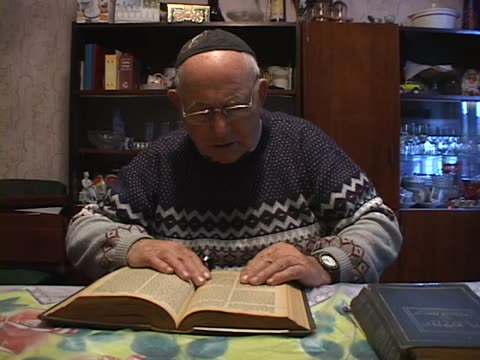
Katz discusses his childhood memories and family. In particular, he recalls holidays, when his mother would read from the tsene rene (Yiddish rendering of the Bible).
From the machine transcript
Katz recalls his grandparents and his childhood home: there was no washing machine and the work was hard. His mother could read on Sabbath from the tsene rene, while girls did not go to cheder and only boys did. The passage ends with a first attempt to find the tsene rene, which is heard partly garbled.
Also mentions girls not attending cheder and the search for the book.
Katz reads an excerpt from the tsene rene. Katz explains that he learned to read in Yiddish when he attended a cheder, but states that he had no time to read because he had to work instead.
From the machine transcript
Katz reads aloud from the tsene rene a passage on the red heifer (parah adumah) and its meaning, and the interviewer reacts to it. Katz then says he learned to read Yiddish in cheder but had no chance to read as a boy because he had to work, including in a labor camp. He mentions that he wears tallit and tefillin daily.
Includes his labor-camp remark and daily tefillin.
Katz talks about life before the war. He worked in berry orchard in a kolkhoz in Ukraine. The last job he did, before World War II broke out, was to load furniture from the factory into the train. On Yom Kippur and Rosh Hashanah, he explained, he would turn off the machines, not work, and attend synagogue. Katz explained that his Jewish superior, Efimovich, tolerated Katz’s decision not to work on holidays. When Efimovich retired, non-Jews directed the factory.
From the machine transcript
Katz talks about his working life: he was sent to a kolkhoz in Ukraine, and the last job before the war was loading furniture from a factory into railway wagons. He describes how he stopped his machine and did not work on Yom Kippur and Rosh Hashanah, attending synagogue instead, with the tolerance of a Jewish superior (Efimovich (?)). After Efimovich retired, non-Jewish managers took over; a Jew now in Israel is also mentioned.
Katz discusses religious life today. His son helped to organize a minyan from neighboring towns, so Katz can observe yahrzeit. The camera records the excerpt of the Parsha Chukat in the tsene rene, which Katz read earlier in the interview.
From the machine transcript
Katz talks about religious life today: before there was a Sabbath and holiday minyan, now it is hard to gather a minyan, so his son arranged for men from neighboring towns to come for a yahrzeit. The tsene rene chapter is again discussed and the camera records the reading. He also describes his prayer books and a woman's Russian-language one, and what he learned in cheder.
Adds that a long stretch (about 19–22 min) is unclear and that he discusses his prayer books.
Katz remembers his cheder education and discusses prewar religious life in general.
From the machine transcript
Katz remembers cheder, where only the Torah was taught and not the meaning of the prayers, and prewar religious life. The interviewer asks whether anyone has written down his account; he says his account of the camp was recorded in Yiddish by someone, and mentions a small book with a Kyiv connection.
Katz shows the Russian book “We only stayed alive: witnesses and documents,” (compiled by Dr. Boris Zabarko) where Katz’ account of World War II is mentioned. Katz’ chapter is entitled “I came to the barrack no. 3.”
From the machine transcript
Katz shows a Russian-language book containing his testimony, edited by Boris Zabarko; the discussion is partly in Russian, about how it was recorded and in what language. The interviewer thanks him and says the account he gave is what matters. The transcript is partly garbled and includes a recogniser loop.
Adds the discussion of how the interview was recorded in Russian.
The next part of the tape is a formal interview with Ernest (Ari) Osipovich Halpert and Tubi Halpert in Uzhhorod (Yiddish: Ungver), born 1923 in Mukacheve. They moved to Uzhorod after the war. Ernest explains how they ceased to speak Yiddish after the war.
From the machine transcript
The interview with Halpert begins: he says he speaks Yiddish with difficulty, having spoken it with his parents and in Munkatsh, but not since the family moved to Uzhhorod after the war. Tubi is also from Munkatsh.
The formal part of the interview begins. Ernest discusses his childhood memories of Mukacheve, where half of the population was Jewish, as well as his family. He grew up with two sisters, who now live in Israel. He descended from a Hasidic family. His father taught at the yeshiva and his grandfather worked for the burial society (chevra kadisha). Ernest attended religious school (cheder) from the age of three until his bar mitzvah, at age thirteen. After his bar mitzvah, he worked in a factory. According to Ernest, work was hard, but it was sufficient to make ends meet. His father owned a small store.
From the machine transcript
The interviewers explain the project and the place name (Ungvar in Yiddish) and the spelling of the surname Halpert. Halpert then tells of his childhood in Munkatsh, where half the inhabitants were Jewish: Hasidic family, father taught at the yeshiva, grandfather in the burial society, cheder from age three until bar mitzvah at thirteen, then factory work. He had two sisters, now in Haifa, and a small family; the Hungarian occupation of the town in 1938 is introduced.
Adds the project explanation and place-name and surname discussion.
Ernest talks about his life during the war, under Hungarian (1938) and German occupation (1944). He explains that Jews were not murdered under Hungarian occupation. Only when Germany occupied Hungary in 1944, were Jews imprisoned in ghettos and then transported to Auschwitz. The youngsters were selected for forced labor in Germany, and so Ernest, his sisters, and his wife had more of a chance to survive. Ernest was imprisoned in a concentration camp in Austria, where he was liberated by the Red Army in March 1945. Although he was not entirely healthy, he was drafted into the Red Army to continue the fight against Germany. At the time, Ernest believed he would participate in the liberation of other concentration camps. He was not aware that most Jews were killed in Auschwitz.
From the machine transcript
Halpert recalls the war: under Hungarian rule Jews were not killed, but after the German occupation in 1944 they were put in ghettos and sent to Auschwitz, where the young were selected for labor in Germany. He and his sisters and wife survived, his parents were killed. He was liberated by the Russians in a camp in Austria and volunteered for the Red Army, hoping to free Jews, not knowing what had happened in Auschwitz.
Ernest discusses his military service. As soon as he was mobilized, the war ended. He returned home in 1947 from military service. He then talks about life after the war and about his family. Ernest and Tubi are childhood friends. Tubi returned to Mukacheve after she was liberated from the concentration camp to live with her sister. Ernest moved in with friends. They married in 1947 and have two children. Peter lives in Germany; his other son lives in Uzhorod and works in the communal support center (chesed). His grandchild lives in Israel. Ernest worked as engineer in a factory. According to Ernest, they lived well during the Soviet period.
From the machine transcript
Halpert talks about army service, which ended with the war, and demobilization in 1947. He and Tubi, long friends, married officially in 1947 and have two sons: Peter in Frankfurt, and another son in Uzhhorod who works with the Hesed; a grandson is in Israel. He worked as an engineer and says they lived well materially in Soviet times, but without a Jewish life.
Ernest discusses life today and mentions contemporary Jewish institutions. He then talks on the phone to help to set up interviews.
From the machine transcript
Halpert speaks about life today and Jewish institutions, and visiting his sisters in Israel since the Soviet period ended. During the passage he is interrupted by phone calls, mostly in Hungarian and Russian, arranging for the interviewers to meet other Jews, such as in a village. This is largely garbled, and a Jewish connection with an Ignats (?) is mentioned.
Adds the phone calls arranging further interviews.
Ernest talks about the difficult life during the Soviet period when he had to keep silent about his two sisters in Israel. According to Ernest, life for Jews improved under Gorbachev. They visited his sisters in Israel for the first time in 1988. He returns to discussing Jewish life today, including Russian-language Jewish newspapers and communal leadership under Menakhem Mendl Taykhman.
From the machine transcript
Halpert describes how hard Soviet life was, since he could not admit he had sisters in Israel. Under Gorbachev things improved and in 1988 they visited the sisters for the first time. He talks about Jewish life today: Hesed, children learning Yiddish and Hebrew, the prayer house, a rabbi from America and Chabad, Rabbi Menakhem Mendl Taykhman, Russian-language newspapers and contacts with the Israeli ambassador.
Ernest talks about his family, in particular his sisters. After they were liberated from the concentration camp, they continued to live in Karlovy Vary, Czechoslovakia until 1948. As soon as Czechoslovakia was about to become another Soviet satellite state, his sisters emigrated. He learned from his cousin that his sisters emigrated, because after his military service he was not allowed to communicate across borders. He was able to meet his sisters for the first time after the war in 1964 in Prague. However, until the collapse of the Soviet Union, he could only stay in touch with his sisters through his cousin who lived in Czechoslovakia. He communicates with his sisters in Hungarian. He only spoke Yiddish with his parents at home.
From the machine transcript
Halpert explains that his sisters stayed in Karlovy Vary after liberation until 1948, then emigrated to Israel when the communists took over. He kept contact only through a cousin who could write abroad, and first met his sisters in Prague in 1964 (?). He now speaks Hungarian with them and with Jewish friends; at home he spoke Yiddish only with his parents, so his Yiddish is now difficult.
Ernest remembers religious life during the Soviet period in Mukacheve. Jews, who had no official relations with the state, lived a religious life with a small study house (besmedresh).
From the machine transcript
Halpert answers Kerler's question about religious life in Soviet times: a small study house continued in Mukacheve for Jews not tied to state work, whereas before the war the town had seven. He notes that the war reached the area only in 1944, by which time the Jews had been deported or killed, that there was no rabbi, and that Jewish life began to revive under Gorbachev.
Ernest talks about postwar traditional weddings and today. He then discusses prewar weddings in Mukacheve with a wedding jester (gramer).
From the machine transcript
Halpert talks about weddings: the traditional Jewish weddings after the war were modest, but one in Munkatsh (with rabbis from Zhytomyr and Berdychiv, and Taykhman) was large. Kerler recalls attending one in the late 1960s (?). Halpert then remembers the prewar wedding jester (gramer) Asher Zelik (?) and his jokes, and says much was forgotten after the war.
Ernest remembers Jews who spoke a daytshmerish (interspersed with Germanic words) Yiddish. They then talk about how little they knew about the fate of Polish and Ukrainian Jews during the war. According to Ernest, Jews were by and large not oppressed under Hungarian occupation.
From the machine transcript
Halpert and the interviewer discuss the words for war (milkhome, shlakht, krig) and Jews in Munkatsh who spoke a Germanized Yiddish (daytshmerish). Asked what was known in 1941–44 about Jews in Ukraine and Poland, he says very little because of censorship. Under the Hungarians Jews could mostly still live Jewishly, with prayer houses and communities, despite some laws and Jews working as lawyers, doctors and factory owners.