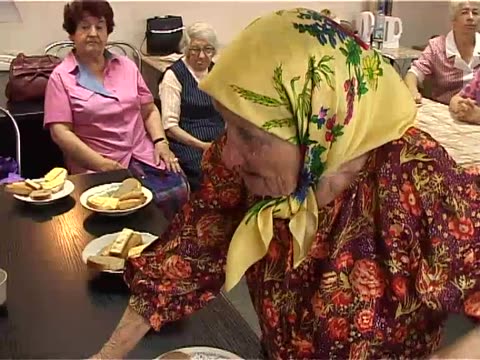
The choir women discuss what Yiddish songs to sing, partly in Russian, while the team waits and waits for the director. Chirkova comes up to the interviewers and says she can talk Yiddish. Her father was a rabbi and her grandfather a cantor, and she complains that she is not allowed to speak Yiddish or keep the holidays freely. She lingers over her religious upbringing, her parents' deaths and her old age. Kerler arranges to visit her at home. The choir women then sing together, and a second woman, probably Nesye Katz, says she was an orphan raised by an aunt and describes how the group meets and sings Yiddish songs.
Also covers Chirkova's family and her complaints about being unable to speak Yiddish, and Katz's own account of being an orphan.
The choir performs several Yiddish songs together, including love songs and a song about the Sabbath, and a few women then start solo items. Kerler and others say a few words in Russian between the songs.
Individual choir women sing solo songs, including a song about a girl selling bagels and a humorous Yiddish song about a girl who wants a dress, shoes and a husband. A comic song about a rabbi and a knife follows. Kerler asks for a repeat of one earlier couplet, and the performer is thanked.
Chirkova talks about her family, including a grandchild named after her brother, and complains about neighbours and her treatment. She mentions the deaths of her parents and grandparents, a relative in America and her own operations. Kerler asks whether the team can come to her home.
The team enters Chirkova's flat and sits down in the kitchen. She starts showing things on the wall and explaining photographs. Kerler asks about her books.
Chirkova explains photographs on the wall, including one sent from America. She says her brother fought at the front and was captured. She also mentions a sister who has died. Another voice asks what Yiddish books she has, and she offers a book.