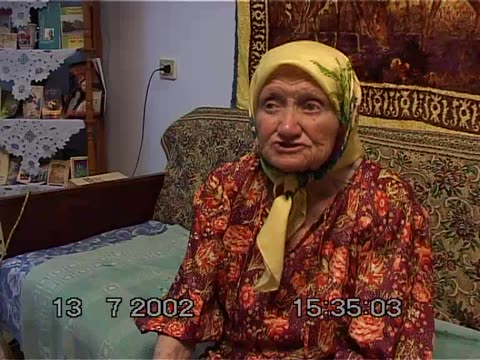
A woman speaks about Jewish observance before the war, saying each person kept it as he wished. She recalls the Passover seder, the four questions asked by the boys, and her father's teaching of religious duties. She closes with an exhortation to remain faithful Jews.
includes her exhortation to stay faithful Jews, which the catalogue label does not mention
After some talk about a chair, Kerler begins the next interview. The interviewee gives his Jewish name Avrom Shmiels, his family name Furer and his Soviet name Arkadii Samoilevich. He gives his birth in Kryzhopil', his parents Shmuel and Beyle and his grandfather who lived to 101. He begins to mention being drafted in 1940.
the personal information and family come in an interview with a different person than the preceding passages
Furer says he was drafted in 1940 and served in Chisinau. He was there when the war broke out in 1941. Kerler then asks where he lived before the army.
Furer says his father was a tailor. There were three brothers, he the eldest, with Nusem and Gabriel named. One brother was killed in the war near Odessa. Furer also describes the roundup of Jews by the Romanians in Kryzhopil'.
Furer describes the crowded living conditions of Jews in Kryzhopil' during the occupation. He tells of his younger brother, drafted at 17 and sent to work in a kolkhoz, who was killed in 1943 at 19. He then says he himself was wounded and concussed, and begins on the Caucasus.
the account of the Jews' crowded housing in Kryzhopil' under occupation, in addition to the brother's death
Furer tells of his war service: the Caucasus, Stalingrad where he was buried and concussed, and an escape across a river near Konstantinovka. He describes his work in the airfield and specialist school, and the Crimea, where he took part in the removal of Tatars. He ends with Belarus, Baltic states, Prussia and Königsberg, and a mined airfield there.
the Crimean Tatar deportation and the mined Königsberg airfield episode
Furer talks about life before the war. His father died at 43, and his mother was left with three sons. They went to work at a kolkhoz outside town for food, the father working as a tailor there.
Furer returns to Kryzhopil' after the war, finding his mother and one brother. As a Communist he becomes a shop director and a cooperative chairman. His wife dies, and he later moves to Vinnytsya at about 60 where he works at the railway hospital.
includes his wife's death and the move to Vinnytsya
Furer speaks about life today: living alone, health, medicine costs and the help from the Hesed. He remembers his late wife Roza, from Kryzhopil', and their life together.
Asked by Kerler about earliest memories, Furer recalls being sent to cheder at six or seven. When classmates mocked him at the Yiddish school, he ran from the melamed. He also describes the Yiddish school and the town's synagogues, one of which later became a theater.
the town's synagogues and the one turned into a theater