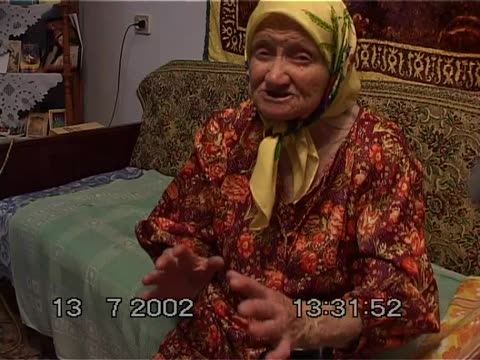
Kerler records Chirkova's name, patronymic and surname, and they work out how the surname Chirkova is to be spelled and pronounced. She gives her maiden name Kleyman and a birth date of April 1912, and says she will tell the story of why she bears this name.
The passage is mostly about the spelling of her name and surname, with her birth date and her maiden name.
Chirkova talks about her return to Vinnytsya after World War II. She then continues to provide personal information, before she briefly speaks about her life before the war.
Chirkova names her birthplace as Krasne in the Tyvriv district (?) of the Vinnytsya region and says she finished a seven-year Yiddish school there. Kerler asks the Yiddish and Russian names of the place and the spelling of her Yiddish name Beylle, and begins to ask for her address.
The return to Vinnytsya is not clear in this stretch; it is mostly about birthplace, district and schooling.
The team formally introduces Chirkova and she provides more personal information. She then addresses her family. Chirkova's parents were also born in Krasnoye. Her father was the local rabbi and her grandfather was a cantor.
Chirkova gives her maiden name Kleyman and her birth in Krasne in April 1912, and says she lived there until the war. She names her parents, Simkhe and Rivka, and says they were also born in places in Poland (?) whose names are unclear. Her father was a rabbi and her grandfather a cantor, whose name is given as Shmuel (?).
Chirkova speaks about her family, particularly her grandfather's fate during World War II. She then tells the history of the local Jews' fate during the war, before she says a personal prayer thanking God for her survival.
Chirkova speaks of her grandfather, who was tormented and killed during the war, and of Jews of the ghetto who were forced to dig their own graves and thrown in alive. She says she returned with her son and was helped through the ordeal, and she speaks of God keeping her alive. She also mentions an album of pictures about the Jews and the people who came to take things.
Chirkova shares insights about her strong Jewish identity, before she talks about contemporary visitors and the support she receives from the state pension.
Chirkova speaks about her Jewish identity and her readiness to do anything for Jews, and about visitors who come, including people going to America. She also describes preparing young people for work abroad and receiving money from them and support from the state. The details are unclear in the transcript.
Chirkova speaks of her work after the war, apparently with invalids, and of her friends and relatives buried in a cemetery in Vinnytsya. She describes arranging the burial of a man in a prayer shawl and tefillin and her sense of having done what was needed.
Chirkova speaks about her awards and medals and her service at the front, and about her poor hearing. She complains of her health and difficulty moving around, and Kerler suggests she get a new hearing device.
The catalogue says she shows military awards; the transcript is mainly about the medals, her hearing and her health today.
Chirkova speaks about her life before the war. She finished seven years of schooling, before applying to a technical institute. She also speaks about her family and bribing during her educational years. Chirkova also discusses keeping her faith.
Chirkova describes applying to a technical institute and meeting Stalin (?) or an official about it, and how gifts were given to a duty person to get things done. She says God records everything a person does, speaks of a trial of her factory director over goods sent to the front, and mentions Uzbekistan and her parents' death there. The account is difficult to follow.
Chirkova talks about her family and parent's graves. She then speaks about her life after the war, when she graduated from the pedagogical institute in Vinnytsya (Вінницький Державний Педагогічний Інститут ВДПІ). Chirkova also shows a present from the institute.
Chirkova speaks of her parents' graves and her studies at the institute in Vinnytsya. She says she was told Jews and Jewish schools were not needed, and mentions a gift from the institute on its eightieth anniversary. Kerler tries to steer her to his own questions, beginning with what her mother did in Krasne.
Chirkova speaks about her family, particularly her mother. She grew up with two sisters and two brothers. Chirkova then explains her mother sold her children to a Ukrainian female neighbor to avert the evil eye.
Chirkova says her mother did not work outside the home but looked after the children. She names her siblings, brothers Yosl and Yankl and sisters Sonya (?) and Basya, with herself the youngest of five, and says many boys died. She tells of her mother's custom of selling children to a Ukrainian neighbor against the evil eye, and of the brother in Moscow.
The catalogue says two sisters and two brothers; she names three sisters including herself and two brothers.
Chirkova explains a folk custom by stringing pebbles to a leather band to put around the neck to avert the evil eye. Her mother learned it from an older Christian woman to avoid selling her daughter. Chirkova states that she wore the necklace until better times.
Chirkova describes the folk custom against the evil eye of buying seven needles from seven shops, in which they were stuck into a leather strap or cord. The strap was hung round her neck, apparently to be worn until better times. Kerler asks how the needles were set, and she says it was the mother who bought a house for the Russian woman.
The catalogue says pebbles; the transcript speaks of needles stuck in a leather strap.
Chirkova speaks about her family's life and Christian acquaintances before the war. She then addresses her father's work as forwarding agent, before she talks about her life today. Chirkova also describes contemporary antisemitism.
Chirkova speaks of the non-Jewish woman to whom the children were sold, who gave her gifts and attended the wedding, and who knew some Yiddish and told her about life. Asked about her father's work, she says he was a rabbi and also an expediter who traveled to villages buying goods. She then complains about her situation today and about a Gentile who treated her badly, and confronts a woman over her wartime conduct.
Chirkova says her father prayed in the beth midrash in Krasne and that craftsmen such as shoemakers and tailors had their own synagogues. She puts the number of synagogues at two or three, and cannot recall the name of her father's.