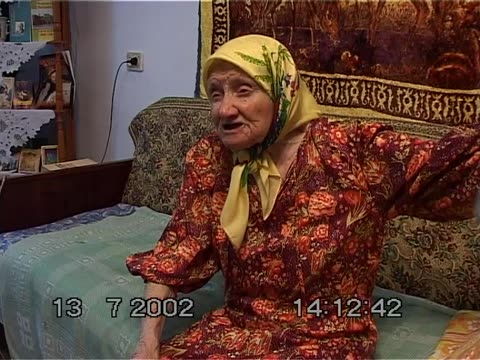
Chirkova speaks about her life after the war. She taught dance to children for six months. Chirkova then talks about prewar religious life in Krasne, before addressing postwar life, as well as life today.
Chirkova speaks about teaching in a dance class for children for about six months, and Kerler asks whether her parents took her to synagogue in Krasne. She mentions separate prayer groups of the shoemakers and tailors and answers questions about Hasidim in the town. She then moves to her postwar working life, studies and a long, partly unclear story about an illness and treatment.
adds Kerler's questions about Hasidim and opponents in Krasne and a story about an illness and treatment
Kerler asks Chirkova whether she remembers prayers and how she prays; she says she prays and knows the books in Yiddish. He asks her to recite the Modeh ani for the camera, and she answers in fragments and talks about her children.
Chirkova talks about her life and encounters with soldiers during World War II. She was a nurse at the front in Central Asia. Chirkova shares episodes from the front in Uzbekistan upon the encounter of locals.
Chirkova recalls being sent to the front as a nurse and working in a hospital in Uzbekistan, with an episode involving a transport of canned goods and an accusation to be cleared before a tribunal. She describes Uzbek customs she saw, such as eating on the ground and men having three wives. She ends by saying she wants to speak, joke and sing in Yiddish.
Chirkova states her Jewish identity and says Jews should observe holidays such as Shavuot and Passover, including kashrut and cleaning of the dishes and spoons. Kerler asks how Yiddish says 'cross' and about wearing a Star of David. She talks about the professor who served with her, and asks the interviewers to write to her, mentioning a letter from New York in Yiddish.
adds the dialect question about the word for cross and her request for correspondence
Chirkova talks about Yiddish books and her schooling in Yiddish, then answers dialectological questions from Kerler and Katz. They ask for the Yiddish words for a cross and for the Star of David, and for colours of the sky, eyes and sea, such as blue. The talk shifts to her memory and age, and Katz begins asking for more words.
adds the colour-term questions and her talk of her memory and age
Katz asks about Hanukkah; Chirkova says people must prepare, pray and help the poor, and that there was no dreidel spinning. She recalls hemp work from earlier times, and describes preparing Sabbath food in the oven, a stew kept closed until guests arrived.
adds Sabbath oven cooking and hemp work; the Krasne charity point is only loosely supported
Katz asks about tsadikim and a hazzan and rabbi in Krasne. Chirkova describes a boy becoming a Jew at age twelve with the tallis, and gives advice on how to be a good person, to help others and keep faith in God. She says who can be a tsadik or a 'good Jew' and a rabbi.
adds the bar-mitzvah-age remark and her views on who a tsadik is
Katz asks about people being cured of fright or the evil eye. Chirkova describes an old woman who says a prayer and rolls an egg and pours it into a glass, to find who frightened the person. A story about a Roma woman who came to her begins at the end.
Chirkova speaks about her life after World War II, particularly an encounter with a Roma woman that predicted her Chirkova's future. She recalls how the woman rolled an egg over Chirkova.
Chirkova tells how a Roma woman came to her after the war and offered to tell her fortune, and how she tested her by asking for a glass of water and then an egg poured into the glass. The woman predicted things about her husband and a child and said a guide would come to her. Chirkova speaks about her return from the front.
adds the fortune-telling details, which are only partly clear in the transcript
Chirkova speaks about her personal piety, praying to God for the strength to help people for good and not for harm, and says she has shared what she has with others.