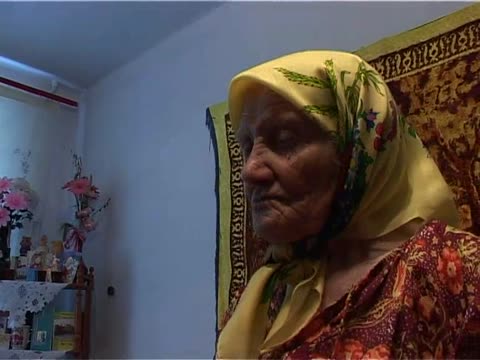
Chirkova speaks about her life today, as well as the support she receives from her children. She then discusses religious customs, particularly explains how to bless Sabbath candles. Chirkova also shares a personal prayer.
Chirkova mentions the food parcels her children send her, and Katz asks about the prayers she remembers from Krasne. She says she blesses Sabbath and holiday candles herself, names the holidays on which she does so, and describes lighting before going to synagogue. Pressed by Katz for the blessing itself, she instead describes her own personal prayer to God for help and for her children's health. Katz then begins asking about spells against the evil eye.
Katz's prompting for the actual blessing, which she answers with a personal prayer, and the start of the evil-eye questions.
Chirkova talks about folk customs, especially to avert the evil eye. She also mentions alternative medicine (agave and urine) to recover from the flu. Chirkova then speaks about an acquaintance.
Chirkova talks about folk healing and says she knows how to help people with spells and remedies. She describes remedies she recommends, including a plant remedy for a cough and flu, one involving urine, and a plant that Kerler asks her to explain again. Kerler and Katz ask for the details and for the Yiddish terms. She then turns to an acquaintance who learned Yiddish songs from Jews and whom she criticises, apparently in connection with the war and the ghetto.
Kerler's questions about how a plant remedy is made, and the criticism of an acquaintance who sings Yiddish songs.
Chirkova speaks about Jews during the war, how they gave up valuables to survive, and what she kept or gave away. Katz asks for the Yiddish word for a silver or gold object, and she settles on a ring and a watch. She says she has passed these things on to a Jewish person since she has no children. Kerler asks about her having no children.
Katz's elicitation of Yiddish words for silver and gold objects, and a ring and a watch.
Chirkova talks about her family, including a son and a grandson in another town, and a brother who came back from the front and died. She expresses her faith that God fixes each person's span of life and that no one can change it. She says she thanks God at every moment and gives away her pension, and she mentions attending both Jewish and non-Jewish gatherings.
Details on her brother, grandson and son, and her belief in God as the one who decides when a person dies.
Chirkova says non-Jews attend Jewish events and that she lectures to people, including in a monastery, where audiences are pleased. Kerler asks whether she tells them about Jewishness, and she says she teaches them about Yiddish and Jewish matters.
Kerler's questions about what she tells her audiences.
Chirkova addresses her life after she returned from the front. She then speaks her life during World War II, when she served as part of a factory for the war effort in Uzbekistan. She also speaks about her sister's work.
Kerler asks about a photograph, and Chirkova says it shows her when she came back from the front. She tells of having it taken at a photographer's, and says she was at the front or working on supplies for it. She mentions a sister who worked in a factory and sent packages. Kerler asks which front she was on; her answers are unclear.
The photograph she shows from the war years, and the unclear answer to Kerler's question about her front.
Chirkova talks about working on the kolkhoz, being recognised by the head of the kolkhoz in Krasne, and growing old and losing strength. She says she was used to speaking and singing in Yiddish and was kept from it. She begins to explain a song about not quarrelling at a wedding, then starts to sing it.
Her talk about aging and about being used to Yiddish speech and song.
Chirkova sings a version of the well-known Yiddish song "Lomir zikh iberbetn" (let's make up). She then addresses her involvement in the local Yiddish choir.
Chirkova sings "Lomir zikh iberbetn", with verses that exchange gifts and objects. She then says people at meetings did not let her speak Yiddish, and she tells of confrontations with others, including antisemites, who tried to stop her speaking and singing it. She stresses that she wants to be loved and respected and that others only imitate Jews.
The song's verses, and her account of being stopped from speaking and singing Yiddish at meetings.
Katz asks for another Yiddish song. Chirkova says she has forgotten it, but she insists she sings only in Yiddish and says she was not allowed to speak. She says one must tell the truth about being Jewish. Katz then asks what one does for someone sick with a fever.
Her statement that she must tell the truth about being a Jew, and Katz's turn to a healing question.
Katz asks how to bring down a fever, and Chirkova answers in Yiddish with scattered Russian terms, naming various remedies. She talks about local medical care, doctors, pharmacies and a healer, and describes her own health problems. She mentions a collapse and injuries from the front.
Her account of her own collapse and wartime injuries, and the local healer and doctors.