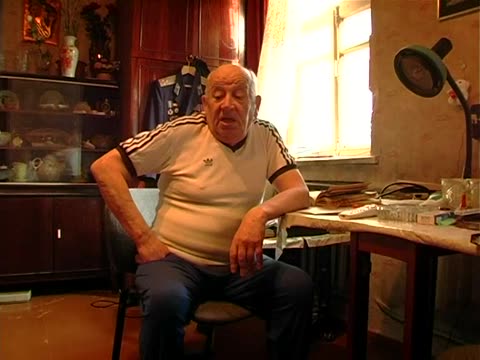
This recording is a formal interview with Arnold Grigorevich Khazin (born in Tul’chyn in 1925). The researchers walk through Khazin's yard to his house.
From the machine transcript
The interviewers meet Khazin and others in the yard and exchange greetings in Yiddish. Names are exchanged, and Kerler asks how a particular word is said in Khazin's Yiddish. The recognition is poor, so details are thin.
The AHEYM team enters Khazin's house and there are introductions. Khazin explains that he will be speaking mostly in Russian, since he does not know Yiddish very well.
From the machine transcript
Inside the house the interviewers ask where Khazin is from; he answers Tul'chyn. He says he will speak Russian and does not really know Yiddish. Kerler reassures him that a Jew from Tul'chyn who speaks only Russian is also of interest.
Kerler reassures him that Russian-speaking Jews are of interest too.
Khazin moved to Vinnytsya when he was two years old and lived there until 1941. His father was imprisoned in 1937, and he lived with his grandmother and then with his aunts. He spoke primarily Russian growing up.
From the machine transcript
Khazin says the family left Tul'chyn for Vinnytsya, where he lived until 1941. At home people spoke Russian and Ukrainian. His grandmother and mother spoke Yiddish together and he understood it; he cannot speak it fully. His father was imprisoned in 1937, and he lived with his grandmother and then with his mother's sisters in Kalynivka (?). Kerler says he cannot document Yiddish from him but accepts this.
Adds the languages spoken around him and that Kerler accepts he cannot document Yiddish from him.
Khazin mentions that he just received medals in honor of the 63rd anniversary of the victory in World War II. He served in the Red Army as a high ranking officer. Khazin discusses his time in the army, in addition to showing military documents and explaining his war medals. In 1941, he joined a Komsomol (Communist Youth League) military unit. Khazin was wounded in Dnipropetrovs’k. From there, he was taken to Tatarstan, where he met up with his mother, grandmother, and sister. They traveled together to Chelyabinsk, because they heard that the Vinnytsya railroad administration was there. They went to look for Khazin's father, who had worked for the railroad and was drafted into the army. They did not find him there. Someone suggested that the family travel to a small village 90 km from Chelyabinsk. He discusses his work as a blacksmith in this village. He was not very successful at the job, so he was sent to study to be an assistant machinist. He worked as an assistant machinist for several months. He then worked as an electrician, which very negatively affected his health.
From the machine transcript
Khazin says he was summoned to the military commissariat for the 63rd Victory anniversary and given a colonel's rank. He tells of 1941 in a Komsomol volunteer detachment with unusable rifles, retreat to Dnipropetrovsk and wounding in a bombing. He was taken to Tatarstan, where he found his mother, grandmother and sister. They went on to Chelyabinsk looking for the Vinnytsya railroad administration and his father, whom they did not find. Evacuees were freezing at the station. They moved to a small railway settlement (Viazove?), where he worked as a blacksmith's helper, then took a course as machinist's assistant. He later worked as an electrician on locomotive turbines in harsh conditions.
Adds the unusable rifles, the freezing evacuees at Chelyabinsk station, and his failed work as a blacksmith's helper.
Khazin's mother worked as a dish washer at the train station. She supported the grandmother and the sister. Some time later, they moved to another small village to be with his mother's sister, who had been evacuated there. On the way, Khazin's mother and sister caught typhus. Khazin worked for a while fixing tractors; then he studied to be a tractor driver. In January 1943, he was drafted. During training, he suffered from extreme hunger. He was finally sent to the front and participated in liberating Vinnytsya.
From the machine transcript
Khazin continues his wartime story. His mother worked as a dishwasher at the station and fed the grandmother and sister. Through the evacuee registry they found his mother's sister in a Tatar village in the Ulyanovsk region, and went there; his mother and sister fell ill with typhus on the way. He worked repairing tractors and trained as a tractor driver. Drafted in January 1943, he trained as a radio operator in Ulyanovsk and Kuibyshev, in hungry conditions. He went to the front, doing radio monitoring and taking part in re-establishing a German communications center in Vinnytsya and in the advance on Ternopil and Sandomierz. He was presented to the commander of the 4th Guards Tank Army.
Adds the radio-operator training and monitoring work, the hunger in the dugouts, and the 4th Guards Tank Army.
Khazin shows a military photograph. During his service, he made it to Prague. He recalls that the citizens would shower the Soviet soldiers with flowers and pelted the captured German soldiers with stones. In Prague, Khazin celebrated victory. He continued to serve in the army until March 1950.
From the machine transcript
Khazin shows a wartime photograph and identifies the army commander and himself beside the guards banner. He tells of working on a radio in an armored vehicle from Sandomierz to the end of the war, advancing toward Berlin and then to Prague. They entered Prague on 9 May; crowds greeted the army while German prisoners were pelted with stones. He celebrated Victory Day there. He served in the army as an instructor until March 1950, eight and a half years of service in all.
Adds the Berlin advance and the length of service as eight and a half years.
After being demobilized, Khazin returned to Vinnytsya. His parents had already returned to Vinnytsya from evacuation by then. His father had been wounded and had health problems. Khazin married a student from the English department of a pedagogical institute, Sof'ia L'vovna Polik. They had two children, who now both live in Israel.
From the machine transcript
After demobilization Khazin came back to Vinnytsya, where his parents had returned from evacuation. His father was shell-shocked and walked unsteadily, while his mother helped and took charge. He married Sofia Lvovna Polik (?), a student of the English department at the pedagogical institute. They had two children, both now in Israel.
Khazin's paternal grandmother spoke to him in Ukrainian but in Yiddish to his mother. Khazin's wife left him for another man. Khazin's daughter, who was five years old at the time, chose to stay with her father, but his son was only one year old, so he was sent to live with Khazin's ex-wife's mother. When Khazin's daughter grew up, she went to live with her mother in order to attend university, since the second husband of Khazin's ex-wife was an influential surgeon in Mohyliv-Podil’s’kyy. Eventually, Sof'ia's second husband passed away, and she moved to Israel with all of the children.
From the machine transcript
Asked about languages, Khazin says his father's mother spoke Ukrainian with him and Yiddish with his mother, and he understood it. He explains that his first wife left him; their five-year-old daughter chose to stay with him while their one-year-old son went to the wife's mother. The daughter later went to the mother, whose second husband was a well-known surgeon in Mohyliv-Podilskyi (?), to enter an institute; the son studied at a mining technical school. After the second husband died, the ex-wife took the children to Israel.
Adds that the daughter could not enter an institute locally (a nationality-line problem) and that the grandmother's languages are discussed.
Khazin also remarried. His second wife's name was Sof'ia Borisovna Novoseletskaia. Her cousin is the leader of the Jewish community in Vinnytsya. Khazin had two more children with his second wife, Igor' and Fima. All of his children received a higher education.
From the machine transcript
Khazin says he married a second time, to Sofia Borisovna Novoseletskaia, from Shepetivka (?). Her cousin Isaak Petrovich Novoseletsky heads the Jewish community at the central synagogue. They have two sons, Igor and Fima, and all the children received higher education.
Khazin talks about his professional life and higher education. He has achieved the rank of colonel.
From the machine transcript
Khazin explains that he graduated from the Kyiv Polytechnic Institute at 46 while chief power engineer of a Vinnytsya oil and fat plant. He lists his army promotions after demobilization, from sergeant major through officer ranks to lieutenant colonel and now colonel. The interviewers ask whether he could become a general; he says that would require a military academy.
Adds the list of promotions and the remark about the military academy for generals.
Khazin shows off his medals. Then he talks about how his father was imprisoned for seven and a half years because of slander. He says that his wife passed away two years ago from stroke. She had had diabetes. Khazin lives with his youngest son, who is 38 years old.
From the machine transcript
Khazin shows and explains his medals: Prague, Berlin, the Great Patriotic War, the Zhukov medal, labor and the Lenin jubilee medal, and the guards badge. Kerler asks about his father, who was imprisoned in 1937 for seven and a half years on a slander charge, then rehabilitated; a maternal uncle, an old Communist, was jailed too. Khazin says his wife Sonia died two years ago after a stroke, a diabetic like her mother, and that he lives with his youngest son.
Adds the uncle jailed as a Communist, the father's rehabilitation, and the details of his wife's illness.
The son married a Ukrainian woman. They lived together for five years but had no children, so they got divorced. When Khazin's wife passed away, he and his son attended synagogue and said the Kaddish in her honor. His son decided to become circumcised.
From the machine transcript
Khazin says his 38-year-old son married a Ukrainian woman; they lived together five years without children and divorced. After his wife's death the two of them went to synagogue where the son said Kaddish for his mother. The son then decided to be circumcised. A remark about a course the son was sent to is unclear.
Khazin talks about the meaning of his last name. He mentions that he is a “koheyn” (member of the Jewish priestly tribe). He learned the Yiddish that he knows from his two grandmothers. His grandfather was a salesman who traveled to sell Singer sewing machines, thus supporting his family of twelve. His other grandfather was a bookbinder. He passed away from heart trouble. He was not religious, so Khazin's grandmother had to accompany him to synagogue to make sure he went.
From the machine transcript
Khazin explains that his surname derives from 'khazn' (cantor) and that his grandfather told him the family are kohanim. He says his Yiddish comes from his grandmothers: his mother's mother lived in Nemyriv and his father's mother Khaike came from near Tyvriv (?). His paternal grandfather sold Singer sewing machines to support twelve people and died in besieged Leningrad. His other grandfather was a bookbinder in Nemyriv working for a princess's library, and died of angina; he was not observant. An aunt's husband, a barber named Rozenberg, believed the Germans civilized and the family did not evacuate and were killed. Lemster asks whether the Leningrad grandfather attended synagogue.
Adds the grandfather's fatal cutlet story in Leningrad and the barber relative who did not evacuate.
Khazin mentions that there were more than 10 synagogues in Vinnytsya before the war. He recalls some Yiddish songs, especially comic songs. His father and mother both used to sing.
From the machine transcript
Khazin says there were more than ten synagogues in prewar Vinnytsya, some buildings still standing. Yiddish was spoken in the street and public places, and Jews were perhaps up to fifteen percent of the 64,000 inhabitants. He says he remembers Yiddish songs, mostly humorous ones, which his father and mother sang. He mentions that the rabbi at the synagogue asks him to sing.
Adds the Jewish share of the population, Yiddish in public places, and the rabbi asking him to sing.
Khazin sings a satirical Yiddish song. [00:48:53] Khazin sings "Sha, sha, der rebe geyt" ("Quiet, here comes the Rebbe").
From the machine transcript
Khazin sings a humorous Yiddish song about a Jew riding to a tavern, with a refrain about a little Hasid, and then 'Sha, sha, der rebe geyt'. Kerler and Khazin discuss whether he will sing more; Khazin worries about being recorded but agrees for scholarly purposes. Kerler then talks to a man who wants a word with him.
Adds a second song, a comic tavern song with a Hasid refrain.
The interviewers talk about AHEYM. There is discussion of Jewish last names. Khazin sings "Vyo vyo ferdelekh" ("Giddyup, horses"). Khazin's mother was born in 1903. Her side of the family was from Nemyriv, where Khazin had spent some time.
From the machine transcript
Lemster and Kerler introduce themselves and explain that they collect Yiddish language and folklore, including variant song texts. Khazin recalls an earlier research group that asked about surnames, and they discuss surnames such as Kerler, Zukerman, Lemster and Feikin. He tells of his work in supply organizations and sings 'Vyo, vyo, ferdelekh', mentioning a woman in Germany who knows more. He speaks of his mother, born in 1903 (?), youngest in her Nemyriv family, who attended the girls' gymnasium free through the princess and trained as a pharmacist. Her older siblings, including brother Naum, a Communist, are mentioned.
Adds Khazin's postwar supply-office work and details on his mother's education and siblings.