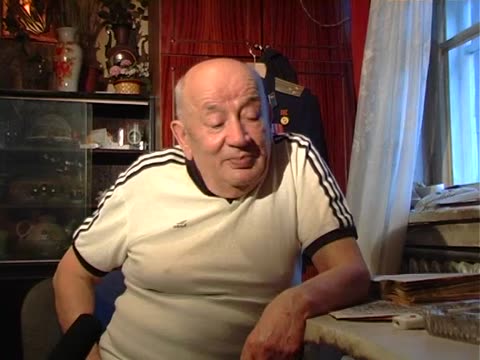
The tape is a continuation of a formal interview with Arnold Grigorevich Khazin (b. Tul'chyn, 1925), conducted in Russian. Khazin sings a song in Russian. Then he sings "Shabes zol zayn" ("Let it be Sabbath") in Yiddish. He mentions that mothers in Vinnytsya used to brag about the fact that their children did not understand any Yiddish.
Khazin sings a Russian song, then, at Lemster's request for more Yiddish songs, sings a Yiddish Sabbath song. Lemster asks whether he knows others, and he says he knows no more. He then remarks that in prewar Vinnytsya Jewish mothers boasted that their children did not understand Yiddish.
The transcript shows a Russian song before the Yiddish one, and Lemster's prompting for more songs.
hazin talks about the periodicals he reads, including a Jewish newspaper in Russian. Khazin shares his views of contemporary politics and talks about his affiliation with the Communist Party.
Khazin talks about the periodicals he subscribes to, including a Jewish newspaper in Russian published in Kyiv and a Kharkiv paper. Lemster asks about his politics. He says he voted for the Communists this time, having voted for Yanukovych before. He says he joined the Party at the war's end, and discusses Yushchenko and Timoshenko.
It includes his views on Yushchenko and Timoshenko, and the Kharkiv paper.
Khazin talks about his maternal grandmother and how she used to sell pots and feed pigs before the war. Khazin talks about the anti-Semitism that he has experienced. Then he mentions his children, who live in Israel.
Khazin talks about his mother's mother, who traded in pots and fed a pig before the war and was buried alive by the Germans. He answers Lemster's question about antisemitism in the army and later, recalling being asked to join the Party in Budapest and a fight at a technical school in Chelyabinsk, after which he left. He mentions his job in industrial supply, a telephone he believes was tapped, and a daughter and a son Boris in Israel (the daughter's married name is unclear in the transcript).
It also covers his army service in Budapest and Chelyabinsk and the fight there, and his work in supply.
Khazin recalls Sholem Aleichem's play “200,000,” which he saw when he was young. He then remembers a song from Goldfaden's operetta. Khazin says that he knows a little bit of Hungarian, German, and Polish.
Khazin recalls a Sholem Aleichem play he saw as a small child. He describes its tailor, the maid and the comic scene about a twenty-five-hour working day, then recalls a song from a Goldfaden operetta. Lemster says the interviewers want Yiddish, and Khazin says he knows a little Hungarian, German, Polish and Tatar.
It includes a remark that he lies awake at night remembering poems and the languages he knows.
Khazin shows the interviewers his Russian-Yiddish dictionary. He says that he bought it with the intention of working on his Yiddish, but he never got around to it. The interviewers ask some questions from the AHEYM dialectological questionnaire. Khazin talks about his opinions of modern medicine.
Khazin shows a Russian-Yiddish dictionary and says he bought it but never worked on it. He describes himself as a Russian-Ukrainian Jew. Kerler and Lemster ask some questionnaire items on words such as 'dybbuk', 'goylem' and 'beter'. He then gives opinions about drinking, smoking and modern medicine, and recalls a joke from a stage play and a Yiddish theater and institute in Vinnytsya in the 1930s.
It includes his view that his Yiddish came from his wife and her family, and his talk of the Yiddish theater in Vinnytsya.
Khazin talks about his trip to Israel, when he attended the wedding of his cousin's daughter. He also mentions that the wife of one of his sons is not Jewish. There is further discussion of politics, particularly in Israel. The interview concludes with a discussion of foreign humanitarian aid to the contemporary Jewish community in Vinnytsya.
Khazin talks about a trip to Israel for a wedding of a relative, and about his son Boris, whose wife is not Jewish. He gives opinions on Israeli politics and the Arab conflict, tells a joke about two women in a hospital, and answers questions about reactions in Vinnytsya to the 1967 war. In the closing part he describes the Jewish community canteen and aid, with a second speaker noting the use of a former synagogue. He ends by thanking the interviewers.
It includes his views on Israeli policy, the 1967 war, and the community canteen and aid.