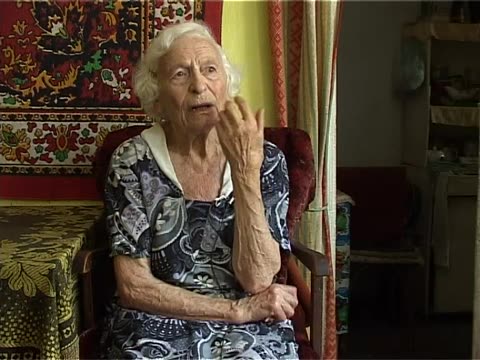
Opens briefly on holiday customs, with Kerler asking about Tisha b'Av. Poberevskii then talks about poor but gifted classmates, many of whom were killed in the war, and about her own studies in Kalinin. She says her father the rabbi did not take her or her mother to shul, and describes her brothers, one of whom studied Talmud and became a lawyer. She also answers questions about the meaning of 'a good Jew' and about her mother's brother. The rest is largely a dialectological questionnaire put by Kerler, with Katz commenting. Items include words for the cross and for converting or baptising (the difference between 'geshmad' and baptising a child), candle-blessing and Friday preparations, 'evening' and 'ear', and 'attic' and 'potatoes'. Further items cover latkes, foods for Shavuot and Hanukkah, Hanukkah games such as the dreidel, and household words. She also answers on kinship terms such as 'mekhutn', on rabbi/rebbe/rov terms and on 'almost' and 'exactly'. She says she hardly speaks Yiddish any more and describes seven years of Yiddish schooling. She speaks of severe poverty in her childhood home: her mother had eleven children and sold yeast at the market, with no pension even though three sons were in the army, and the house was cold in winter. She also says there is no rabbi or functioning synagogue in Zhmerynka now and that about 300 Jews live there.
Beyond holidays and poverty, the transcript shows a long dialectological questionnaire, her father's rabbinic role and her schooling in Kalinin.