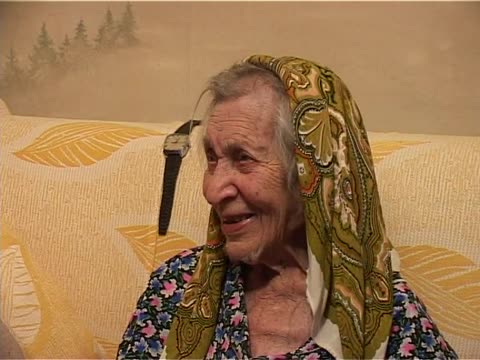
Zhytomyr, Ukraine9 July 2002Interviewed by Dov-Ber Kerler, Jeffrey Veidlinger, Dovid Katz, Anatolii Kerzhner, Petr IvanovPart 2 of 240 min · 9 passages
Questionnaire work with an elderly woman, with a Russian-speaking woman putting the items in Russian. Items include how to say 'to want to eat' in different tenses, what was eaten at Purim, 'mistake' and 'to make a mistake', 'near' and 'far', 'ceiling' and 'roof', 'face' and a handsome face, the dreidel, and 'back'. Katz and Kerler praise her knowledge and ask whether she remembers any old Yiddish songs. Kerler then asks whether she remembers the Revolution.
Includes Purim food and a request for songs, besides the questionnaire items.
The interview is concluded. The woman and the team exchange thanks and good wishes for health. Katz and others mention that Katz's colleague's mother lives in Israel, and there is talk of his father, a writer. There is also some chat about America and a town, with speech partly in Russian.
The team arrives at Antsis's apartment, greets her and introduces itself, including the cameraman, the guide and Professor Katz of Vilnius. They chat in the hallway about language and about her age, and the project is briefly explained. Antsis mixes Russian into her Yiddish and says that today everyone in her circle speaks Yiddish. Katz and Kerler ask where she is comfortable sitting for the interview.
Kerler sets up the formal interview, giving the date as July 2002, and Antsis gives personal information. Her official name is Klara Meerovna Antsis, although neighbours say Markovna. Her Yiddish name is Khaike (Khaye Sore), and she explains that she was called Khaikele as a child. A question about her birthplace is put but the answer is unclear. Kerler then asks for her address.
Antsis talks about her family and the hunger of the early 1930s. One brother died after overeating when food finally became available, and another died during the war. Of four children two survived, and her sister emigrated to America when many people wanted to leave, then died not long afterwards. Antsis names the sister as Freydele and tries to recall her mother's name (Dania or Datshi, unclear). Her father had a small shop. Her mother later worked on a Jewish kolkhoz near Zhytomyr, while Antsis studied at a technical school.
Adds the sister who emigrated to America, her father's shop and her mother's work on a Jewish kolkhoz.
Antsis recalls that her childhood was very hard. After finishing technical school she was sent to the Donbas to work for several years before the war. She returned to Zhytomyr, married, and the war began. Her husband was a lieutenant, and her child was six years old.
Antsis describes the war years. Her husband, a lieutenant, was killed in 1943, and her six-year-old child died of malaria in Uzbekistan. She stayed there with her mother, who did whatever work she could find, and Antsis herself worked on a kolkhoz. Kerler asks about the return after the war.
Antsis tells how she and her mother returned to Zhytomyr while the war was still going on. Her mother, still fairly young, worked again, and Antsis herself found employment where she could.