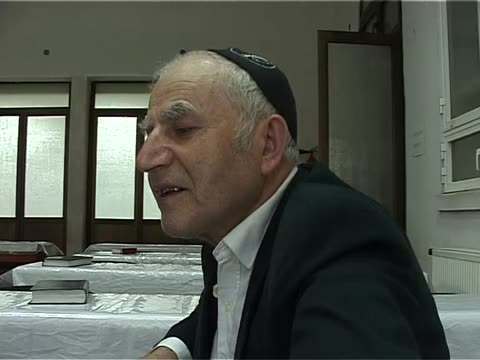
Burshtein recalls the family's flight in 1939. He saw his Polish teacher in the street while German troops marched past, so he could not reach her. He tells of a Bolshevik saved by Jews who dressed him in tallis and tefillin in the beit midrash, and then of the walk with his father through burnt villages and forest to the Russian side. The journey takes them via a town named Zembrów(?) to Białystok, where Jewish families host them for Sabbath, and then on to Babruysk and a kolkhoz commune where his father got work at a factory.
Includes the story of the Bolshevik saved in the prayer house and the stopovers at Zembrów(?) and Białystok.
Burshtein describes life in Babruysk, where his father worked at a factory whose goods were shipped to Germany. Russian Jews were forbidden to speak about the Germans and did not know what was happening to German Jews. He mentions that German Jewish refugees came and that he learned songs from them.
Burshtein sings a refugee song about a homeless wanderer, learned from German Jewish refugees who walked the streets singing in the 1930s, and a second song about life as a game. He explains that the children followed them and the songs were printed. He and Kerler then touch on the towns near the German border and on the refugees' languages.
Burshtein talks about the German Jewish refugees in Russia and the Soviet-German pact, after which nothing negative could be said about the Germans. He tells how people on arrival in Babruysk would not believe the accounts of killings, and recalls Hitler's speeches heard on the one radio in town, in the school. He also recalls a Jewish forced-labour episode and his brother's return home, and reflects on why the Germans were so cruel to Jews.
Adds the pact, the disbelief of Soviet Jews and a radio listened to in a town hall(?) in the 1930s; the catalogue speaks of the school radio.
Burshtein retells a story he says he read, that Hitler's family descended from a Jewish family and that his father cheated over an inheritance. Katz asks when he heard this and Kerler about the name. Burshtein says Hitler was not a Jew, and the talk turns to Jewish names. He then announces another song.
Burshtein sings a series of Yiddish songs he knew from Poland: a matchmaking and wedding song, a song on love as a passion, a Zionist song about all Jews going to the Land of Israel that was sung in the months before the war, and songs on homesickness, a prisoner's oath and a street song about a lonely orphan. Kerler asks about Purim songs, which he does not remember. Katz then asks for a prayer from the siddur, and he answers about how a Jew was addressed.
Gives the content and number of songs, including the Zionist song sung before the war.
Burshtein recites from memory, in a Yiddish and Hebrew mix, a Shavuot piece and parts of other prayers, including the Four Questions. Katz asks about the Passover questions and Kaddish. He says he prays alone daily and learned Rosh Hodesh prayers as a child, and he says he needs a siddur.
Burshtein sings Hebrew liturgical pieces from the Rosh Hodesh service, one of them with the text of Psalm 136. He then answers Kerler's question about the Jews in Gorove, saying it was a Jewish town with one big synagogue and a number of small ones.
Burshtein describes the many small prayer houses in Gorove, each trade having its own, and one large synagogue. The Polish town commandant would come and sit with the Jews there.
Burshtein says most Jews spoke only Yiddish and Poles Polish. He recalls the hostility of the Polish children at school, a teacher who pulled him out of class by his sidelocks, and the corporal punishment there. He describes studying with two rebbes, the second of whom had a whip, and a Polish school Christmas play. Kerler asks about the Russian word for prison.
Katz and Kerler ask about conversion to Christianity and to Judaism and about hasidim in the town, and Burshtein says there were very few such cases. A second voice and Burshtein discuss the rebbe and the "good Jew" to whom people came with questions. Burshtein says there were hasidim who sat in the beit midrash but cannot say whose. He recalls the rabbi, shortly before the war, crying out in the beit midrash that Jews should be taken out of exile.
Covers conversion and the good Jew/rebbe distinction and gives the rabbi's cry before the war.
Burshtein repeats the rabbi's pre-war call to take the Jews out of exile and the rabbi's walking round the beit midrash with the Torah scroll. Kerler asks if the synagogue was wooden. Burshtein describes it as having a Star of David on the roof and a larger interior, with a shammes in it. They then discuss the meaning of a dybbuk.
Short dialect questions put to Burshtein: the word for a golem, a sleepy or slow person, the way to say 'go on', the word for trouble, honest, pious, a pious Jew, and potatoes. He answers each, and says the usage in Babruysk differed from that of Gorove.
Burshtein sings two Yiddish songs: a love song about a young man marrying a girl he met in a park and finding her ugly, and a song about childhood and the loss of his mother. Between them he is asked about the word shlemazl. Katz and Kerler also ask about a song from Russia, which he says he knows.