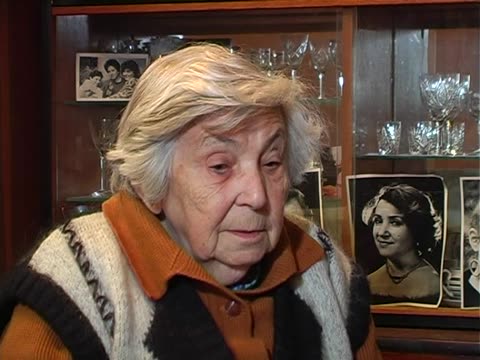
Kerler asks Nibulskaia about the songs she knows and where she learned them. She says she grew up in Korosten and attended a seven-class Yiddish school there. Kerler asks about a local wonder-rebbe or healer and a wartime victim, whom she has only heard of.
includes a question about a local figure killed in the war and her seven grades
Nibulskaia recalls the arrival of electricity in Korosten, first only on the street and not yet in houses in the 1920s. She recites a school song about electricity. She then begins to talk about the Yiddish school and its good first-grade teacher, who played the violin while the children danced.
Nibulskaia names her teacher as Khaver Arye Vaynberg, whose grave she visits in Zhytomyr, where he later became a school director. She says she studied seven years but cannot remember the literature taught. She then begins to sing a school song about a beautiful girl named Belke.
Nibulskaia continues the Belke song. She then explains that people went to libraries and read newspapers at that time, and that a Russian-language one was not wanted by someone. Kerler asks in which language they read.
Nibulskaia says there were Russian and Yiddish papers, including the children's paper Zay greyt, up to the seventh class. Kerler asks her to repeat the Belke song so that he can write it down, and she sings it several times with hesitations, forgetting parts. They go over words and lines, and she ends by mentioning the school's good director.
Nibulskaia describes a school practice of drawing a plane, car, horse, ox or crayfish on paper. The best pupils were entered on the plane, and she always flew on it. A crayfish was drawn for a pupil with bad marks.
Nibulskaia recites a school song about the crayfish that refuses to pull. Kerler then asks about holidays under the Soviets, and she says they no longer celebrated them. Kerler asks about anti-clerical songs and a red seder.
Nibulskaia says her father, Meir (son of Menashe?), held a real seder every year until his death. He attended synagogue daily, in Korosten (three synagogues then, closed later) and in Zhytomyr after the war. She also mentions his work and small pension, her mother, and the hard life.
adds her father's name and his workplace and pension
Nibulskaia says kosher meat was bought from the shoykhet in Korosten. She then talks about her family: three sons-in-law, two good and one bad, and one who knows Jewish religion but not Yiddish. She names relatives, including a cousin Nobelman and a journalist and writer, and the group discusses writers.
Kerler and Nibulskaia arrange a return visit on 9 January and talk about finding other elderly Yiddish speakers. S2 and S3 sing a song of a beggar from a Yiddish theater play, and Kerler plans to record it again on the next visit.