0:00
Melamed’s song.
From the machine transcript
A man sings a Yiddish song about a melamed who prefers to teach only rich children and takes no poor ones into his cheder. Kerler says he will look the song up.
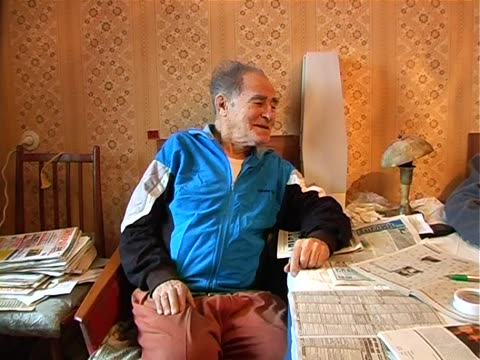
One conversation with Isaak Yakovlevich Shraibman, continuing over MDV 810, MDV 811.
Melamed’s song.
A man sings a Yiddish song about a melamed who prefers to teach only rich children and takes no poor ones into his cheder. Kerler says he will look the song up.
Entering Shraibman’s apartment and setting up.
The team settles into Shraibman's apartment. Shraibman explains that his hometown is now called Volodars'k-Volyns'kyy and why. Kerler introduces the team members by origin (Russia, Israel, America, Poland). Shraibman muses that Jews did not all come from Egypt but from Russia and Germany.
Adds Kerler's self-introduction and Shraibman's reflection on where Jews came from.
Hometown Volodars’k-Volyns’kyy.
Shraibman explains the history of his hometown's names. It was named after the revolutionary Volodarsky after the revolution, earlier called Horoshky (from the word for peas), and after being given to General Kutuzov it was known as Kutuzova, where a monument to him stands. He places it about 60 km north of Zhytomyr, on the road toward Korosten.
Jewish life in Volodars’k-Volyns’kyy.
Shraibman says that before the revolution about eighty percent of the town's population was Jewish, with Jews and non-Jews living among each other. Only five or six Jews remain today. He explains this by wartime losses and emigration to Israel. Kerler then asks his year of birth.
Life during the war and family.
Shraibman, born 1930, was eleven when the war began and was hidden by non-Jews for about a week and a half. He tells of his maternal grandfather, a tailor who worked in the surrounding villages with a Singer machine, and of another grandfather killed in 1918 by Petliura's men. He describes sheltering with a customer in the village of Dvorishche (?) and the decision to return to town despite warnings. He recounts the arrival of Soviet scouts, the German entry, the formation of a police force, the shooting of Jews and the roundup of about 700 Jews in the militia stable.
End of Revolution.
Shraibman recalls his grandfather's view of 1918, when he thought the soldiers were cultured people and dismissed reports against them as Soviet propaganda. He then describes how the family fled on foot from their town to Korosten.
Shows the passage mixes the grandfather's attitude with the flight on foot to Korosten.
Evacuation and family.
Shraibman describes the family's evacuation. They went to a village in Tambov oblast and worked in a kolkhoz without passports, then fled the approaching Germans to Fergana in Uzbekistan. Of an extended family of eleven (counts unclear), six returned and several died of hunger. Kerler asks, and Shraibman lists, who was in the family: grandparents, aunts, his mother, a sister with two children. He mentions finishing school in the town before army college.
Postwar army service and bomb.
Shraibman states that he finished school in 1949, entered an army college and became an officer in 1952, serving until 1975. He tells that in 1954 he was at a testing ground where an atomic bomb was tested on living people and he survived. Kerler presses for details of the test site. In 1975 he left the army and came to Zhytomyr, where a widowed aunt on his father's side lived.
Adds the atomic-bomb test on people in 1954 and the reason for settling in Zhytomyr (a widowed aunt).
Return to Zhytomyr and army ranks.
Shraibman says the aunt later went to Israel and he stayed. Kerler asks his army rank, and a misunderstanding about the Russian word is cleared up. He discusses Jewish generals in the war and a book on Stalin sent by a friend, saying he does not think Stalin was an antisemite. He explains that an officer had to be a Communist and that he later left the party under Brezhnev.
Adds the exchange about Jewish generals, Stalin and Churchill.
Leaving the Party and fear.
Shraibman describes leaving the Communist Party in the 1980s by claiming to have lost his party card, and the pressure put on him. He says he was neither a real Communist nor an anti-Communist. He answers Kerler's questions about the campaign against cosmopolitanism and the Doctors' Plot in 1952 and about Jewish cadets. He recalls growing up in a Soviet family where his grandmother Gitl kept kosher and his grandfather was not deeply religious. He mentions his daughter in Haifa and a granddaughter in the Israeli army.
Adds the 1952 cosmopolitanism campaign, his grandparents' observance and relatives in Israel.
Family and life today.
Shraibman speaks of the large family he came from, which is now scattered. A cousin lives in Kyiv, a cousin in Moscow, an artist relative (name unclear), and others in Israel and America. He tells of visiting the old town and its graves and meeting elderly non-Jews who recognize the family name. His wife died about nine years ago and he lives alone. He mentions working with the current rabbi Shlomo and with the former chief rabbi Plotkin (?).
Religious life today.
Shraibman speaks about religious and communal life in Zhytomyr today. He helped Rabbi Shlomo when he arrived and speaks Yiddish with him. He works at a boarding school for half-orphaned children, with a Jewish gymnasium and a cheder, whose non-Jewish director has a Jewish wife. He mentions the director's daughter, who married a Jewish man from Moscow and works with the Jewish community. Kerler then asks about his childhood memories.
Childhood memories and prewar religious life.
Shraibman recalls four prayer houses in the prewar town, organized by trade and class (shoemakers, tailors, a poor people's and a wealthy people's one), all closed in 1937. At age seven he had to enter the Ukrainian school because the Yiddish one was closed. Old Jews prayed in private rooms, and after the war a minyan was hard to find. Kerler asks about the beis-medresh and about the custom of throwing burrs at older people on Tishe b'Av, and they compare the names for the burrs.
Adds the Tishe b'Av burr-throwing custom and the terms for the burrs.
Food customs.
Shraibman describes how the family prepared gefilte fish. It was made from pike, since carp came into use only later, was slightly sweet and peppered, and was cooked for four hours or more. Kerler remarks on the sweetness as a Galician or Polish trait and turns the conversation to the military school.
Military academy.
Kerler asks Shraibman about the military academy years, and Shraibman replies that the army was simply the army. He says there were other Jewish cadets. He is glad he knows Yiddish, unlike many older Jews, and recounts telling someone he learned it in the Russian army. He says Yiddish was spoken at home and in the family, and that relatives born after the war and living in America still know it.
Family and life today.
Shraibman says he loves Yiddish as his mother tongue. At work in cold stores he spoke Yiddish to Jewish and non-Jewish colleagues, most of the Jews not knowing it. Kerler asks whether Yiddish could be heard on the streets of Zhytomyr in the 1970s, and Shraibman begins a story about a friend who served in the army near Zhytomyr.
Life in Zhytomyr and military service.
Shraibman finishes the story of a friend (Lyova Lerman (?)) and his wife, who objected to Yiddish being spoken on the street in his officer's uniform. He describes how rare it was to speak Yiddish in the army. He tells of hearing Yiddish on a ship from Yakutsk and meeting Moldovan Jews who shipped wine barrels there. Kerler asks how he and Rabbi Shlomo understand each other across Yiddish dialects, and Shraibman says Jews understand one another through the soul rather than the language.
Antisemitism.
Kerler asks whether Shraibman met antisemitism in the army or the Soviet period. He says he never hid being a Jew and refused to tolerate antisemitic jokes. He tells of a confrontation with drunken antisemites at the Kyiv station and with a major ranting about Jews in a taxi queue. A passing exchange partly in Russian shows the man knew a relative of his, and Shraibman insists he will not allow such things while alive.
Adds the Kyiv station and taxi-queue incident in detail.
To be a Jew and his wife Mere.
Asked by Kerler what it means to be a Jew, Shraibman answers that it means believing in God and keeping Yiddishkayt, though the first part is not binding for him. He calls his whole life the best time. He talks about his wife Mere, a school friend whose mother died before the war and whose father was killed in it. They met again after eleven years apart and married when he was about 30 and she 29. The passage ends with remarks on Jews coming from small towns and a garbled closing.
Adds Kerler's question on what it means to be a Jew and the account of how he met and married Mere.