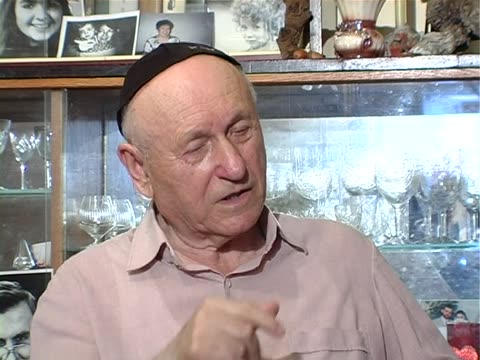
Nibulskiy tells Hershele Ostropoler anecdotes in Yiddish with Russian and Ukrainian dialogue. In one, Hershele tricks a cloth seller. In another, he tricks a landowner by claiming to need tefillin, gets a horse and sells it to Gypsies. Last comes a story about a peasant, a Passover turkey and a beating.
Beyond the catalogue label, the transcript shows a cloth-seller story, a tefillin-and-horse story and a Passover turkey story.
Kerler asks about the three synagogues in the town and until what year people could attend services. Nibulskiy says it was until the early 1930s, when he was a boy of eight or nine (?), after which the synagogues were closed.
Answers Kerler's questions about prewar food. Nibulskiy recalls poppy-seed rolls that his grandmother baked for the Sabbath and ate with milk, and a plum tsimes sprinkled with sugar. He explains that 'tsimes' was also a compliment for a nice, clever girl or woman.
Kerler asks about a word for floor and the wooden sidewalks on which people strolled on the Sabbath after cholent. Nibulskiy recalls non-Jewish neighbors who greeted Jews in Yiddish, including a woman, Marye Tchaikovsky, who always spoke Yiddish. Russian talk in the room ends the passage.
Beyond the catalogue's 'Prewar life', the passage includes a short word question about floors and boardwalks.
The couple talk about a Russian illustrated magazine of the Petersburg press, with a caricature of a bearded Jew speaking Yiddish. Nibulskiy says his father subscribed to it. A person named Roma (?), living in Los Angeles, comes up, and Kerler says he has been there once.
The talk is about a Russian magazine (called Niva) and a relative or acquaintance in Los Angeles.
Nibulskaia says that pupils of the Yiddish school were all brought up as nonbelievers. At Passover they marched in the street singing anti-religious songs and shouting against religion, and children's rhymes mocked it. She says she no longer goes to synagogue but believes in God, and Kerler asks how it all looks to her today.
The passage shows her own view of her atheist schooling and of her faith today.
Kerler asks whether Nibulskiy remembers any further charm formulas. Nibulskiy says his father taught him one and tells of his great-grandmother Klore, who called him in to three women arguing over whether he was fit to give blessings. He then tells how a young man from Moscow asked him for a charm or blessing.
The passage turns on a charm against the evil eye and the great-grandmother's three women, not general folklore.
Nibulskiy finishes his story of how a visiting businessman asked for a charm and gave him a hundred. Kerler asks about extinguishing coals against the evil eye, and Nibulskiy explains the term for warding off the evil eye. Nibulskaia says she does not know the custom.
The passage concerns the evil-eye charm and the term for warding it off, not religious life today.
The couple say they know hardly any Hebrew. One says he or she never attended a Yiddish school, and Nibulskaia says she taught herself to read Yiddish, mostly in recent years. A recogniser loop covers part of the passage.
Nibulskaia speaks of a younger relative, Segel (?), in Ramat Gan who is due to visit in August; the transcript does not make the relation clear. His father was a committed communist. She recalls that her own father was a believer and that her mother made small pancakes for Hanukkah.
The passage names a cousin (?) in Israel and shows family religious differences.
Nibulskaia recalls going as a child to an uncle on Hanukkah to collect Hanukkah money. Kerler asks about the uncle's son, who speaks Yiddish at home but cannot write it, and then asks for a name.
The team and family fuss over camera framing, with Margot addressed. Nibulskaia is shown a handmade tea container made from a coconut shell, and the room chats about it. Kerler then turns to questionnaire items.
The team and the coconut-shell object are in the passage.
Answers questions from the dialectological questionnaire on the meanings of golem and dibbuk and on words for sick (krank, shlof). They also discuss the terms for pious, honest and believing (frumer, erlekher, nabozhne). They discuss which are literary words or synonyms, and the interviewers say they will return.
Kerler asks about varenikes and retells a short anecdote about a Hershele-like trickster. Nibulskiy then tells a story of Hershele Ostropoler and the chicken soup. A woman cooks soup, and Hershele pays by the number of fat 'eyes', but the fat forms one big eye. Kerler then asks for a song.
Kerler asks Nibulskaia for songs, and she says she has forgotten most of them. She says she remembers a good deal despite her age, which her husband corrects. She says she still solves arithmetic problems for the neighbors' children. He prompts her to tell about dancing around a fire.
The passage turns on songs she no longer remembers and her age.
Nibulskaia recalls the 1933 famine, when her blacksmith father had nothing to eat and the family moved to a kolkhoz near Novozlatopil (the kolkhoz's name is unclear in the transcript) with twenty-eight Jewish houses. The school there had only the lower grades, so she walked eight kilometers each way, stealing produce from the fields. In winter she lived in a cold dugout dormitory with plank beds, and she went on to a Russian school in Korosten after seventh grade. Her mother worked as a cook and kept a garden.
The passage also covers the dormitory conditions, her parents' work in Korosten, and a painter from a place spelled Rysaval (?).
Nibulskaia shows family photographs: herself with her parents, a wartime picture connected to her brother's visit from the army, and pictures of her daughters, Tania and Genia. Kerler remarks on how the photographs have faded.
The passage names her daughters and a wartime photo.
Footage of the team and room. A speaker mostly in Russian and Ukrainian, with garbled Yiddish transcription, performs a homemade song and talks about it. Kerler and the speaker discuss posting the recording on YouTube.