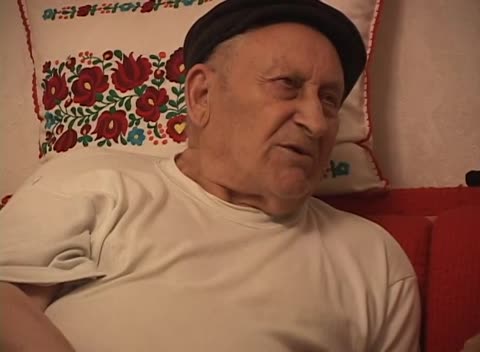
Galambos speaks about his yeshiva education. He also recites the lyrics of a Yiddish song about a "yeshive bokher" (yeshiva student). Galambos describes how he went "esn teyg" (join families for meals) at different homes and his daily study routine. Galambos attended yeshivot in Kisvárda (Yiddish: Kleynvardeyn) in 1936 and Putnok in 1935.
From the machine transcript
Kerler asks Galambos about his yeshiva years. Galambos recites a Yiddish song about the hardships of being a yeshiva student. He describes eating each day with a different family and the daily round of study, prayer and meals. He studied in Kisvárda and Putnok in the mid-1930s.
The song text and a Putnok year (1935) are in the transcript.
Galambos talks about prewar religious life in Vaja, particularly his religious school (cheder) education. He also addresses his mother's observance. Galambos recalls how his mother read the megillah out loud to other women. Galambos then addresses different religious texts he studied in cheder and yeshiva.
From the machine transcript
Galambos says all of Vaja was Orthodox and kosher, with Ashkenazi rather than Hasidic Jews, and that boys wore sidelocks. He tells how his mother read the megillah aloud to other women. He describes cheder from age three, including girls' cheder, the teaching of Hebrew and translation, and his own gaps in understanding the prayers. He also compares cheder and yeshiva study of Gemara.
Language of instruction in cheder and the question of Hasidim in Vaja are also discussed.
Galambos continues to share information about his education, when he studied in cheder and at a Hungarian school every day from the age of six.
From the machine transcript
Galambos continues describing his schedule as a child, with school and cheder every day from age six, and says he had little real childhood. He also describes Sabbath afternoons at cheder. Kerler asks whether certain texts were said with a melody, and Galambos has not heard that.
Kerler's questions about chanting with a melody.
Galambos speaks about prewar praying customs. He then sings "Belz, mayn shtetele Belz."
From the machine transcript
Galambos answers questions about which prayers and Sabbath rituals were sung with a melody, such as Yom Kippur, Rosh Hashanah, Friday night and kiddush. He sings a song about the town of Belz and childhood there. They then mention a brother who has died, and Kerler asks about his years in yeshiva.
Galambos speaks about his life in Vaja, after he graduated from the yeshiva in 1936. Galambos then touches upon his visit to Auschwitz. He served in the Hungarian army and was a forced laborer during World War II. Galambos's father and four sisters were killed in Auschwitz. He states that nineteen members of his family were killed in the camp.
From the machine transcript
Galambos gives the years of his yeshiva study and says the yeshiva life ended with the coming of the war. He talks about returning to Vaja and about Auschwitz, which he has visited. He was in the Hungarian army, and his father and four sisters were killed in Auschwitz. He gives figures for his family's losses, with nineteen heard.
The family losses are named in detail and the yeshiva years are repeated.
Galambos speaks about life today. He then speaks about Jewish life after the war. Galambos returned to Vaja in 1944. According to him, 184 Jews (out of 2,700) lived in prewar Vaja and 41 Jews returned after the war.
From the machine transcript
Galambos describes a recent event in a synagogue where a man wept while speaking about the Holocaust. He says he came back to Vaja in 1944. Before the war Vaja had 184 Jews; 41 returned afterwards, and only a handful now remain. He adds that few survivors are left in the world, with a few in America and Israel, and mentions one man in Budapest.
Catalogue says 2,700 population; the transcript heard here has only the Jewish figures.
Galambos speaks about his family, particularly his brother. He then speaks about prewar life in Vaja and Jewish regional geography. He also touches upon prewar traditional weddings.
From the machine transcript
Galambos speaks about his late brother and the last time he saw him. Kerler asks about the proportion of Jews to non-Jews in Vaja and in other places, such as Czechoslovakia, Munkács, Huszt and Beregszász, and where Yiddish speakers remain. Kerler then asks about Jewish weddings, and Galambos recalls three weddings of his sisters in the family. He says non-Jews did not speak Yiddish in Vaja, but did in the Carpathians.
Comparison with other towns' Jewish populations and non-Jewish Yiddish speakers.
Galambos addresses prewar Purim celebrations, including food customs. He also recalls Purim shpiels. Galambos then speaks about Passover celebrations before the war.
From the machine transcript
Galambos describes Purim in Vaja: going to the megillah and then going door to door with a Purim play for small coins. He says part of a Purim rhyme, which Kerler asks him to repeat so as to write it down. He answers that a chimney-sweep play was not done and that the shoykhet organized the Purim performance. He lists the festive meal, then answers Kerler's questions about the four questions at the Passover seder and the Haggadah, and links them to Auschwitz.
Passover questions and Auschwitz reflection.
Galambos speaks about religiosity and prayers, including "got fun Avrum" (women's prayer in Yiddish). He also addresses the Land of Israel.
From the machine transcript
Galambos and Kerler discuss belief in God after the Holocaust. Galambos mentions prayers said by women, including the prayer to the God of Abraham at the end of the Sabbath, and Psalms. Kerler asks about the future of the Jewish people and whether he has relatives in Israel. Galambos answers about the Land of Israel and a story about Moses and the sea.
Theological reflection after the Holocaust, and the question of relatives in Israel.
Galambos talks about prewar religious life in Vaja, in particular visiting the grave of the Kaliver tzadik (Rebbe Menachem Mendel Taub). Galambos then shares an episode about the Tosher rebbe, Grand Rabbi Meshulam Feish Segal-Loewy.
From the machine transcript
Kerler asks whether people from Vaja used to travel to a rebbe or a grave. Galambos says his father went to the grave of the Kaliver tsadik, and he himself did not. He tells an episode about the Tosher rebbe, to whom Jews came in the ghetto asking what would happen, and who answered that he was a simple man; Kerler tells a story of his own. They mention the rebbe's son in Canada. They then turn to Jewish weddings in Vaja.
The Tosher episode is placed in the ghetto in 1944.
Galambos again addresses prewar traditional weddings, including a local wedding jester.
From the machine transcript
Galambos describes Jewish weddings in Vaja. There was a canopy and a meal, with no dancing, a toast, and singing at the meal. A wedding jester from a nearby place rhymed there. He says there were no klezmer musicians in the village.
Names the jester's town as heard (garbled).
Galambos speaks about his mother's cooking, including gefilte fish and cholent. He also addresses drinking customs in prewar Vaja.
From the machine transcript
Galambos says he still makes his mother's dishes, such as gefilte fish and cholent. Kerler asks about Sabbath loaves, dumplings and the terms for them, and Galambos says he still has matzo meal. They discuss whether Jews drank palinka and whether it had to be kosher. They also cover wine, drinking on Passover and Purim, and toasts at kiddush in the synagogue. The recording has English and Russian fragments from others in the room.
Terms for challah and dumplings, plus drinking customs.
Galambos talks about prewar celebrations on Rosh Hashanah and healing customs.
From the machine transcript
Galambos and Kerler talk about the customs between Rosh Hashanah and Yom Kippur, and Galambos mentions casting crumbs into a spring (tashlikh) with a kind of noodle food (?). Kerler asks about old women's charms against the evil eye and whether coals were put out in water against illness. Galambos does not remember such charms; people said Psalms for the sick.
Galambos chants "Avinu Malkeinu" (prayer recited on Rosh Hashanah). He then addresses customs on Rosh Hashanah and recalls a Yiddish saying.
From the machine transcript
Kerler asks Galambos about the prayer recited at Rosh Hashanah, and Galambos recalls a Rosh Hashanah custom and a rhymed saying. The passage is hard to follow in the transcript.
The transcript is too garbled to show the chanting or the saying clearly.
Galambos addresses prewar Sukkot celebrations.
From the machine transcript
Kerler asks whether it was cold at Sukkot and whether people used to sleep in the sukkah. Galambos says Sukkot weather was still fairly good in the past, though it is cold now.
Galambos answers questions about cultural terminology and addresses prewar religious and healing customs.
From the machine transcript
Galambos answers questions about terms for the synagogue and church, about changing the name of a very sick child, and about where the dead were buried before the war, though he does not follow that question. He also discusses knocking on the shutters to call people to services and says he could read some Yiddish before the war.
The catalogue's 'healing customs' is the renaming of a sick child; the transcript also covers burial, knocking at the shutters, and reading Yiddish.
Galambos speaks about his life today and regional geography.
From the machine transcript
Galambos mentions praying and reciting Kiddush in the small community of Vaja today, which has no rabbi. Kerler and Galambos then discuss the Yiddish names of Hungarian towns, such as Klausenburg for Kolozsvár and a town with a large Jewish community whose name is unclear in the transcript.
The transcript shows a discussion of the Yiddish names of Hungarian towns and of the community's leader, not geography as such.
Galambos addresses prewar occupational structure in Jewish Vaja. He also mentions the local wine production, before talking about prewar Shavuot and Sabbath food customs.
From the machine transcript
Galambos says Vaja's Jews were craftsmen and merchants, with a shochet, a shamash, a gabbai and a rabbi who died in the early 1930s (?). He describes a nearby village with a beautiful synagogue where kosher wine was made. Kerler then asks about Shavuot dairy foods such as cheese pancakes and kreplach, and about goose fat, cholent, kugel, beans and Passover-style dishes, and the two compare Yiddish and Hungarian words for them.
The transcript shows an extended comparison of Yiddish and Hungarian food words and a discussion of kosher goose fat.
Galambos speaks about his life today. He then addresses prewar Passover celebrations, including differences regarding Ashkenazi and Sephardi customs.
From the machine transcript
Galambos talks about making kosher Kiddush in the synagogue and about keeping separate Passover dishes in the attic before the war. He describes Passover foods such as stuffed goose, matzo balls and potato kugel, and says that in Vaja the Orthodox did not eat soaked matzo (brak) except on the last day. Kerler then asks him to recite Purim plays again.
The transcript shows the discussion of whether soaked matzo (gebrokts) was eaten, and Kerler's request for Purim plays.
Galambos recites Purim shpiels. He then speaks about his visit to Israel approximately eight years ago.
From the machine transcript
Galambos recites Purim-play rhymes for Kerler, who explains that the scholars find them interesting. Galambos then says he visited Israel about eight years earlier and liked it, but has mixed feelings about the Hasidim there. He also recites a prayer he said on Yom Kippur for Jewish children and finds it hard to translate.
The transcript also contains his views on Hasidim and military service and a Yom Kippur prayer he composed.
Galambos discusses his childhood memories, before he sings "Habeit mishamayim" (look from heaven) in Yiddish. Galambos heard the song in 1948 in Pest, performed by a Polish theater troupe.
From the machine transcript
Kerler asks whether Galambos sang Hungarian songs in childhood. Galambos then recites the words of the song 'Habeit mishamayim' in Yiddish and says he heard it in Pest around 1948 from Polish Jews.
The transcript shows the song is recited as text and that he places it around 1948.
Galambos sings "Papirene kinder" (paper children; the title song of the movie "A brivele der mamen") and speaks about his life today.
From the machine transcript
Galambos recites the words of 'Papirene kinder'. Kerler remarks that the film in which it appears came out after the war. Galambos says 41 people came back to Vaja and that he says Kaddish for his brothers, and Kerler asks about his brother's widow.
The transcript shows the return of 41 people to Vaja and his Kaddish for his brothers.
Galambos shows family photographs and speaks about his family. He shows again the photograph when his family was forced to move from Vaja to Kisvárda on April 17, 1944.
From the machine transcript
Galambos shows family photographs, including a picture of his siblings; one sister died in Auschwitz. He explains that a non-Jewish photographer took the April 1944 picture of the family being driven to Kisvárda (the name is garbled). He also shows a group photograph of Jewish children in Vaja and talks briefly with Kerler about the Hungarian language.
The transcript shows the sisters and brothers, the non-Jewish photographer, and a group photograph from before the war.
Galambos shows a copy of the Haggadah.
From the machine transcript
Galambos shows a Haggadah and gives it to Kerler. Kerler asks him again for his address and asks him to tell a story or sing a song about what will happen when the Messiah comes.
Galambos speaks about religious customs.
From the machine transcript
Kerler asks about a song on the coming of the Messiah, and Galambos answers with remarks about the shofar. They discuss how to send material to him, and Galambos talks about the coming Rosh Hashanah.
The transcript shows talk about sending material and about the coming Rosh Hashanah.
Galambos chats the with the team about America, Israel and Romania.
From the machine transcript
Galambos and Kerler talk about stale noodles, then about America and Canada, democracy and Israel, and how the United States has helped Israel. They go on to talk about the Jews of Debrecen, Romania, and Galambos's learning of Hungarian. Galambos says he spoke only Hungarian at school and Yiddish at cheder.
The transcript shows talk about noodles, democracy, Romania and Galambos's language learning.