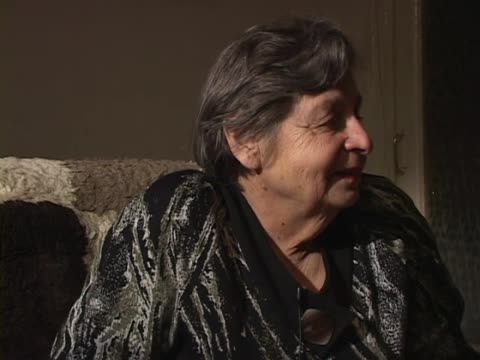
Raisa Izrailevna Faiershtein (born 1932 in Soroca) talks about her family, in particular her parents. She recalls how she attended synagogue services with her parents before the war. Her grandparents were born in Racovat, Moldova, and her parents lived there, before they moved to Soroca (recorded in Briceni).
Faiershtein talks about her aging parents, whom she took in; they died within days of each other. She says she went to synagogue with them and that her grandparents came from Rakovits before her parents settled in Soroca, where she was born. She also mentions her husband's birthplace near Soroca, calls Soroca a Jewish town, and says she writes her poems in Russian and cannot easily render them in Yiddish.
Also covers her husband's birthplace, Soroca as a Jewish town, and her Russian poetry and difficulty translating it.
Faiershtein translates one of her Russian-language published poems about her life during World War II. She remembers how she was carried, escaping shootings, and hid with Moldovian neighbors. She published five books in Russian, including 1017 poems.
Faiershtein reads and half-translates a Russian poem about the Holocaust, then recounts her childhood in 1941. She was driven toward the Dniester, saw children torn from their mothers and thrown into a fire, and was carried by other people because she could not walk fast. She hid with a Moldovan family in Rakovits and reflects on the poem's message never to forget the war.
Gives the escape, being carried by others, and the Moldovan family's cellar hiding in more detail than the catalogue.
Faiershtein recalls going to synagogue as a child, with the women and men seated separately. She describes Sabbath observance: no work, no lighting fire, and a Moldovan slaughtering the chickens. Asked about Purim she cannot remember, and she says the war and beatings erased much of her childhood. Lemster then asks about her working years, and she answers about being invited to schools.
Adds the answer about invitations to schools and the question on her working years.
Faiershtein answers questionnaire items on words for being ill, sleepy and sick, and on the word for a Jew who converted. She compares which words are Yiddish and which are German-like. She also says she has almost no one to speak Yiddish with today.
Faiershtein talks about her life today as a writer and introduces her books. She also talks about her family. Faiershtein then addresses Holocaust deniers and the contemporary relationship between Jews and non-Jews.
Faiershtein talks about her life today as a poet: five books with 1,017 poems, and she explains their Russian titles. She mentions her sons, daughter-in-law and granddaughters, who have Jewish names. She speaks about a local teacher who builds Holocaust memorials, Holocaust denial, relations with non-Jews, and pensions, prices and Hesed help. She also talks about her late husband, a school director in Cupcini.
Adds her writing and book titles, her family, Holocaust denial, and pensions and Hesed aid.
Faiershtein talks about life in the Soviet period. Her husband worked as a school principal for a school in Cupcini, Moldova, for twelve years. She describes the good reputation of the school under his leadership.
Faiershtein speaks about her husband, a school director for twelve years, and the school's high reputation, with visitors coming from other republics to learn from him. He died in Chișinău and was buried in Edineț; she mentions that her mother's gravestone and others were smashed at the cemetery. She says life was better before.
Adds his death and burial, and the vandalised family gravestones.
Faiershtein answers questions about a Yiddish word for "ahead" and a sentence using it, and about the order of words in a sentence. She switches to Russian to say she has had several operations, clinical deaths and strokes, which affect her memory. She offers to read Russian poems, including one about her husband, and Katz blesses her.
Informal talk in the room, partly in Russian: about not being able to read Yiddish and translating from a literal gloss. A second woman tells Lemster about her grandfather, his travels and a nickname. The speech is largely garbled.
The transcript shows conversation about reading Yiddish and a woman's grandfather, not just footage of the center.
Questions put in this conversation
Items of the dialect questionnaire asked here; each link plays the moment.