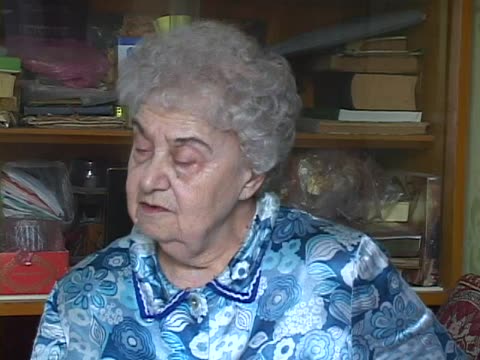
Muchnik provides personal information and talks about her family. Her father owned a leather/shoe shop and was also born in Orhei. Muchnik's mother was born in Chiştelniţa. Muchnik grew up with two brothers, both of whom moved to Israel, and one sister.
From the machine transcript
After Lemster's opening announcement, Muchnik gives her birth date and says she stayed in Orhei until the war. She names her father David Muchnik and his leather and shoe workshop, and her mother Golde from a village near Orhei. She names her grandfather Yosef, whose father was Moshe, and the grandfather's second wife, who left him for America. She also says there were four children, including two brothers who lie buried in Israel and an older sister Elke.
Names the grandparents and the grandfather's second wife who left for America.
Muchnik talks about her life, including education, before the war. She went to a Yiddish kindergarten at the age of three and then attended a Hebrew tarbut school for four years. Afterward, Muchnik studied at a Romanian secondary school and graduated in 1940. She worked as primary school teacher in Molovata between 1940 and 1941.
From the machine transcript
Muchnik recounts her schooling before the war. She attended a Yiddish kindergarten, then a Hebrew Tarbut school where she learned to read and write Hebrew but never Yiddish. She went on to a Romanian gymnasium, finishing in 1940, and then taught young children in the village of Molovata (?) until the war.
Muchnik discusses her childhood memories, as well as prewar holiday celebrations at home. She points out her father's observance and mentions that her parents were killed in Orhei during World War II. She then speaks about her family. Muchnik's older brother moved to Eretz Yisrael in 1930 and returned for his younger brother in 1935. She also touches upon childhood games.
From the machine transcript
Muchnik recalls her home and Jewish holidays, including the seder, and her father's devout observance. She says that during air-raid alarms at the start of the war he prayed at the window, and that both her parents were later killed. She mentions her sister studying in Bucharest, her older brother leaving for Palestine in 1930 and returning in 1935 for the younger brother, who was killed by terrorists in 1936. She says she had no playmates and played with picture cards and with an aunt.
Gives details on siblings' studies and on the younger brother's death in 1936.
Muchnik speaks about her school education at the local tarbut school and lists her awards, before talking about her secondary school education. She also describes her childhood home and friends.
From the machine transcript
Muchnik talks about her primary school, where she won prizes and a gold medal, and about difficulty gaining admission to the gymnasium. She describes the family home on the Jewish street in Orhei, with a balcony shared by three generations. She names girlfriends and one schoolmate, and recalls her teacher Yanovich and his grading of her and her sister.
Adds the home on the Jewish street, friends and teachers.
Muchnik addresses her education and work after World War II. She studied at a technical school and worked as financial consultant for thirty years. She then speaks about her family.
From the machine transcript
Muchnik says that after the war she studied at a financial technical school and worked as a finance specialist for her whole career, with her seniority counted as thirty years. Asked about songs sung by her mother, she says her aunt Beyle, whom she calls her second mother, spent more time with her and sang to her. She begins to recall a children's rhyme.
Muchnik sings Yiddish songs about ancestry and asking questions. She then sings "Vos vet zayn? (what will happen) and "Got hot bashafn himl mit erd" (God has created heaven and earth). Muchnik also briefly sings a Yiddish song about longing, before she sings a Hebrew song, she remembers from tarbut school. She then sings Yiddish songs about the kosher butcher's daughter and rebbe.
From the machine transcript
Muchnik sings or recites a series of Yiddish rhymes and songs. They include a humorous song on lineage, a riddle song about how an emperor sleeps and eats, a seder-style song, and a song of creation, Adam and Eve and the serpent. She also gives a short song about a headache and longing, a Hebrew school song from Tarbut, and a comic song about the shoykhet's daughter and a rebbe. Kerler and Lemster ask her to repeat some and ask where she learned them, and she does not remember.
Muchnik addresses religious customs at home. She points out the different prayer customs between herself and her father. She then recites the morning prayer "Modeh ani" and recalls prewar Passover celebrations at home.
From the machine transcript
Muchnik compares her own prayer habits with her father's. He prayed in Ashkenazi pronunciation, while she uses Sephardic (modern Hebrew) pronunciation from school. At Kerler's request she recites the morning prayer Modeh ani and a blessing, in the way he said them. She then recalls a childhood Passover seder, where she as the youngest asked the questions, and her parents' custom of inviting soldiers as guests.
Muchnik speaks about prewar religious life and holiday celebration, particularly Sabbath, in Orhei. She describes how her parents invited soldiers on holidays and mentions the family's Sabbath goy.
From the machine transcript
Muchnik describes how two Jewish soldiers from the barracks sat at the family seder, and how the household managed without a maid. She tells about their Moldovan non-Jewish helper Moshe Alekseyi, who carried water and did Sabbath tasks, and an anecdote about the wine of the plagues. She also tells of his belief that he was Alexander of Macedon. Lemster asks whether non-Jews spoke Yiddish, and she says she did not know any who did.
Adds the story of the Moldovan helper Moshe Alekseyi and Lemster's question about non-Jewish Yiddish speakers.
Muchnik describes Sabbath food customs at home and shares her recipe for gefilte fish. She also addresses her mother's baking.
From the machine transcript
Muchnik describes Sabbath food in her family, including gefilte fish, of which she gives a recipe with onions cooked in water and then oil, egg and bread. Lemster asks about the ingredients. She also mentions an unfamiliar dish called pitshe, noodles, kugel and small cookies, and tells how her mother baked challah every Friday. The cholent was sent to a neighbour's oven or their own, and she recalls the family kitchen with oven.
Adds the gefilte fish recipe discussion and baking details.
Muchnik discusses her childhood memories of Simchat Torah celebrations at her grandfather's house. She also addresses prewar religious life and Hasidic locals. In particular, Muchnik recalls how her grandfather put visiting rebbes up.
From the machine transcript
Muchnik recalls Simchat Torah at her grandfather's house, where a room was turned into a prayer room and Torah scrolls were brought from the synagogue, with Hasidim at the table. She mentions that her father was not a Hasid. She also describes a rebbe who visited Orhei and was lodged each year in a room at her grandfather's house. People waited to receive the leftovers from his meal, and she carried plates as a child.
Adds the visiting rebbe lodged by her grandfather.
Muchnik talks about her adolescence. She was a member of the local underground group of the Zionist youth organization Gordonia. She then briefly talks about her life during World War II, before talking about Passover celebrations at home.
From the machine transcript
Muchnik speaks about the underground Zionist group Gordonia in the gymnasium years, which had the Hebrew name Kvutsa (?) and was visited by a representative from Chișinău. She recalls a blessing said to be given by a rebbe, and the start of the war. She and her sister left on foot while her parents stayed. Asked by Lemster and Kerler about Sabbath songs, she returns to the seder and her childhood effort to see Elijah the Prophet.
Covers Gordonia and the start of the war, and an Elijah memory.
Muchnik addresses prewar holiday celebrations at home, including Sukkot, Passover, Hanukkah. She describes the family's sukkah and lists Hanukkah dishes.
From the machine transcript
Muchnik describes the family sukkah built by her mother, with her father busy in his workshop, and her brother killed at about twenty. Meals were eaten there. She recalls Passover preparations, the special dishes brought down from the attic, the hungry day of Passover eve and her aunt feeding her. Asked about Hanukkah, she says her mother made various pastries and she describes receiving small sums of money for ice cream.
Adds Passover eve hunger and Hanukkah money.
Muchnik discusses her childhood memories of holiday celebration of home. She mentions that her mother visited the local rebbe for advice. Muchnik then addresses prewar Purim celebrations.
From the machine transcript
Kerler asks about salting meat, and Muchnik says her mother sent questions to a religious judge when something was doubtful. She then recalls Purim on the Jewish street, with a costumed procession stopping at her father's house. She says she does not recall a Purim play, and remembers neighbour children saying a Purim rhyme to get coins.
Adds kosher meat questions and the Purim rhyme.
Muchnik speaks about prewar and postwar traditional weddings. She then addresses Shavuot celebrations and food customs before the war.
From the machine transcript
Muchnik says she attended a wedding in a village before the war but remembers little, and neither klezmer nor Yiddish songs. She recalls Yiddish songs at weddings only after the war in Bender. Asked about Shavuot, she says green branches and dairy foods marked the holiday, and that her mother baked dairy pastries and bagels. Kerler and Lemster ask for names of the baked goods.
Muchnik speaks about her life before the war and talks about her family. In particular, she speaks about her brother, who prepared his aliyah to Eretz Yisrael as chalutz.
From the machine transcript
Muchnik talks about her family and her older brother Haim, a Zionist who prepared to go to Palestine as a chalutz. She tells of an evening walk with him to the river, a key he made so he could come home late, and a police episode. She also mentions a sister who studied in Bucharest and another brother who later studied in Palestine. At the end she begins to speak of the Romanian fascists in the years before the war.
The catalogue's brother story also includes a police incident, the sister's studies, and a second brother.
Muchnik speaks about the Romanian Fascist regime instigated activities before the war. She recalls looting and describes local Romanian gatherings.
From the machine transcript
Muchnik describes the activity of Romanian fascists in Orhei before the war: gatherings of peasants with sticks and sacks who were to plunder Jews. She recalls climbing onto the roof to watch their meeting place, and Jewish households closing shutters at night in fear of a pogrom. She tells of a night alarm in which neighbours knocked on windows to warn the Jews.
Includes a night alarm among the Jewish neighbours and a childhood vantage from the roof.
Muchnik speaks about prewar religious life. She maintains that her father attended daily services at the market synagogue and the Great Synagogue on holidays. Muchnik remembers the cantor in the Great Synagogue. She then shares an episode about spending Rosh Hashana at a Romanian police officer's house.
From the machine transcript
Asked about her mother's candle-blessing and prayers, Muchnik says she does not remember. She recalls her father's two synagogues, the market shul daily and the large Kleyz on Sabbath and holidays, and the handsome young cantor. She then tells an episode about visiting a police officer's daughter before Rosh Hashanah and going through the house of a Romanian police chief. At the end she mentions being first in her class at the gymnasium.
Begins with Lemster's questions on her mother's candle blessing and ends with her school prizes.
Muchnik speaks about her life before the war, specifically sharing an episode about her work as school teacher. Muchnik also her addresses her book collection.
From the machine transcript
Muchnik tells how, after a school year when she received no prize book, a parcel slip from Bucharest led to a post-office package of books from the royal publishers. This became the start of her own library. She says she now reads mainly Russian, never read Yiddish, and studied French and German at the gymnasium.
Adds her present reading language and her gymnasium languages.
Muchnik speaks about her education at the local tarbut school. She sings a song, written by Hayim Nahman Bialik. Muchnik then talks about individual family members, who faced state persecution in during the 1940s and 1950s.
From the machine transcript
Asked by Kerler about the Tarbut school, Muchnik recites a few lines of Bialik in garbled Hebrew and says she only picked up some from older people. She then speaks of relatives persecuted by the Soviet regime: a brother-in-law (named Vinogrād Mendl Haimovitsh, from Mărculești) sentenced to ten years in 1942, rehabilitated around 1950 after her sister, an accomplished teacher, was also affected. Kerler asks about the dates and the Yiddish inscription on a gravestone.
Adds the brother-in-law's arrest and rehabilitation and Kerler's questions about a gravestone inscription.
Muchnik speaks about postwar Yiddish culture in Orhei. She recalls performances by Sidi Tal. Muchnik then speaks about her family's and local's fate during World War II.
From the machine transcript
Answering Lemster and Kerler, Muchnik says the Yiddish actress Sidi Tal used to perform in Orhei before the war and she herself was not much at the theatre. She tells of the fate of her parents and a lawyer friend of the family during the war, who went to their death. She regrets that no memorial marks the place where Orhei's Jews were killed and buried.
Adds her parents' killing and the absence of a memorial at the burial place.
Muchnik speaks about religious life today, including her visits to Orhei to visit her relatives' graves.
From the machine transcript
Muchnik tells how she started travelling to Orhei to find the graves of her relatives and finds her grandfather's Yiddish gravestone; on the day she mentions it is a brother-in-law's yahrzeit. She speaks of the rabbi's wife Leah Abelsky, the Sabbath table, and the rabbi's Lithuanian-style Yiddish. She asks the rabbi about a Hebrew birth date.
Adds the rabbi's wife Leah, the rabbi's Yiddish, and the Sabbath table.
Muchnik discusses her childhood home and family's observance. In particular, she addresses the generational gap between her Hasidic grandfather and her non-Hasidic father.
From the machine transcript
Muchnik talks about the family house in Orhei, shared with her paternal grandfather, a Hasid whom a rebbe visited. She says her father did not take part in the Hasidic celebrations and dancing, and she did not understand why as a child. Kerler suggests he was a mitnaged.
Adds the shared house and the rebbe's visits to the grandfather.
Muchnik answers questions about cultural terminology. She then speaks about her maternal wealthy grandfather. Muchnik then shares episodes about prewar local life and recalls a non-Jew who got along with locals.
From the machine transcript
Asked about the word 'dybbuk', Muchnik explains it as a stubborn person; Kerler and Lemster also ask about other words. She then describes her wealthy maternal grandfather, a landowner with a carriage and horses, and his richly furnished house. She also recalls the all-Jewish street where she grew up, and a Moldovan who bought a house there and became friendly with the Jews and learned Yiddish.
Begins with a terminology question on 'dybbuk' and ends with a Moldovan neighbour who learned Yiddish.
Muchnik talks about her life today. She then answers questions about cultural terminology and discusses religious customs for women.
From the machine transcript
Muchnik speaks of her present life: the Jewish centre, writing, and the few people with whom she can speak Yiddish. She answers questions on expressions and prayers, including 'a gut ort' and a prayer for Sabbath night. She says women went to the synagogue only on Rosh Hashanah and Yom Kippur, and recalls Roza Zabritsky dressing up on Yom Kippur.
Adds her speech with others today, expressions asked by Kerler and Lemster, and women's synagogue attendance.
Muchnik explains family photographs and speaks about her life today, as well as mentions artifacts for the local museum. Muchnik also talks about her sister's studies.
From the machine transcript
Muchnik explains family photographs, including one of her sister and her husband, and speaks of items she plans to give to the local museum: old postcards, photographs and her sister's diplomas from Bucharest. She tells how she once sold postcards and regretted it. She also mentions her sister's studies and a professor's comment about her nationality.
Adds the sister's diplomas and her professor's remark.
Muchnik answers dialectological questions from the AHEYM Yiddish linguistic questionnaire. She also speaks about her life today.
From the machine transcript
Kerler puts a short sentence to translate into Yiddish (a Russian sentence about someone bringing a book). Muchnik gives a Yiddish version and says that people at the centre forget words.
Contains a single sentence-translation item and her remark about forgetting words.
Muchnik recites "Die Lorelei" (the Loreley) by Heinrich Heine.
From the machine transcript
Muchnik recites Heine's Lorelei in German, which she learned at the gymnasium, after Kerler asks her to repeat it. She then starts to speak of another piece or of an article she wrote, which she sent to a brother in America, and recalls her elder brother's participation in a Yiddish theatre.
She also mentions an article she wrote and sent abroad, and her brother's theatre role.
Muchnik talks about prewar Yiddish cultural life, as well as her family. According to her, there was a local Yiddish drama circle in Orhei.
From the machine transcript
Muchnik tells how her elder brother acted in a Yiddish theatre, taking the role of Death, and forgot to remove his wristwatch, so that he was nicknamed after it. Lemster and Kerler ask what plays were staged and whether they were in Yiddish. She recalls a symposium of Hebrew specialists where her brother, a carpenter, corrected a professor, and talks of her brother's love of Hebrew and Yiddish and of cheder.
Adds the story of the brother's wristwatch in the role of Death and his Hebrew interests; the location of the circle is unclear.
Muchnik talks about her life today, religious texts and religious customs.
From the machine transcript
Muchnik discusses a prayer text and a request to transcribe it into Russian letters, and her reaction to being called a nationalist because of her support for Israel and the Jews. In answer to Kerler she says she must believe in God. She stresses that she is the last of the Muchnik family and tells a story of a friend rescuing her from a fire, which she calls a miracle. Kerler then starts asking how one says 'why' in Yiddish.
Beyond life today and religion, the passage includes a prayer for Israel, her statement of identity and a story about a fire.
Muchnik answers dialectological questions from the AHEYM Yiddish linguistic questionnaire and questions about cultural terminology. She also talk about her life today and shares Yiddish and Hebrew sayings.
From the machine transcript
Kerler and Lemster ask Muchnik for Yiddish equivalents of 'why' and 'about what', and she answers. She says that old Jews say a phrase asking God to protect from something worse. She explains the word golem (a helpless person) and gives a Hebrew-sounding saying. The interviewers remark that she has not learned Yiddish formally.
Adds the explanation of the word golem and the saying about God protecting from worse.
Muchnik speaks about Yiddish literature and talks about contemporary Jewish life. She then speaks about her religious education with a private tutor before the war.
From the machine transcript
Muchnik answers questions about Yiddish writers: she has heard of Bialik, Sholem Asch and Sholem Aleichem but did not read them. She mentions an older Jewish woman in Chișinău who reads Yiddish. She recalls writing letters in Hebrew to her brother, and her religion lessons at the gymnasium with a private teacher who had studied in Vienna. She can read an Israeli newspaper only with vowel points.
Adds her Hebrew letters to her brother and the ability to read a Hebrew newspaper.
The team concludes the interview with Muchnik and the camera records a family photograph.
From the machine transcript
Muchnik says something about the next day, the 24th, as the interview closes and a family photograph is taken.