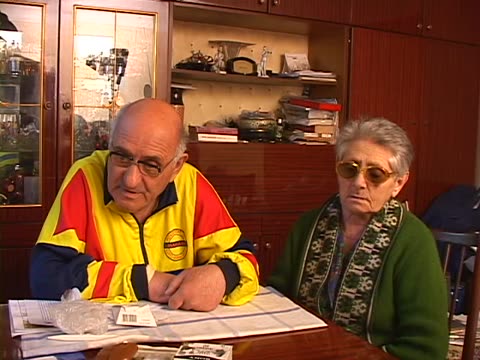
They speak about life today.
From the machine transcript
Opening talk, partly about a woman who still writes and speaks Yiddish by phone with the couple. Kerler then gives the date, 2 June 2006, and the place as Chișinău and introduces the two interviewees.
The catalogue says life today; the transcript shows the recording introduction by Kerler.
The formal interview begins. They provide personal information and speak about their family. Benderskij's father, who was also born in Nisporeni, worked at his brother's vineyard. Benderskaia's father was a kosher butcher.
From the machine transcript
Formal interview begins. The speakers give their birth years (his 1928) and the names of their parents and grandparents; the dates for some are unclear. His father worked in a family vineyard, and her father was a kosher butcher; her mother was a housewife. They also talk about a grandfather who traded in dried plums and about relatives who disappeared in the war.
Also covers the grandparents, the plum trade and a missing relative.
Benderskaia speaks about locals' fate in Sarai during World War II.
From the machine transcript
An account of the killing of local Jewish women in Sarai in 1941. One mother fell on her child and the child survived; a local non-Jewish woman took the child, had him baptized and raised him. Kerler asks who the victims were and where the story comes from, and they say the neighbours told it.
Gives the rescued child story and names the non-Jewish source.
Benderskij talks about his family and his uncles' vineyard. He states that his uncles exported the wine to different countries.
From the machine transcript
Benderskij describes his uncles' vineyard and winery in the village: cellars, large barrels, wine sold to non-Jewish buyers and sent to Bukovina by rail. He also describes the drying and export of plums to Paris and elsewhere on contract. Kerler asks about the Romanian word for plums; Benderskaia mentions lists of the dead and numbers of Jews in the town.
Adds plum drying and export and the lists of victims.
Benderskij addresses prewar Jewish life in Nisporeni. According to him there were two synagogues and approximately four hundred people lived there. Benderskij also addresses his grandfather's observance. Benderskij worked as economist and Benderskaia was an accountant.
From the machine transcript
Prewar Jewish life in Nisporeni: the town had two synagogues and a few hundred Jews. Benderskij's grandfather was strictly observant. Afterward he worked as an economist in an institute and she as a bookkeeper.
Benderskij talks about his family. They talk about their return home and mention that they gave their family members a proper burial in 1946. They then return to prewar religious life in Nisporeni.
From the machine transcript
Benderskij says that after the war they returned to find the grandfather's house, in which a non-Jewish worker had gathered his bones. In 1946 they gave their murdered relatives a proper burial; the two synagogues are discussed, and Benderskaia's family name and a rebbe from Belarus are mentioned. They return to prewar religious life, with Simchat Torah.
Adds the synagogues and Simchat Torah.
Benderskaia speaks about prewar Jewish life and holiday celebration in Nisporeni. She also mentions her family and describes Sabbath celebrations and food customs at home. Benderskaia grew up with two brothers.
From the machine transcript
Benderskaia recalls weddings, Purim masking and shalakhmones, and her grandmothers. She describes Sabbath: large challahs, a visit to the shoykhet, her mother's koshering and lighting candles, and her two brothers. She mentions fish on Sabbath and holidays, and Yom Kippur spent in synagogue.
Adds Purim, weddings and the grandmothers.
Benderskaia addresses prewar Purim and Hanukkah celebrations, including food customs, in Nisporeni.
From the machine transcript
Benderskaia recalls the Purim play and children's visits for treats, but remembers only a scrap of a song. She also recalls Hanukkah money for children, kapores before Yom Kippur, and her mother reading in Hebrew. Kerler asks about Hebrew learning.
Adds kapores and the parents' reading.
Benderskaia talks about her life before the war. She also speaks about her family and her father's persecution by the Romanian state. Benderskaia evacuated to Vladivostok, Russia, during World War II. Benderskij talks about his family and education before the war. He explains how he studied at religious school (cheder).
From the machine transcript
Benderskaia recounts her schooling in the 1930s, a broken arm, and her father's Romanian citizenship hearing, then flight on foot with the Russians' arrival. Benderskij describes cheder, where the pupils played tricks on the old rebbe, and his grandfather. Kerler asks about corporal punishment, and Benderskij starts on children carrying food at the holidays.
The Vladivostok evacuation is not in the transcript, which shows a flight on foot.
Benderskij discusses his childhood memories of holiday celebration in Nisporeni. Benderskaia and Benderskij then describe locals. Benderskij maintains that his family were second class citizens.
From the machine transcript
Benderskij describes how, before the holidays, he and his grandfather carried food and bread to poor people. A man nicknamed Yosele the Little and local assimilation are discussed, including a Jewish family whose son converted for a Christian woman. Lemster asks about poor and rich families, and about Christians converting to Judaism.
Adds charity before holidays and conversion.
Benderskaia talks about life after the war. Benderskij then speaks about his family's vinyeard and wine production. They then remember prewar Passover celebrations, including food customs.
From the machine transcript
They talk about wine, with Lemster asking whether the family wine was kosher and what was drunk at Purim and Passover. They go on to Passover: her mother's koshering of dishes with fire, the seder, the four questions, and food during the week. Kerler asks about specific dishes.
Adds kosher-wine discussion and the seder.
Benderskij speaks about contemporary holiday celebrations. Benderskaia then speaks about their life before the war, as well as food (meat) customs. Benderskaia also shares an episode about her visit to Iaşi.
From the machine transcript
Benderskij recalls Passover in the 1990s, when they received three kilos of matzo from the Hesed. Benderskaia then discusses her father and kosher meat, with Kerler asking about meat terms such as brisket. She tells of a stay in Iași, where doctors prescribed non-kosher meat when she was ill as a child.
Adds meat terminology and the Iași episode.
Benderskij addresses prewar religious life and describes how his grandfather frequently visited a rebbe in Chişinău.
From the machine transcript
Benderskij recalls his grandfather's repeated visits to a rebbe in Chișinău, and a visit he made with him. The rebbe was an educated man, and the grandfather gave money to people. Kerler then moves on to gefilte fish.
Benderskaia speaks about food customs at home, particularly her mother's recipe for gefilte fish. Benderskij also recalls food customs at home.
From the machine transcript
Benderskaia describes her mother's gefilte fish: carp chopped with onion, cooked with oil, pepper, a little flour and sugar, and sweet rather than salted. Benderskij says his grandfather liked it salted, and potatoes with fish are mentioned. Kerler and Lemster ask about the preparation.
Adds the recipe details.
Benderskij speaks about his life and childhood friends before the war. He also addresses childhood games and describes his life under Romanian occupation.
From the machine transcript
Benderskij speaks of his childhood and two friends, one now in America, and games played with ball and the Romanian game of zurka. He describes the arrival of the Soviet troops, an exchange between neighbours, and a grandfather's warning about children. Lemster asks about rescuers; the speaker recalls non-Jews who helped Jews and the search for relatives' property on return.
Adds the Soviet arrival and rescue discussion.
They briefly speak about Jewish life in Nisporeni after the war. Benderskij and Benderskaia also touch upon their lives during the war. He evacuated to Kazakhstan. They also talk about their family.
From the machine transcript
Few Jews returned to Nisporeni after the war, and the speakers cannot say how many died. They were evacuated, he to Kazakhstan and she to Andijan (?). Lemster and Kerler ask about Transnistria; Benderskij says nobody can say who was killed there, and mentions Jews from Bukovina and elsewhere deported to Transnistria.
Adds Transnistria.
Benderskij addresses prewar Jewish life, as well as nature, in Nisporeni.
From the machine transcript
Kerler asks about Nisporeni's bathhouse and mikveh, about the custom of throwing crumbs into water before the New Year (tashlikh), and about the pond or lake there. The couple and Kerler then discuss the Yiddish words for a pond, a river and a stream. The passage ends with Kerler turning to the subject of evacuation.
Shows the passage is largely dialect questions on the words for pond and river and on tashlikh, as well as the nature of the town.
Benderskij speaks about his life during World War II. He describes how his family evacuated in 1940, via Chişinău, the Cigîrleni region 4:33; the Caucasus; Makhachkala, Russia; Türkmenbaşy (formerly: Krasnovodsk), Turkmenistan; Kazakhstan (Almaty province) In the Cigîrleni region, Benderskij was evacuated by the Red Army across the Dniester river. Benderskij describes the evacuation staging area in Türkmenbaşy and the journey through Kazakhstan to the Karaezbek 9:20 kolkhoz. Benderskij then describes his life on the kolkhoz, where he stayed for six months. His family then moved to Almaty, Kazakhstan, where they stayed until 1944.
From the machine transcript
Benderskij tells how the family fled the advancing front, with soldiers and horses killed under bombing, through a burning Chișinău. At the Dniester crossing, with thousands of people at a bridge, an officer shot a man who refused to ferry them. They then travelled to the Caucasus, Makhachkala, Krasnovodsk and a collective farm in Kazakhstan, where they stayed about six months. His father was taken for labor, fell ill and was released. Kerler asks about a Russian term he uses.
Adds the crossing of the Dniester by bridge and the shooting of the man who refused to ferry them, and the father's conscription to labor.