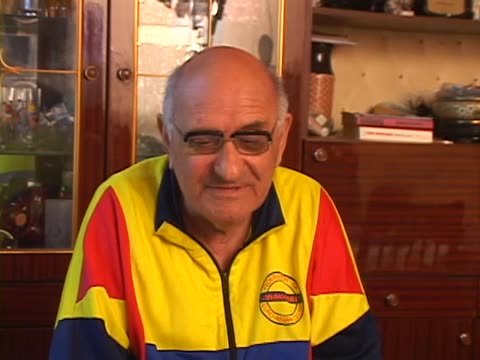
Benderskij speaks about his return home, via Chișinău, in June 1944. He explains how he left Chișinău with his father to check upon their house in Nisporeni. They then speak about their family. Benderskij grew up as only child and Benderskaia grew up with two brothers.
From the machine transcript
Benderskij describes the return home in 1944: he and his father went ahead to see whether the house in Nisporeni was still there, and found nothing left in it. Kerler then asks Benderskaia about her siblings; she had two older brothers, Menashe and Yosl, born in the early 1920s (?).
Names the two brothers; the catalogue's claim that Benderskij was an only child is not clear in the transcript.
Benderskaia speaks about her family, particularly her older brother's bar mitzvah, including food customs. She also touches upon traditional weddings and remember town musicians.
From the machine transcript
Benderskaia recalls her brother Menashe's bar mitzvah: her mother prepared food and sweets at home, Menashe read from the Torah, and boys and girls came to the table. She says there were no klezmorim at the bar mitzvah but there were at weddings. She and her husband name local musicians (a violinist who later led a music school in Israel, and a non-Jewish player), whose names are unclear.
Shows the discussion of klezmer musicians, Jewish and non-Jewish.
Benderskaia and Benderskij speak about prewar cultural life, particularly reading Yiddish books, Yiddish theater and organizations. Benderskij remembers support by the Joint Distribution Committee. They also recall meetings that were organized by chalutzim and list locals.
From the machine transcript
Lemster asks about Yiddish culture in Nisporeni. Benderskaia and Benderskij recall the library and her mother's reading of Sholem Aleichem, and travelling theater troupes that came to Chișinău. Benderskij names the Joint, collections for poor people and the chalutzim who gathered to talk about Palestine. They mention a few local people, and the details are patchy.
Adds the library, her mother's reading of Sholem Aleichem, theater visits and chalutzim.
Benderskij and Benderskaia speak about Jewish life before the war, including drinking customs, occupational structure and family dishes. Benderskaia's mother was a tailor.
From the machine transcript
The couple discuss prewar drinking customs, saying that Jews did not get drunk, and a mad Jew in town. They go on to trades in the town such as tailors, shoemakers, smiths and harness makers, and winter and summer clothing. Dishes and their names follow (gefilte fish, kishke, potato pancakes, Passover potato dishes), with Kerler and Lemster comparing local terms.
Adds the drinking customs, the clothing and the comparison of food terms.
Benderskij and Benderskaia answer questions about cultural terminology. Benderskaia then addresses folk customs and shares an episode about practicing healing customs ("leshn koyln") among Christians in 1953.
From the machine transcript
Benderskaia and Benderskij answer Kerler's questions about the words dybbuk and golem and the "good eye" charm. Kerler then asks about quenching coals as a healing practice. Benderskaia says it was not done in their home but tells of a hospital episode in 1953 (?), after the war, in which Christian women used the custom.
Adds the 1953 episode of coal-quenching among Christians in a hospital.
Benderskij and Benderskaia talk about their lives after the war. He moved to Chișinău from Nisporeni in 1969 and Benderskaia in 1970. They were married in 1949. They then describe their wedding.
From the machine transcript
Kerler and Lemster ask when they moved to Chișinău, which was around 1969 (?). They then ask about their wedding in 1949, held at home with perhaps a hundred or two hundred guests and attended by surviving friends. Lemster asks whether Christians also attended.
Adds the guest count and that the wedding was at home.
Benderskaia talks about her life during World War II. Her father worked as a secretary under the Soviet occupation. She explains how her family evacuated from Nisporeni with a horse and wagon to Reclushen 36:37, on foot to Verkhnodniprovsk, Ukraine; by train to Vladimir (Volgograd (Stalingrad) province); Taskhkent and Andijan, Uzbekistan. She recalls how her brother went missing and bombing in Moldova. Benderskaia also describes her and her family's life in Uzbekistan. In Andijan, she worked on a kolkhoz until 1944.
From the machine transcript
Benderskaia tells of her family's evacuation. Her father had been a Soviet-era village secretary and left with an ox cart as Nisporeni was bombed, and the family fled to the Dniester. At the crossing a commander had the bridge taken down, and a Jew from Lozova took them across with his cart and cow. Her brother Menashe was lost and found again. They continued on foot, then by train to Vladimir in the Stalingrad region, to Tashkent and Andijan, where she worked on a collective farm in a front brigade. Her father and brothers were mobilized, Menashe died after the war and Yosl fought to Königsberg, and her father was released ill in 1944.
Adds the loss and finding of her brother Menashe, her brothers' mobilization, and her work on the collective farm.
Benderskaia talks about her return to Nisporeni and life after the war. Her family rented an apartment at a Christian house, before living in two different houses, her family owned. Benderskij also speaks about his life after the war under Soviet occupation. They raised one son.
From the machine transcript
Benderskaia describes the return to Nisporeni in 1945. They found no house of their own and rented from a Christian, then lived in her aunt's house and in her grandfather's, where floors and fittings had been torn out. Lemster and Kerler ask the Yiddish word for floor. They then say they have one child, who works in Chișinău and is in the mid-fifties (?), and mention their grandchildren.
Adds the housing after the return and the question of the word for floor.
Benderskaia and Benderskij address prewar life in Nisporeni, including non-Jews who spoke Yiddish. They then discuss Yiddish songs and food customs.
From the machine transcript
They talk about non-Jews in Nisporeni who spoke Yiddish, some well and others only imitating it. Lemster and Kerler then ask about the song "Tumbalalaika", sung at weddings, and about foods such as mamaliga and lemishke. The passage ends with Kerler remarking on the project.
Adds the song questions and the food terms.