People › Mikhail Isaakovich Gordin › conversation

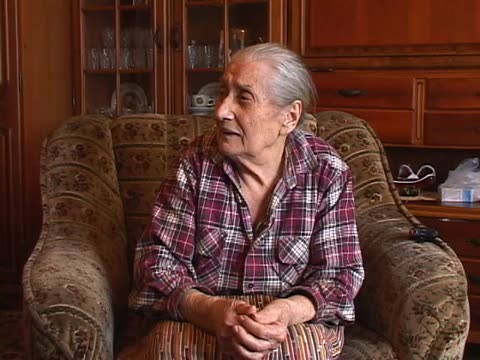
Mikhail Isaakovich Gordin

Chișinău 10 June 2006 Interviewed by Dov-Ber Kerler, Moisei Lemster 22 min · 1 part on 1 tape two sources agree
Loading the player…
  1. MDV 182 28:49–50:28 · 22 min · archive.org · a part of the tape
Passages

28:49

The formal interview with Gordin begins. He talks about his family, as well as prewar Purim and Passover celebrations. Gordin's two brothers made aliyah.

From the machine transcript

Gordin begins his interview. He says his mother died in 1947 and that two of his brothers went to Eretz Yisrael. A cousin and an aunt helped him, and he explains how relatives from Bălți (?) and Florești sent Purim gifts. He recalls carrying Purim gifts as a small child with his father and being given money, then Passover customs: kosher dishes, matzo latkes, potato dishes and poppy-seed latkes. Kerler asks about the name of Purim.

Adds the relatives who helped him and the Passover food customs.

32:44

Gordin provides personal information, before addressing prewar Simchat Torah celebrations. He then talks about his family.

From the machine transcript

Gordin gives his birth year, 1936, and says he was born in Florești and lived there until the war. He describes Simchat Torah lanterns made from pumpkins. His father worked as a loader on the Florești railway and his mother, Leike, did not work. Of five children three survived. Both parents came from Kisnitsa in Yampil raion and moved to Florești around 1919–20, where his mother's sister lived.

Adds Gordin's birth year, his parents' names and origins, and the Simchat Torah lanterns.

36:39

Gordin speaks about his life during World War II. He also speaks about his family.

From the machine transcript

Gordin tells of the war years. In 1941 his father was drafted and the family fled to Kisnitsa to his grandparents, then on to Kryzhopil and Zabokrych. There the Germans arrived and Jews were rounded up and killed. They ended up in Myskivka (?), where a ghetto under Romanian administration held them for the rest of the war. His father worked at an oil press and later on forced labor building a bridge. Kerler asks who ran the ghetto.

Adds the flight route, the killings at Zabokrych, the ghetto at Myskivka, and his father's forced labor.

40:56

Gordin speaks about his life after the war. He states that his mother died during the Hunger of 1946/47. He graduated from school in 1955 and then joined the Red Army. Gordin studied chemistry in Vladivostok, Russia, and then Chișinău. He worked as chemical engineer at a furniture factory.

From the machine transcript

Gordin says his mother died in 1947, in the hunger years, after the family returned to Moldova. He tells of finishing school, failing to enter an institute in Leningrad, serving in the army, and studying chemistry in Vladivostok. He then returned to Chișinău and worked a year in a village before taking factory work. Kerler asks what he studied. The year he finished school is unclear in the transcript.

Adds that Jews were hard to get into the Chișinău institute; the transcript does not confirm 1955 or the furniture factory.

43:11

Gordin speaks about musical performances and daily life in the ghetto.

during the war Songs and musicGhetto MDV 182 · MCO
From the machine transcript

Asked about singing in the ghetto, Gordin recalls a Jewish musician who played for the Romanians, and says Bessarabian Jews were driven from Myskivka to Kryzhopil while his father bought them a place. He recalls ghetto life with its killings, singing and dancing, but no camp song. He names the ghetto elder, Anshl, and his two daughters, whom he married off to men from Mărculești. Kerler asks whether people prayed there.

45:52

Gordin talks about prewar religious life in Florești. He then addresses his return to Florești after the war. He was married in 1965 and raised a son, who lives in Israel. Gordin then talks about his family.

From the machine transcript

Gordin says his father prayed only on holidays, with tallit and tefillin, in the synagogue where the women sat upstairs, and that Florești had a shoykhet before and after the war. After the war the family returned to Florești and found their house wrecked. He was married in 1965 and has a son in Ashdod, who knows Hebrew and English and some Yiddish. He travelled to his grandson's bar mitzvah.

Adds his father's prayer habits, the shoykhet, his marriage, and his son and grandson in Israel.

49:12

The team concludes the formal interview with Gordin.

From the machine transcript

Kerler closes the interview with Gordin and talks about arranging the honorarium paperwork.