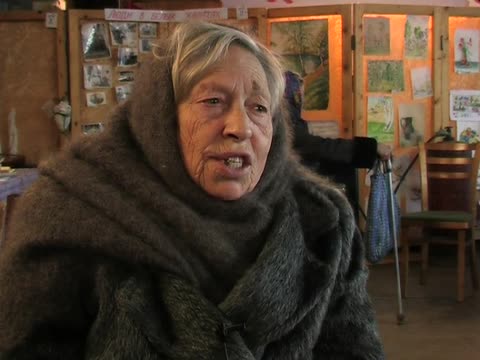
Roif, nee Reiser, talks about contemporary Jewish life. She was born 1930 in Iași. She then addresses her childhood memories and her life before the war. She describes the interactions between her father-in-law and the Ştefăneşti rebbe. He lived in America for six years and returned a wealthy man, according to Roif.
From the machine transcript
Roif talks with Katz about Jewish observance and the Ştefăneşti rebbe. She describes her father-in-law, who spent six years in America and returned wealthy, and his wife's illness. The rebbe sent his gabbai to fetch the doctor. Roif also tells of their kashrut observance and the family's deportation to a camp.
Adds the details of the in-laws' story and the observance of kashrut.
Roif provides personal information and talks about her family. Three days after her birth, she was taken in by her paternal grandfather, who lived in Duruitoarea, because her mother was physically unable to take of Roif. She then discusses her childhood memories in Duruitoarea and her family. Roif recalls the family's involvement in agricultural work.
From the machine transcript
Roif says she was born in Iași. Three days later relatives took her to her grandfather in the village of Duruitoarea, about 25 km from Rîşcani. She tells of her paralysed mother, who was sent to Iași, and of the family farm with horses, a cow and poultry. Her father's name was David (Dudl).
Roif sings a Yiddish song dedicated to wealthy people to learn about what life means. She then talks about contemporary Jewish life and charity.
From the machine transcript
Roif sings a Yiddish song about the rich and the meaning of life and giving to the poor. She then talks about Jewish life and charity today. She gives alms and lives on small pensions plus support from Germany for survivors. She gives figures for pension and prices. Katz asks how elderly Jews without that support manage.
Roif sings a Yiddish song about daily ordinary life, she heard in the ? ghetto. She also addresses life in the ? ghetto underground religious activity. The second Yiddish song, Roif learned in the ghetto, talks about violence and living conditions in the ghetto.
From the machine transcript
Roif tells how a holy book was passed on to her uncle in the camp and kept in Bălți. She then sings two songs learned in the camp: one of longing for home, the other about a hungry child who steals bread. She says the songs come from camp life and that she has forgotten others.
Roif talks about her life during the war. She explains how her family was first imprisoned in a ghetto near Rîşcani for three months, then Mărculeşti for two weeks, before being forced to march to the Cosăuţi woods, where the prisoners were supposed to cross the Dniester River over to Transnistria. Roif recalls mass shootings in the woods. Roif then describes the crossover to Transnistria and her family's fate during the war.
From the machine transcript
Roif describes the deportation. The family was held near Rîşcani for three months, then in Mărculeşti for about two weeks. They were driven to the Cosăuţi woods before crossing the Dniester. Her paralysed mother was carried on a cart. She died in the first kolkhoz in Transnistria. Roif also tells of an aunt and her children who died, and the Red Cross.