People › Iosif Kunovich Burg › conversation

Iosif Kunovich Burg

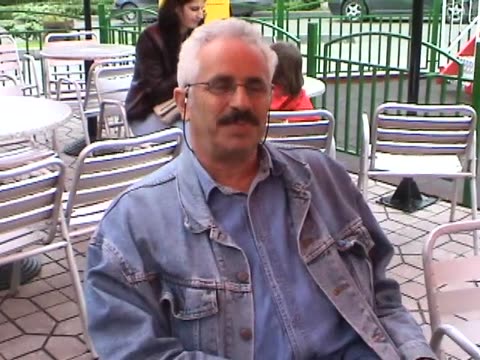
Chernivtsi 29 May 2006 Interviewed by Dov-Ber Kerler, Jeffrey Veidlinger, Moisei Lemster 40 min · 1 part on 1 tape proposed
Loading the player…
  1. MDV 232 19:37–59:12 · 40 min · archive.org · a part of the tape
Passages

19:37

The team arrives at Iosif Kunovich Burg's apartment and set up the interview with him. The team informally chats with Burg (see MDV 405, 406, 408, 414, 419 in Chernivtsi collection).

Informal MDV 232 · MCO
From the machine transcript

The team arrives at Burg's apartment and sets up. There is informal chat about a woman who speaks good but somewhat literary Yiddish and about names. A Russian aside mentions an earlier visit to Shiryov (?) in December. Burg then offers to talk and says he did not need to exert himself the day before.

21:35

Burg talks about his work and recent publications in Italy and Germany. He speaks about a contemporary ceremony honoring Burg's work, which took place in Chernivtsi .

From the machine transcript

Burg talks about his recent publications: eight books have already appeared in Germany and a book in Italy, in Florence. He describes the previous day's presentation of two new books in Chernivtsi, attended by local notables, the governor's representatives, the mayor and the Romanian consul general. Speeches were in Ukrainian, Russian, German, Romanian and Yiddish, with Shaye Kleiman a rare Yiddish speaker present. A guest from the Austrian national library's literature archive also visited. Burg was carried down the stairs and was exhausted and ill afterwards.

The speakers and languages at the ceremony, the guest from the Austrian archive and Burg's exhaustion afterwards.

32:52

Burg mentions an anecdote, he included in his speech at the ceremony. He then speaks about contemporary interest in his work.

From the machine transcript

Burg retells the anecdote he told at the ceremony, about a Jew who found a purse full of money on the Sabbath and prayed. A miracle made it Thursday around him while it remained Sabbath where he stood. He used it to ask the audience to keep the event short. He then tells of a lonely friend who phoned him in December and died within days, and says he cannot sleep or leave the house for three years.

A friend's call and death, and Burg's own frailty.

37:36

Burg talks about his life today. His wife's name is Nina Diyomidnova Burg, nee Obelenskaia.

From the machine transcript

Burg speaks about his life today: he is very infirm and cannot read even with glasses, which he wore for many years. His wife Nina goes out and the two are alone, and their daughter lives in Germany. Asked about her family name he gives it as Abalensky (?) and the patronymic as Amidovna (?). Kleiman will read to him the booklet Kerler brought, and he has also received a piece about Moshe Hilman (?). He ends with a prayer not to be left helpless in old age.

Nina's maiden name and patronymic as the transcript hears them, and the booklet Kerler brought.

40:48

Burg tells the Joseph story from the Torah. He then answers a dialectological question.

From the machine transcript

Burg speaks about being forgotten after he is gone. He mentions a series about Joseph and says the new generation will not know about Yosef Burg, though his writing is tied to Bukovina and the Carpathians, and mentions an article about him by Mishe Lev. He complains that he can no longer walk or write. Kerler then asks about the word pares for money. Burg knows it from his father and neighbours in Vizhnitsa (?) and thinks it may be Bessarabian but does not know its origin.

Burg's reflections on his legacy and a question about the word pares, rather than a retelling of the Torah story.

44:46

Burg addresses Hasidism. In particular, he describes a charity summer project for children near Vishnitsa, organized by Eliezer Steinberg before the war. Burg recalls stories by Steinberg regarding the camp.

From the machine transcript

Kerler raises Hasidism, and Burg answers by describing a summer colony for poor children near Vizhnitsa, set up each year before the war by Eliezer Steinberg, where Burg was a boy. He tells Steinberg's legend of the Baal Shem, who came each Friday to a waterfall to bathe, and of the abyss between two mountains that closed up for him; a Ukrainian rider challenged him. He also mentions Dovbush (?), the Carpathian outlaw, and a newspaper article about a meeting.

Details of the Steinberg camp and the Baal Shem legend.

48:56

Burg explains the concept "parsha" (Weekly Torah Portion). The team then concludes the interview with Burg.

From the machine transcript

Burg considers the word parshe/parshes, which Kerler asked about. He suggests a link to the Torah portions of the Chumash and perhaps to leaves, but is unsure. He and Kerler then conclude the interview with thanks and farewells.

50:33

The camera collects footage of a house in Şofrîncani, Moldova.

Footage MDV 232 · MCO
From the machine transcript

Camera footage of a village house in Moldova, with a man guiding and commenting mostly in Russian. He shows the bedrooms, carpets and pillows from a dowry, a sofa where Lemster once slept, the kitchen with its stove, the bathroom and the ironing room. The hostess comes in and shows photographs of her late husband and grandson and offers vodka and home-grown tomatoes. The guide jokes that such tomatoes are not found in America, and Kerler and Lemster join the banter.