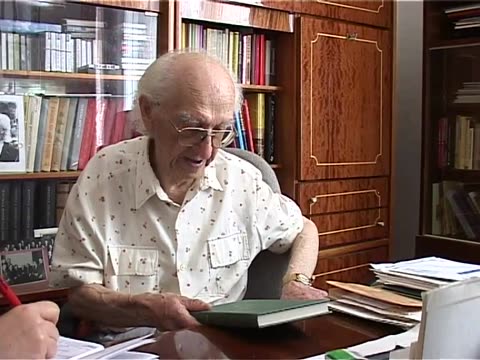
The team greets Burg outside his apartment and then sets up the formal interview with him. Burg talks about his distinctions he received from the Austrian and German government. He is also honorary citizen of Chernivtsi.
From the machine transcript
The team greets Burg and Kerler introduces the crew members, who include a Polish filmmaker. Burg and Kerler chat about the filming, and Kerler gives him a book as a gift. Burg then says he has received decorations from the Austrian government and from the German president, and mentions that he is nearly 91. They also talk briefly about a Munich professor who sends greetings, and the crew arranges lighting.
Kerler introduces the crew and gives Burg a book; they also talk about a Munich professor.
Burg talks about his home town Vyzhnytsya. According to Burg, 92% of the 6,800 inhabitants were Jewish before World War II. Burg explains contemporary efforts to memorialize prewar Jewish life of Vyzhnytsya. He then talks about contemporary and postwar Jewish life in Chernivtsi with a population of roughly 2000 today, according to Burg. After the war, Burg states approximately 93,000 Jews lived in Chernivtsi. Burg then talks about his activities, giving lectures and publications at Israeli universities in the 1990s.
From the machine transcript
Burg talks about Vyzhnytsya, where nearly all of the roughly 6,800 inhabitants were Jewish before the war. He mentions the Vyzhnytsya Hasidic dynasty and a Jewish doctor who revived a small community there. He then discusses the Jewish population of Chernivtsi before the war, after the war and today, the census figures, and the decline in emigration-era readership of the Chernivtsi newsletter. He mentions his honors as honorary citizen of Chernivtsi and as a writer, his small pension, and his lecturing and publishing in Germany and Israel. He also mentions his visits to Israel and several recent books and friends who helped with them.
Beyond Vyzhnytsya and Chernivtsi, he discusses his pension, his lectures at German universities, and his visits to Israel.
Burg shows several of his publications: “A farshpetikter ekho” (A belated echo), published in 1990; “Frayndshaft” (friendship), published in 2002; “Tsvey veltn” (Two worlds), published in 1997, “Okruchy” (Polish, crumbs). The last bilingual book ("Shedra Osyen;” lavish autumn) was published in Russian and German to honor Burg’s life and works. It includes a cover of his birth house. Burg explains that the street name was changed to honor him. He then discusses articles that have been published about him.
From the machine transcript
Burg shows and discusses several of his books, including a Polish edition and a recent volume, and a street in Vyzhnytsya that now bears his name. He mentions a collection of articles about him and press coverage in the United States, Israel, Germany and Ukraine. He also mentions the former synagogue that now houses a culture house, a New York Times article about him, and his wish to be remembered as the last Yiddish writer.
Also discusses the newspaper coverage in several countries and the New York Times article.
Burg talks about his life as a Yiddish writer and his contemporary activities in promoting Yiddish culture in schools for instance. He talks about the difficulties setting up Yiddish language classes at a Jewish school. Burg then talks about contemporary Hasidic life, before he talks about his family.
From the machine transcript
Burg describes his role as chairman of the Steinbarg Jewish cultural society and his efforts since 1990 to start a Jewish school with Yiddish teaching in Chernivtsi. He recounts how a Yiddish-language curriculum was undermined by pressure to teach Hebrew and by funding from Israel. He mentions the small attendance at weekly prayers, the Yiddish instruction in Kyiv and the Chabad school. A discussion of who counts as Jewish follows, in which Burg describes his daughter and granddaughter's status. Kerler also mentions the role of Hasidic communities in keeping Yiddish alive.
Also covers the discussion of who counts as Jewish and Burg's own daughter and granddaughter.
Burg describes one of his stories about Yiddish teaching in Germany. He then talks about his studies with Eliezer Steinberg.
From the machine transcript
Burg describes a story of his about teaching Yiddish at German universities and mentions a Hamburg scholar who studied with Kerler. He also mentions donations that helped publish a book. He then recalls Eliezer Steinbarg, whose colonies he attended as a child, and recounts writing a poem for him and his advice on being a writer. He says that after the war Chernivtsi still had twelve Yiddish writers.
Besides his studies with Steinbarg, he talks about a Hamburg scholar and donations for his book.
Burg addresses Jewish intellectual life in postwar Chernivtsi. Burg lived in Russia during the war and returned to Chernivtsi in 1963. According to Burg, twelve Yiddish writers lived there. He remembers several encounters with the Yiddish poet Yoysef Kerler. Burg taught at the Ivanovo State Pedagogical Institute, after he finished his graduate studies of West-European literature in Moscow in 1947. Burg studied with Yitskhok Nusinov. Burg briefly discusses Nusinov’s works, before he mentions the encounters with Yiddish writers, such as Perets Markish, Itsik Fefer, and Dovid Bergelson. Burg then discusses recent Yiddish publications and talks remembers an episodes regarding Fefer, who came from a prison in Crimea, and attended ? 58:53’s show in Moscow in 1948.
From the machine transcript
Burg addresses Jewish writers in postwar Chernivtsi and his own return from Russia, where he had spent the war. He recalls attending the funeral of Mikhoels in Moscow, the anti-Jewish campaign of 1948 and his graduate studies in Moscow. He worked at a pedagogical institute and studied with Nusinov. He mentions Moscow Yiddish writers he knew, including Markish, Bergelson and Fefer, and discusses a few present-day Yiddish writers. He ends with an account of Fefer being brought from prison to meet Paul Robeson in Moscow and not telling him what had happened.
Adds his studies in Moscow, Nusinov, the 1948 campaign and present-day Yiddish writers such as those in Odesa.
Burg talks the destruction of Yiddish cultural and intellectual life by Hitler and Stalin. He also addresses how Israel did not encourage the continuation of Yiddish cultural life. Burg recites a Hebrew poet about Yiddish culture. Burg then broadly discusses the history of Jews and contemporary Yiddish life, including an event in Berlin, commemorating the liberation of Auschwitz. He also talks about the encounter with the German author and correspondent for the Frankfurter Allgemeine Zeitung Michael Martens, who published a book about Burg called “Irrfahrten: Ein Ostjudisches Leben” (odysseys: an east-Jewish life).
From the machine transcript
Burg reflects on the fate of Yiddish culture. He names Hitler and Stalin as destroyers of Yiddish writers and culture, and the State of Israel as sharing the blame for weakening Yiddish. He lists great Yiddish poets and writers such as Leivick, Manger and Halpern. He notes that Hasidim in Israel still speak Yiddish, and that younger people elsewhere do not. He recounts a Berlin evening commemorating the liberation of Auschwitz and speaking Yiddish there, and receiving letters from Germany about Yiddish study. He tells how the German journalist Michael Martens (Frankfurt) visited him in Chernivtsi and Vyzhnytsia and wrote a small book about him; Kerler remarks on the German interest in Yiddish.
The transcript also shows the Israeli Hebrew-poet recitation as an unnamed Jerusalem poet whose name Burg cannot recall, and his Bnei Brak anecdote.
Burg talks about prewar Jewish life in Chernivtsi, which was divided between the assimilated German-speaking Jews and Yiddish-speaking Jews. Burg states that the Yiddish-speaking population was divided between Litvish and Bessarabian Yiddish.
From the machine transcript
Burg describes prewar Chernivtsi. Its Jews were largely assimilated, with the German of Berlin and Vienna as their language, alongside a Jewish quarter where only Yiddish was spoken. He characterizes the Czernowitz Yiddish as close to Western European Yiddish, unlike Galician or Bessarabian Yiddish, and says almost no native speaker of it can be found today. He mentions a Bessarabian Yiddish speaker living in Chernivtsi, and Kerler talks about the varieties of Yiddish he has had to speak. The passage opens with a bit of chat about drinking.
The transcript shows an opening bit of informal talk and Burg's discussion of today's speakers of the Chernivtsi dialect.
Burg provides information about his family, as well as personal information. He then shows the distinctions (Cross of the Order of Merit – Verdienstkreuz) he received from the Austrian and German government. He then shows the distinction he received from the Ukrainian Jewish Congress.
From the machine transcript
Burg gives his parents' names and the name of his grandfather, which he gives with a double name, as called to the Torah. He says he was born in Vyzhnytsia in 1912, and Kerler notes the date of this first interview in Chernivtsi (16 May 2003). Burg then shows his decorations: the Austrian and German orders presented by ambassadors, the Cross of Merit, and a Star of David medal from the Ukrainian Jewish Congress. Certificates and the languages they are written in (German, Russian, Ukrainian) are discussed, and Kerler asks if he could travel to Vyzhnytsia.
The transcript also shows the discussion of his grandfather's name as called to the Torah and the interviewer's invitation to travel to Vyzhnytsia.
Burg talks about different kinds of Yiddish from his childhood and prewar Yiddish culture. He remembers the theater group Vilna Troupe, who brought in a different Yiddish dialect to Chernivtsi.
From the machine transcript
Burg talks about the Yiddish of his childhood home: his family said tate and mame. He describes the Bukovinian dialect as modelled on the German of Vienna and Berlin, unlike that of the Bessarabian Jews who settled in Chernivtsi. He says the Lithuanian-style stage Yiddish came with the Vilna Troupe, which often visited in the 1930s. Kerler asks whether their speech was actually Litvish, and Burg says it was closer to Galician speech, but with a different sound.
The transcript also shows a comparison of Litvish, Galician and Bukovinian speech and Burg's first contacts in Vienna beginning at the end.
Burg talks about his travels to Vienna in 1935, where he met with the Yiddish writer circle. He talks about Yiddish writers, such as Mendl Naygreshl, Itzhak Turkov, Melech Ravitch, and Melech Khmilnitski*. Burg saw Hitler shortly before Austria was annexed by Nazi Germany in 1938. Burg was taken along with fellow Jews from Vienna for forced labor at military barracks in the suburbs of Vienna. Burg was released after he talked to the person in charge of the camp, showing his Romanian passport. He drove back to Vienna in a car with SS officers. Burg tells stories about the persecution of Viennese Jews during the German occupation.
From the machine transcript
Burg recalls Vienna in 1937, shortly before the Anschluss. He met a circle of Yiddish writers there, including Abraham Fuchs, Mendl Neugroschl, and Turkow, and speaks about Neugroschl's wealthy family and his son in America. He heard Hitler and Goering speak. He describes being seized in the street and taken in a truck with other Jews to barracks outside Vienna for forced labor. He was released after speaking German and showing his Romanian passport, and was driven back to Vienna by SS men. He tells an anecdote of a Galician Jew waiting at a tram stop, and shows a photograph of the writers in Vienna, naming others.
The transcript also shows the Neugroschl family, the Turkow brothers and the identification of writers in a photograph.
Burg talks about his family and childhood memories. His father worked on a float transporting people across the Cheremosh River 52:38. Burg’s mother gave birth to five children. He grew up with Chaye, who was murdered along with their mother during the war and Binyomen, who volunteered for the Spanish Civil War and died in battle. After his bar mitzvah, encouraged by his father, Burg moved out of his parent’s house to earn his own money in Chernivtsi. He rented a room at a poor tailor’s house and studied at a school. He was supported by his well-off uncle Max. Burg then studied at the Jewish teacher’s seminary with Eliezer Steinberg to become a teacher. After graduation, Burg worked as a private tutor. He then talks about the publication of his first story in the “Czernovitzer bleter” in 1934.
From the machine transcript
Burg tells of his family and early life. His father was a raftsman on the Cheremosh, and his book 'Oyfn Cheremosh' draws on this. Burg's maternal grandfather lived long ago; Burg was Yosef Mordkhe until the Soviet period and Yosele at home. His mother bore five children, two died, and his brother Binyamin was killed in Spain and his sister Chaye died with the mother in the war. At thirteen he left home, lodged with a poor tailor in Chernivtsi, and was helped by his rich uncle Max. He then attended Eliezer Steinberg's Jewish teachers' seminary and gave private lessons. He mentions the editor Shmuel Abba Soifer and the 1934 publication of his first story.
Burg talks about the rebbe of Vyzhnytsya, Menachem Mendel Hager. He describes how locals built a soccer field onto the Jewish cemetery. He then talks about his family’s life during World War I. Two of his aunts were beheaded by a mounted soldier. He then talks about the Soviet period, when the oldest Jewish cemetery was desecrated and destroyed to use the material for Soviet monuments. Burg continues talking about the liberal life under Austro-Hungarian rule before WWI, before he talks about contemporary antisemitic press. Burg maintains that the tolerance, experienced under Austro-Hungarian rule, persists until today.
From the machine transcript
Burg speaks about the graves of three generations of the Vyzhnytsya rebbe's dynasty in the cemetery. He describes how the old Jewish cemetery was turned into a sports ground and the gravestones reused for Soviet monuments. He recalls the First World War, when Cossacks killed two of his aunts in Vyzhnytsya; a Ukrainian carpenter buried them and a gravestone was later set up. He then speaks of Austrian-era tolerance in Bukovina, which in his view persists in Chernivtsi today, contrasted with antisemitic newspapers in Galicia and with Romanian rule between the wars.
Adds the family of the aunts, an uncle's rescue of the narrator, and a comparison with Galicia and Romania.
Burg talks about life under Soviet rule, which began in 1940, as well as the persecution of Jews.
From the machine transcript
Burg talks about the arrival of Soviet rule in 1940, which Jews welcomed as a protection against the Nazis. Persecution soon followed, and the wealthy, politicians and Zionists were deported. He recalls a night in June when half of Vyzhnytsya was taken away in trucks and many never returned. Kerler then asks him to read one of his stories.
Adds the night-time deportation in Vyzhnytsya and Kerler's request to read a story.
Burg reads one of his story “Akeydes yitskhok” (The Story of Isaac), which deals with his childhood.
From the machine transcript
Burg reads aloud his own Yiddish story about the binding of Isaac, which draws on his childhood. It describes his birth on a Friday evening in May, his mother's songs, his father's tales and the cheder teacher who vividly retold the Torah. It ends with the Holocaust, in which many Isaacs were killed in gas chambers. Kerler thanks him afterwards.
Burg discusses his childhood memories in his hometown Vyzhnytsya, including Hasidic family of Hager. He mentions an episode of the local priest and the Rebbe of Vyzhnytsya, who showed mutual respect for each other. According to Burg, the rebbe carried a cross on his shoulders to help the priest. Burg remembers non-Jews, their neighbors, who spoke Yiddish. He then talks about his encounter with the rebbe of Vyzhnytsya. His mother went with Burg when he was ten years old, so he can be blessed. Burg explains that that rebbe did not bless because, according to him, Burg was already blessed.
From the machine transcript
Burg returns to childhood Vyzhnytsya and the Hager rebbes, naming Rebbe Israel as the fourth in the line, whose annual visits were festive occasions with torchlight processions. He tells of the local priest and the rebbe, whose mutual respect is shown by the priest throwing a cross aside to greet him. He gives the town's population and says Yiddish was the language of the town, even of Christian neighbours. He recalls his mother taking him to the rebbe for a blessing at about ten or eleven, when the rebbe said he was already blessed.
Adds Rebbe Israel as the fourth in the line, the population figures and the torchlight welcome.
Burg recites part of the Torah (chumash), before he talks about his bar mitzvah Torah portion (parshah), as well recites it. He then talks about religious life today.
From the machine transcript
Burg speaks about his memory of the weekly Torah portions and his bar mitzvah haftarah, then recounts the Jacob and Rachel passage he was told to review. He calls it poetry, history and Zionism together, and defends cheder education as the source of Yiddish writers. He answers Kerler's questions about cheder and yeshiva in Vyzhnytsya, whether he was called a heretic, and his religious practice today. He describes Sabbath in Vyzhnytsya, including his father's pipe, and compares the town's moderate Hasidim with Hungarian ones, with a remark on Yom Kippur in Chernivtsi.
Burg talks about his religious education, when he attended religious school (cheder) for seven years. Burg attended a Romanian school, before cheder every day. He then attended the Vyzhnytsya yeshiva. He then talks about Jewish life in prewar Vyzhnytsya and childhood memories of his grandfather. According to Burg, the majority of Jews were Hasidic. He recalls an episode about a Jewish barber who received non-Jewish customers on Sabbath. He covered the windows and locked the door in fear of rebuke from the Hasidic community. However, Burg stresses that the Hasidic community were moderate in his hometown. Burg remembers the time when his father told him stories about the Baal Shem Tov, when his family sat around the fire during the winter.
From the machine transcript
Kerler asks about Hasidic Jews in Vyzhnytsya, and Burg describes men with sidelocks and the knaplekh (?) Hasidim of Hungary. He says he knows of other Hasidic centres only in a limited way. He remembers his father telling stories about the Baal Shem Tov, and winter nights by the fire by the river in a poor household.
Adds the question about which Hasidic centres were known; the barber episode is not clearly present in this stretch.
Burg discusses food customs and holiday customs, such as Tisha B’Av and Passover. Berg then recites the beginning of the Four Questions on Passover.
From the machine transcript
Burg answers Kerler's questions about holiday foods: potato cheese-pancakes (kayzlekh) for Passover and latkes for Hanukkah, with the word barbolyes (?) for potatoes and tatshn baked potato dishes. He discusses Shavuot greenery, Tisha B'Av customs, reading the Song of Songs on Passover and the haggadah at home. He recites part of the Four Questions in Hebrew and Yiddish. Kerler also asks how long he attended cheder.
Burg talks about his and Jewish life in general in prewar Chernivtsi. His family moved from Vyzhnytsya to the city when he was twelve years old. His father continued in his profession and traveled to Vyzhnytsya every day. He passed away at 38. According to Burg, there were 76 prayer houses in Chernivtsi.
From the machine transcript
Burg tells how the family moved from Vyzhnytsya to Chernivtsi when he was about twelve. His father, a timber trader, continued traveling to Vyzhnytsya and lodged them in a tenement room, and died in 1938; the mother stayed on for two years until the Soviets came. He says Chernivtsi had seventy-six prayer houses before the war, and discusses the synagogues near where they lived.
Adds the father's timber trade and the mother's two further years in Chernivtsi.
Burg discusses prewar Jewish life in Chernivtsi. He then talks about his travels to Zurich, Switzerland, when he spent time at a reform community there. He recounts the differences in religious service. Burg then discusses the modernization of Jewish life during the Enlightenment period.
From the machine transcript
Burg discusses assimilated Jewish intelligentsia in prewar Chernivtsi and the progressive Temple, now a cinema-theater. He describes a visit to a liberal (Reform) congregation in Zurich, where he was invited to give a lecture. He describes the service there, with prayer in German, a young cantor and mixed seating, and his disagreement with the rabbi, who is the son of a poet (the name is unclear in the transcript). He then turns to Moses Mendelssohn and the German Haskalah, and to his grave, memorial and sculpture.
Adds the Zurich Reform service and the rabbi's views, and the talk about Mendelssohn's grave and statue.
Burg mentions his schooling at a Romanian school in Chernivtsi, as well as his cheder education with the teacher (melamed) Shloyme Hersh. From his childhood, Burg recalls different stories told by Eliezer Steinberg, with whom Burg studied at the Teacher’s Seminary.
From the machine transcript
Burg recalls attending a Romanian state school until age thirteen and the cheder in Vyzhnytsya in the afternoon and evening. He names the melamed Shloyme Hersh and describes his discipline. He then recalls Eliezer Steinberg's children's stories and summer colony, and retells a tale about the Baal Shem Tov meeting a Hutsul leader in the Carpathians. The passage ends with a brief aside about women wearing bracelets.
Adds the Baal Shem Tov legend told by Steinberg and Burg's Romanian-language schooling, which the catalogue mentions only briefly.
Burg briefly talks about prewar Jewish life in Vyzhnytsya and discusses the connotation of “geyen in bod arayn.” He then talks about Eliezer Steinberg and the stories Burg remembers him telling. Burg then discusses his young adult life. He was a member of the youth organization Hashomer Hatzair. He then joined the “Yiddisher Shulfarayn” (Yiddish School Union), headed by Steinberg. He recalls various Yiddish writers, such as Itzik Manger, Shloyme Bikl, and Moyshe Altman, who would attend evening events. He then talks about contemporary academic events in Chernivtsi, before Burg discusses prewar Yiddish culture and theater, as well as cultural events organized by the Yiddish School Union. In particular, Burg talks about the second Czernowitz Yiddish conference, held in 1928, and publication of the Czernowitzer Bleter. The publication was closed down in 1938. Burg remembers the well-attended funeral of Eliezer Steinberg in 1932.
From the machine transcript
Burg discusses the bathhouse and mikveh in Vyzhnytsya and the expression about being led into the bathhouse ("geyen in bod arayn"). He retells animal stories attributed to Eliezer Steinberg, including a sailor and a lioness, and describes Steinberg's fables and children's books. He talks about his own youth: Hashomer Hatzair, the Yiddish School Union, and evenings with writers and artists such as Itzik Manger and Shloyme Bikl. He discusses the Czernowitz language conference, with an exchange with Kerler about a commemorative conference planned for the hundredth anniversary, as well as the Yiddish theater and the Bund. He also describes the Czernowitzer Bleter of the 1930s and the writers who published in it, and the death and funeral of Steinberg in 1932.
Adds Burg's folk-etymology of the bathhouse expression, the animal tale told by Steinberg, and the talk about the planned centenary conference.
Burg talks about Yiddish culture after Perestroika and the founding of the “Yidishe kultkurgezelshaft Eliezer Steinberg” (Yiddish Cultural Association), which republished the Czernowitzer Bleter based on the prewar format, upon Burg’s initiative. Burg remembers that during Stalin’s terror after the war and the persecution of Jewish intellectuals, Jewish cultural activists burned any traces of Yiddish press, especially the entire Czernowitzer Bleter. Burg then shows a copy of the contemporary Czernowitzer Bleter.
From the machine transcript
Burg explains how, after perestroika, the Yiddish cultural society named for Eliezer Steinberg was founded and the Czernowitzer Bleter revived in the old format. He recounts that the prewar run could not be found in the Chernivtsi archive because Yiddish papers had been burned after the war during the anti-cosmopolitan campaign, and that a photocopy came from Bucharest. He shows the current issue, with pages in Yiddish and in Russian/Ukrainian, speaks of funding from the Joint, and says he has given his archive to Vienna.
Adds the funding by the Joint, the transfer of his archive to Vienna, and the format change to a bilingual paper.
Burg talks about his career and recognition as Yiddish writer, inspired and professionalized during the “zumer kolone” (summer camp) ran by Eliezer Steinberg.
From the machine transcript
Burg recalls how he began to write, going back to Steinberg's summer colony, and the discouraging response to his first poem. He printed his first story in the Czernowitzer Bleter at age twenty-two, in 1934, and he names the years of his published books. He also talks about reviews and recognition, including a German newspaper article and a Yiddish paper in New York, disagreements with a journalist, and an Austrian medal.
Adds Burg's account of his reception and awards, including a disputed article and an Austrian medal.
Burg talks about his life as a Yiddish writer after the war, during Soviet rule. He lived in Chelyabinsk, Russia during evacuation. According to him, he did not have many opportunities to get his work published. Burg came to Moscow in 1945 to talk to the editor of Eynikayt, who encouraged him to write for the newspaper. Burg was not allowed to return to Chernivtsi and sent to study at the Ivanovo State Pedagogical Institute instead. Burg then talks about his studies at the institute, whose director was Levin. Burg met Dovid Hofshteyn, who published a children’s book together with Ful beShames* at the Russian center, which was part of the institute.
From the machine transcript
Prompted by Kerler to discuss the Soviet period, Burg says he came to the Soviet Union already a writer. In evacuation in Chelyabinsk he wrote an article on Jews in industry, which he sent to Eynikayt, and he met its editor in Moscow in 1945. He learned from a reply that his mother and sister had been deported to Vinnytsia oblast and shot, so he did not return to Chernivtsi; he was sent to the pedagogical institute in Ivanovo, where Levin was prorector and he befriended a docent connected to Dovid Hofshteyn.
Adds the fate of Burg's mother and sister, the Romanian emigration option, and that he did not return to Chernivtsi.
Burg recalls his encounters with Ful beShames*, who taught medieval Russian literature. Burg tells a story how Shames invited him to hear a Russian-speaking woman Nina recite a poem by Shmuel Halkin in Yiddish. She later was to become Burg’s wife. He then talks about his first time leaving the Soviet Union in 1989, traveling to Austria. He was invited by the Austrian ministry for culture. Burg then talks about his wife, who studied with Shames and then worked as a teacher. Burg taught his wife Yiddish.
From the machine transcript
After a brief exchange on addresses and contacts, Burg recalls Shames (Ful beShames), a docent of old Russian literature in Ivanovo who loved Yiddish. Shames invited him to hear a Russian-speaking student read a Yiddish poem by Halkin; she became his wife Nina. Burg describes her Obolensky family background and her father, a former tsarist officer who became a peasant after the revolution and later an accountant at a textile factory. He recounts his first trip abroad, to Austria in 1989, where he met an émigré count at a dinner and the family's Russian aristocratic connection became apparent. He says his wife was a teacher, studied with Shames, and learned Yiddish from him.
Adds Nina's family background (Obolensky) and the dinner in Austria with an émigré count.
Burg returns to talking about his work during the Soviet period. After he graduated from the Ivanovo State Pedagogical Institute Burg in 1947, he received a working assignment to teach at the Pyatigorsk institute for four years. He then moved to the Stalingrad region to work as a teacher for another four years. He taught German literature and his wife Russian literature. He then returned to Chernivtsi. Burg then talks about his reputation as a Yiddish writer.
From the machine transcript
Burg recalls leaving Ivanovo when it became dangerous and going to Moscow, then taking a posting at the Pyatigorsk institute in the Caucasus for about four years. He then spent four years in a Cossack village in the Stalingrad region, he teaching German and his wife Russian literature, before returning to Chernivtsi, where a daughter was born. He speaks of his standing as an honored figure and writer in Chernivtsi, his vice-presidency of the Israel–Ukraine association, his readings in German-speaking countries and elsewhere, and the tourists who now visit him. Kerler then asks which writers influenced him most.
Adds his home and daughter in Germany, current honors and income from tourists.
Burg explains how Russian and Yiddish writers influenced him intellectually. He then talks about his encounter with Israeli, Austrian, and German ambassadors. Burg remembers the encounter with Yosef Burg in Zurich, Switzerland; and talks about other meeting with Jewish intellectuals. He then talks about his family, in particular his parents. His mother was born in Lăpușna, Moldova.
From the machine transcript
Burg names the Russian prose writers (Bunin, Paustovsky) and Yiddish writers (Peretz) who influenced him and recalls his father calling Yiddish a golden language. He describes greeting the ambassadors at his jubilee, his meetings with Dr Yosef Burg of Jerusalem in Vienna and Zurich, and the confusion between the two Yosef Burgs. He discusses growing up with four languages. Then he talks about his parents: his father, who read German and Yiddish and died in 1938, and his mother, from a Carpathian village, who could not read. Burg adds an account of saying Kaddish and praying before the amud in Chelyabinsk during the war.
Adds the father's death and Kaddish in Chelyabinsk, plus language upbringing and the Vyzhnytsia anecdotes.
Burg briefly recites prayers. He then answers a number of dialectological questions from the AHEYM Yiddish questionnaire. He also discusses prewar political Jewish life and family.
From the machine transcript
Burg answers dialectological questions from Kerler, about words for 'back' and 'ten people at the table' and the use of terms for Hebrew and the holy tongue. He answers that Bund and Zionists in Chernivtsi were not hostile and that much of the Jewish youth was communist; his brother fell in Spain. They look at a photograph of his daughter and discuss his granddaughter, who writes in Russian. Kerler then asks him to read another short story.
Adds the exchange about Bund and Zionists and the photograph of his daughter and granddaughter.
Burg reads his story “Eykho.”
From the machine transcript
Burg reads aloud his own short Yiddish story "Eykho", about a train journey on which the narrator meets a Warsaw ghetto survivor who fought as a partisan. The reading turns to memories of the Warsaw ghetto uprising on the first day of Passover.
The camera films paintings and photograph in Burg’s apartment and the team concludes the official interview.
From the machine transcript
The team closes the interview with talk in Burg's apartment, with the camera on paintings and photographs. Burg mentions the conference building and the Jewish house in Chernivtsi, gives directions for finding the house near the theater, and Kerler thanks him and speaks of his plans. Russian and Yiddish talk between the others follows about travel in the coming months.