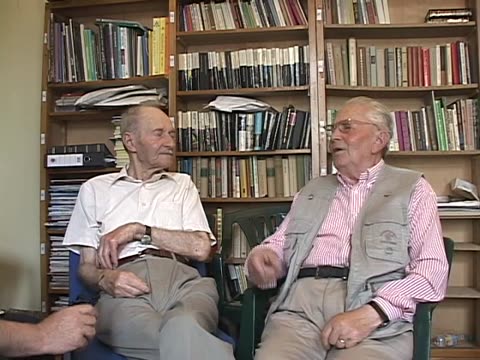
Kraus and Grunfeld speak about life today and geography, as well as Yiddish dialects. Grunfeld then shares a joke about Litvaks, he heard from his grandfather.
From the machine transcript
The two interviewees and Kerler talk about a trip and a restaurant, then about regional names (Moldavia, Transylvania, Regat) and how Yiddish differs from region to region. Kerler asks about Lithuanian Yiddish. Grunfeld tells a joke he heard from his grandfather about Lithuanian Jews misunderstanding a word for herring, and mentions Podolia and Bessarabia.
Also covers a trip and restaurant, and regional names such as Moldavia and the Regat.
Grunfeld speaks about his life during World War II as forced laborer on the Tighina stronghold.
From the machine transcript
Grunfeld says he served as a Jewish forced laborer (the Romanian term is mentioned) near the Dniester and at Tighina/Bender. They dug trenches and set up munitions. He searches for the Yiddish word for a fortress. The passage ends with chatter about camera light.
Grunfeld addresses prewar Jewish life in Gheorghe Gheorghiu-Dej, Cluj-Napoca and Oradea.
From the machine transcript
Grunfeld describes Jewish life in the area before and just after the Second World War, with some thousands of Jews in Dej (name unclear in the transcript), a yeshiva, and a comparison with Cluj and Oradea. He says Oradea was about a third Jewish, and mentions Satu Mare. Kerler then asks what he heard about Jews while at Bender.
Also mentions a yeshiva headed by a rabbi and other towns.
Grunfeld speaks about his life during World War II as forced laborer at the Tighina (Bender) fortress in 1943 and 1944. He recalls soldiers arriving at the local military base.
From the machine transcript
Grunfeld describes the work at the Tighina fortress in 1943–44. His group delousing and disinfecting the clothes of soldiers returning from the front, in a sanitary checkpoint at the border. He says there were no problems with the soldiers and that the physical labor was heavy.
Details the disinfection work on soldiers' clothes.
Kraus talks about his life during World War II. He explains that he was a student at the Cîmpia Turzii (Yiddish: Deyresh) yeshiva in 1940 and was subsequently forced to work in Transnistria and Ukraine. Among other places, Kraus worked at a quarry. In particular, he recalls forced assemblies and killings in 1940.
From the machine transcript
Kraus recounts that he studied at the yeshiva in Cîmpia Turzii in 1940, at age 17. He recalls the Iron Guardists' violence against Jews that winter, with the rabbi and young men forced outside into the snow, and many Jews killed. Kerler asks about the Guardists and Transnistria. The other speaker explains the Guard and the Cuzists.
Includes explanation of the Iron Guard and the Cuzists.
Grunfeld and Kraus address Romanian war politics and the politics of the head of the Jewish community.
From the machine transcript
They discuss the Iron Guard and Cuzists, the Guard's January rebellion in Bucharest crushed by Antonescu, and Antonescu's refusal to deport Romanian Jews. One speaker claims a rich Jewish leader who had been his university colleague intervened. Kerler comments that Jews were useful as workers.
Kraus speaks about his forced labor at a quarry from 1940 until 1944. They then address the pogrom in Iași, before Kraus shows a Soviet membership book, issued in 1945.
From the machine transcript
Kraus describes forced labor at a quarry and on railway work near Iași toward the Soviet border. Kerler asks about the Iași pogrom and the outbreak of war in June 1941. Kraus shows his Soviet-era membership booklet of 1945 and says he was in Cîmpia Turzii when the war began.
Includes the Soviet booklet shown by Kraus.
Kraus and Grunfeld address the forced assemblies of Jewish communities in Cîmpia Turzii and surrounding villages, who were then deported to the Turda ghetto via Luduș.
From the machine transcript
The speakers describe how Jews from Cîmpia Turzii and surrounding villages were taken out of the villages, moved to Luduș and then to Turda in the ghetto. Grunfeld says his grandparents came from a village (Zalău (?)) and that there were twenty prayer shawls in its congregation. Kerler asks the Yiddish form of the village name.
Includes a village's Jewish congregation and its Yiddish name.
Grunfeld again tells the joke about Yiddish dialects.
From the machine transcript
Grunfeld retells the joke about Lithuanian Jews who misunderstand each other's dialect, with the word for herring taken as a plague. A friend's wife's grandfather told it, speaking with his grandfather in the synagogue. Kerler recalls it was already told earlier and that his colleague Ildi is interested in dialects.
Kraus shares an episode about fellow Jews from his life during the war.
From the machine transcript
Two speakers discuss Lithuanian Jews and Bessarabian Jews, including Jews working in Bessarabia who met bearded men and asked about a minyan. They discuss a term for these people (Lipovans?). Kerler then asks about a song one of them sang.
Uncertain what episode is narrated; mentions Lipovans (?).
Kraus sings a Yiddish song about marriage. They then address Purim shpiels and celebrations berfor the war. Grunfeld explains how he dressed up as a Christian during Purim.
From the machine transcript
Kerler asks Kraus to recall a song; fragments of a dialogue song about marriage follow. They discuss Purim before the war: sending shalekhmones between families, a competition over baking, and the Purim play. Grunfeld says he dressed as a Romanian peasant and visited the school director, and they discuss Yiddish among the village Jews.
Includes a song fragment about marriage.
Grunfeld speaks about his family and his education. He attended a Romanian school. They then address geography.
From the machine transcript
Grunfeld speaks about his schooling and family: born in 1920 and attended a Romanian school, while his father (born 1892 (?)) attended a Hungarian one. He describes the mixed languages of Transylvanian Jews (Yiddish, Romanian, Hungarian) and compares them with Moldavia. They discuss why it is called Siebenbürgen, with its seven fortresses.
Includes the origin of the name Transylvania/Siebenbürgen.
Grunfeld talks about his life during World War II as forced laborer. He describes how he was taken from the fortress to the city of Tighina in 1943. In particular, he recalls a Romanian police officer who spoke Yiddish.
From the machine transcript
Grunfeld describes being moved in 1943 from the fortress to the town of Tighina, where a Romanian policeman from Bessarabia spoke Yiddish to them. Kerler and the speakers discuss Bessarabian Yiddish and the towns of Soroca and Orhei. They add that Jews there spoke Yiddish widely, and a child's contact with Jewish Sabbath customs.
Includes Bessarabian Yiddish and Soroca/Orhei.
Kraus and Grunfeld speak about Jewish life before the war, in particular Sabbath celebrations. Grunfeld then addresses dialectology.
From the machine transcript
They talk about the Sabbath goy who lit the stove for religious families. Grunfeld recalls a story told by his grandfather about a visitor and exile. Kerler asks about the meanings of 'erlekh' versus 'frum', words for gypsies and Roma, and the term for lacking money.
Includes elicited word meanings, with terms for Roma.
Kraus and Grunfeld address Passover celebrations. Grunfeld then speaks about his bar mitzvah and the morning prayer "moyde ani."
From the machine transcript
Kerler asks about Passover customs and eating bread-like foods; the speakers say strict families avoided them. Grunfeld recalls his bar mitzvah, when his grandfather addressed him by his Yiddish name, Jewish-gentile classmates teasing, and the morning prayer. They discuss the minyan and the number of boys required.
Includes the Modeh ani prayer, for which Grunfeld says he was reported to his father.
Kraus recites a wedding prayer. They then talk about prewar Jewish life and answer questions about cultural terminology.
From the machine transcript
Kraus recites a wedding blessing. They reflect on their age and the Yiddish books in the community library. Kerler then asks the meaning of sayings such as 'zog a gut vort', 'a gut ort', 'a guter yid' and 'a guter bruder'.
Includes the sayings with gut and the Yiddish books in the library.
Kraus sings a Sabbath song (zemira). Grunfeld then recalls what his grandfather would sing on Sabbath. They then speak about religious life in the 1980s and 90s.
From the machine transcript
Kerler asks about Sabbath songs (zemires); Grunfeld recalls his grandfather at the Friday-evening table and singing Eshes Khayil and Sholem Aleykhem. They then discuss matchmaking and an observant man who ate only kosher food, died in Cluj, and was buried in Israel. They also describe religious life since the 1980s–90s.
Includes the matchmaking and the story of a man buried in Israel.
Grunfeld talks about the building of the community and prewar Jewish life, including community structures.
From the machine transcript
Grunfeld describes where most Jews lived in Cluj, central streets and quarters, including a street with two synagogues, and a street named for a mill held by a Jewish miller. He speaks of Ashkenazi, Sephardic and Hasidic prayer customs, the Chatam Sofer, and which languages families spoke at home, Yiddish, Hungarian and Romanian. Kraus adds that Hungarian and Romanian were both used.
also covers Ashkenazi/Sephardic customs and home languages, with Kerler's questions on the Jewish quarters