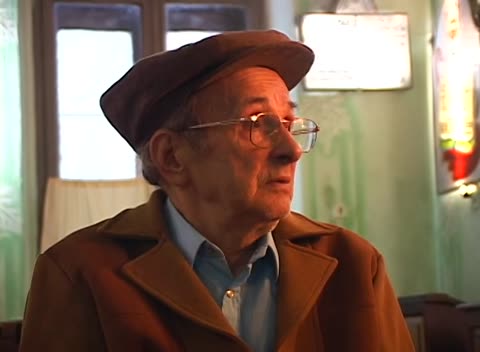
The team meets with Iancu Isidor and they chat informally.
From the machine transcript
The team meets Isidor and chats informally. They discuss distances and the route onward, staying the night, and a man in Cluj named Miller who speaks Yiddish and could be contacted.
Adds the Cluj contact.
Isidor speaks about his family and contemporary Jewish life. He then talks about his Romanian school teacher.
From the machine transcript
The talk is largely garbled and mixes Yiddish with Romanian. It covers a visiting delegation from England, a former teacher of Romanian, a banquet of teachers and the search for a telephone number. Kerler explains the project and the 800 hours recorded with older speakers about prewar life and Yiddish. Isidor's own words about his family are not clear in the transcript.
Adds the English delegation and the project explanation, and shows the school-teacher passage is hard to follow.
Isidor shares a prewar religious anecdote. He then addresses prewar Jewish life and contemporary Jewish life in Dorohoi.
From the machine transcript
The speaker tells of prewar Dorohoi: a rabbi chosen at 21, mostly mocked by older rabbis. He describes the Jewish town with 24 synagogues organised by trade, and recalls their closing or becoming a museum. The rest is practical talk about visiting relatives in Cluj and Săveni, a Yiddish-speaking couple, a telephone, and being called Tuvye.
Adds the Jewish town with 24 trade-based synagogues, the Săveni relatives and the Tuvye name.
Isidor talks about visitors and contemporary Jewish life.
From the machine transcript
Mentions summer visitors who speak Yiddish, many from Israel, and phone arrangements. Then recalls prewar business: a handshake sealed a deal, and a dispute went to a rabbi or dayan. A story about his mother and a commercial matter begins.
Adds the handshake business custom, the dayan as court and the summer visitors.
Isidor talks about business in the early 1970s.
From the machine transcript
A business story about a Jew named Mikhail, a fur dealer, and Tuvye's dealings with him, in which a non-Jewish buyer takes many furs. The dispute is settled on Sabbath in the synagogue courtyard, with the culprit made to pay and give kiddush for four Sabbaths. It ends with a question about what year this was, answered as early 1970s (?), when several synagogues still stood.
The team sets up the interview with Shaia. He then provides personal information and talks about his family. He grew up with a sister, who lives in Iaşi, and a brother, who lives in Israel. Shaia then talks about his education and provides more information about his family. He attended a Romanian school and recalls how difficult it was for him to speak Romanian at first. His father was tailor. His mother, born in Gertsa, Ukraine, was also a tailor and helped out Shaia's father. Shaia then talks about the fate of his wife's family during World War II.
From the machine transcript
Setting up the interview, Shaia gives his family name, his Jewish and civil first names, and where he was born. He mentions his sister in Iași and his brother in Israel. Yiddish was the home language, and he found the Romanian school hard at first. His father was a tailor, and his mother, from a place whose name is unclear in the transcript (Hertsa?), helped him as a seamstress. He then describes how his wife's family, from Noua Sulița (?) in Bessarabia, was deported under the Soviets and Romanians and how one child died.
The deportation story concerns his wife's family from Bessarabia and a child who died on the way.
Shaia discusses his childhood memories. He recalls the Dorohoi pogrom of 1940.
From the machine transcript
Asked about his childhood, Shaia describes the 1940 pogrom in Dorohoi as he and his brother heard it. Two soldiers, one Jewish and one Christian, were killed. The Jewish soldier was buried in the Jewish cemetery, and soldiers fired on the Jewish funeral procession. He cannot give the exact numbers killed. At the end Lemster asks about school and the year 1941.
Details the soldiers' funeral and the shooting of Jews; year uncertain.
Shaia speaks about his education at a religious school (cheder). He then recites the morning prayer "moyde ani." He also recalls his cheder friends.
From the machine transcript
Shaia speaks about attending cheder for several years, learning Hebrew and prayers, and recites the morning prayer. He names his teachers, including Reb Yosele, and says some of the children were from Bessarabia. He says singing was not part of cheder, and the passage ends with a brief exchange about his age.
Shaia talks about his school education and work. He attended a Romanian school until tenth grade and was then trained as hatter. He then talks about his family, particularly his sons.
From the machine transcript
Shaia says he went to the Romanian school until the tenth class and then learned to make hats, becoming a hat-maker and section head. He worked through the communist period. He has two sons. One lives in Iași and has two daughters. The other lives in Israel and married a Christian doctor, who faced difficulties over recognition of her medical credentials, and both returned to Romania. The passage ends with Lemster's question about the word dybbuk.
Includes his sons' families, the Israeli son's marriage and the daughter-in-law's professional problems.
Shaia answers questions about cultural terminology and dialectological questions from the AHEYM Yiddish linguistic questionnaire. He also addresses prewar Purim celebrations and religious life in Dorohoi.
From the machine transcript
Shaia answers questions on Yiddish terms: the meaning of the insult dybbuk, golem, and Yiddish equivalents of Romanian words like 'bridge', 'stairs', 'flowers', 'shop', and 'cemetery'. He doesn't remember some Yiddish equivalents. He also answers about songs sung at work, Purim in shul with masks and noisemakers and a Purim song, and about the Stefanesti rebbe. He repeatedly says he spoke only Yiddish at home.
The elicitation items (dybbuk, golem, Romanian-Yiddish word pairs, Purim customs) go beyond the cultural terminology named in the catalogue.
Isidor remembers Shaia's father. Shaia then addresses prewar life and non-Jews who spoke Yiddish. In particular, he remembers his father's non-Jewish apprentice.
From the machine transcript
Isidor remembers Shaia's father, a lock tailor who was very careful with a child, then addresses the non-Jews who spoke Yiddish. The Yiddish-speaking apprentice from a village learned the trade from Shaia's father, married in 1941 (?), was conscripted, and was sent to a disciplinary unit. Lemster and the speaker discuss a Yiddish word of doubtful meaning in the story.
The story of the non-Jewish apprentice who married and was sent to a disciplinary unit.
The team concludes the interview with Shaia. The camera then records synagogue footage and informal chatting.
From the machine transcript
Lemster thanks Shaia and ends the interview with good wishes. The remaining time is footage of a synagogue and informal chatting, partly in Romanian and Russian. There is talk about a hat, and Isidor invites the team to visit his home.
The team chats with Isidor outside and then walk with him, while he talks about prewar Jewish life in Dorohoi. Isidor also addresses the Dorohoi pogrom in 1940.
From the machine transcript
Walking outside with the team, Isidor points out the former Jewish streets and says Dorohoi is more truly Jewish than Iași. He names the Jewish owner of the large mill and the former large synagogue and describes the 1940 pogrom, caused by soldiers from Chernivtsi. A Jewish soldier who shielded his officer was honoured, and soldiers were shot for it.
The interview with Isidor continues in his home. He addresses Jewish life in the immediate postwar period. He then talks about the plans regarding a museum about the history of Moldovan Jews.
From the machine transcript
Isidor tells of Jewish life after the war: after deportation about three thousand Jews remained, many emigrated to Israel in the 1950s–60s, and there were two shuls after the war. He describes a planned museum in the synagogue about the Jews of northern Moldavia, funded by the federation. In the closing minutes he starts to talk about his childhood and the interview proceeds at his home with an offer of cognac.
Gives the scale of postwar emigration and funding of the planned museum.
Isidor provides personal information and talks about his family. His father was a grain merchant and was shot in Transnistria in 1944
From the machine transcript
Isidor gives his name and his Jewish name Toybi. His father Moyshe was a grain merchant from a town whose name is unclear in the transcript (Kiriliv?) and was shot in 1939 (?) or 1944. The transcript is unclear on the date.
The date of the father's death is unclear in the transcript.
Isidor discusses his childhood memories and provides more information about his family. His mother was a 49:09. He grew up as an only child. Isidor then talks about his life after World War II. He studied to become a Romanian teacher.
From the machine transcript
Isidor says his early childhood years, up to age four, were spent in Transnistria. His mother, Khale, was older than his father and died a natural death. He was an only child and does not remember his grandparents. After the war he was a student and became a Romanian teacher. He had a melamed at home but studied alone, and he now studies Shulkhan Arukh.
Includes his religious self-study.
Isidor addresses postwar religious life and his religious education at a cheder for three years in the early 1950s in Dorohoi. Isidor also studied with a Hebraica professor. Isidor then explains how the community would gather at his home for religious services.
From the machine transcript
Isidor recounts postwar religious life in Dorohoi, where lay cantors led the services. Once the cantor fell ill before the High Holidays, he was pressed by his strict mother to lead prayers himself, which was his debut. He studied at a cheder for about three years just after the war, then with a Hebrew professor, and he was elected president of the community. He also explains how local Jewish traders used to gather at his home for religious services.
Includes his debut as cantor, his election as community president, and the traders' gatherings.
Isidor talks about the contemporary Jewish community of Dorohoi and his activities as the head of the community. Isidor states that he only spoke to his mother in Yiddish.
From the machine transcript
Isidor talks about the present Jewish community of Dorohoi and his work as its head: a cantor brought in, a Torah scroll bought, a club set up for cards and coffee, and difficulties with some congregants. Asked by Kerler, he says he spoke Romanian with his mother more than Yiddish. He mentions non-Jews in nearby towns who spoke Yiddish from working with Jews, and a few women in Dorohoi who still speak good Yiddish.
adds non-Jews who spoke Yiddish and the few women in Dorohoi who still speak it
Isidor talks about his education. He studied at the Pedagogical Institute in Iaşi, before studying at the University of Bukarest. He addresses Jewish student life in Iaşi. He was a teacher for thirty-seven years.
From the machine transcript
Isidor talks about his studies: first the pedagogical institute in Iași, then university in Bucharest by correspondence while already working as a teacher. He recalls Jewish student societies and a cultural house in Iași, and a Jewish scholar's manuscripts of sayings and jokes that were never published. He says a teacher's service lasts thirty-seven years, fourteen of them in a village, and that he also led the Pioneers.
adds the unpublished manuscripts of sayings and jokes and his Pioneer leadership
Isidor shares an episode about an encounter between the Kolomyya Rabbi and himself, his mother arranged in the late 1940s. He explains how the rov blessed a coin. He then explains how his school education was affected after the visit.
From the machine transcript
Isidor tells how, as a boy facing the fourth-class exam, he was taken by his mother to the Kolomyya rabbi, who spoke Yiddish with him, asked about saying kaddish for his father and blessed a coin. He kept the coin for many years. At the exam he did well, reciting poems, and he passed. Kerler asks about the exam and about when the rabbi lived.
adds the exam itself and the rabbi's insistence on speaking Yiddish
Isidor talks about his life during World War II. He was confined to the Mohyliv-Podilskyy and Sharhorod ghettos. His mother worked in a kolkhoz kitchen. He then describes how he learned Yiddish and shares an episode when he was a student at the religious school and the conflict with the rebbe about drinking unkosher water.
From the machine transcript
Isidor recalls the war years: crowded quarters, the dead carried out each morning in Mohyliv and Sharhorod, and his mother working in a canteen where staff could take nothing home. Asked about Yiddish, he says he learned it over time among Jewish children at school. He tells of a Passover when he and other boys drank water from a barrel, and of the rabbi's penalty for it. He then talks about kashrut, the need for a Jew to be present at milking, and his present household.
adds the kashrut talk, the milking rule and his present household
Isidor talks about his life today and his non-Jewish wife. He then talks about his father, who was a the victim of an antisemitic attack in 1944 in Dorohoi.
From the machine transcript
Isidor talks briefly about his life today, including his non-Jewish partner, and about meeting someone with a beard. Kerler asks about his father, who, Isidor says, was attacked in November 1944 straight after the war. It was not a pogrom but an attack by robbers.
adds that it was a bandit attack, not a pogrom, in November 1944
Isidor answers dialectological questions from the AHEYM Yiddish linguistic questionnaire.
From the machine transcript
Kerler asks Isidor a few dialectological questions, such as how a particular word is said and what a certain thing is called. The answers are mixed with talk about a telephone and arrangements for filming, in which others also speak.
The camera collects town footage, when the team and Isidor are headed to the synagogue. The camera then collects footage of the community, while the team talks to Yisroel. Yisroel was born 1930 in Dorohoi.
From the machine transcript
The team moves toward the synagogue, with talk about where to sit and where someone is. The camera then records people in the community while a second man talks with the team about Dorohoi, Israel and his own background. Much of the speech is garbled, and the second man's birth year and place are unclear in the transcript.
adds the exchange with a second man about Dorohoi and Israel
The team chats with Isidor and Meir about the community and life today. Isidor explains how he met his non-Jewish wife, who was born in Suceava. Isidor's cousins live in Israel.
From the machine transcript
In an informal chat Isidor tells at length how he met his non-Jewish wife, a young woman working at a hospital who came to Dorohoi from a village. He describes their meetings, her family, and his teaching her Jewish customs such as keeping milk and meat apart. He also talks about the life of his household, a daughter who now lives in Italy, and his cousins in Israel. Kerler and a second man join in.
adds the story of how Isidor met his non-Jewish wife, and the detail that cousins live in Israel