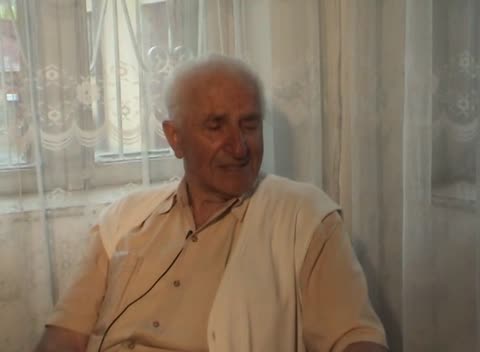
Finkelshteyn provides personal information and discusses his childhood memories, including family. His father was a carpenter and was born in Pașcani, but grew up in Iași. Finkelshteyn grew up with five brothers and three sisters. Finkelshteyn's mother was also born in Iași. He also addresses his grandparent's life.
From the machine transcript
After the date and his name are confirmed, Finkelshteyn gives his birth date and says he never left Iași. He recalls his childhood and his large family (three sisters and six brothers, whose Jewish names he lists) and his father David, a carpenter born in Pașcani (?) who lived in Iași. His mother was also from Iași. He describes his grandfather Aharon, a stove builder who made tile stoves for wealthy households and ate only kosher food, and Kerler checks the word for the stove with him.
Also includes a terminological exchange on the word for the stove.
Finkelshteyn discusses prewar Jewish life and Sabbath celebration, including food customs. He then explains how his mother koshered meat and then returns to Sabbath celebrations. Particularly, Finkelshteyn addresses gefilte fish.
From the machine transcript
Finkelshteyn describes Sabbath preparations and kosher meat in the family: the Jewish butchers, how his mother salted meat, and the foods she cooked for Sabbath, especially stuffed pike. Kerler elicits terms such as the word for a butcher, for the Danube and for a large river or sea, and the Romanian words for these.
Also includes questions about words for a river and the sea.
Finkelshteyn discusses his childhood memories and recalls poverty. He also lists foods his mother would preserve for the winter. Finkelshteyn attended a Romanian school for four years. He explains that he learned a trade when he was eleven years old. Finkelshteyn learned with another carpenter, before joining his father's business. Finkelshteyn worked in this profession until his retirement.
From the machine transcript
Finkelshteyn recalls a hard childhood: his father's work was seasonal, and in winter his mother preserved food and rendered fat for the family. He says he was born in 1923 and the family lived through the Depression and rising antisemitism. The children attended four years of Romanian school, and at eleven he began learning his father's trade, working as a carpenter until his pension. His sisters worked as seamstresses and two brothers as sales clerks.
Gives the Romanian school's name and the siblings' occupations.
Finkelshteyn speaks about his family. He also mentions his education at a religious school (Talmud Torah) and describes his daily working routine as carpenter. In the postwar Soviet times, Finkelshteyn worked at a factory.
From the machine transcript
Finkelshteyn says Yiddish was the only language at home and that his father wrote and read it. He talks about cheder, praying and synagogue attendance, which working Jews could not manage, and mentions the Iași pogrom as something too terrible to tell. He explains how he worked as a carpenter until his pension, mostly in a state factory in Soviet times, and how Jews were expected not to work manual jobs. He describes his apprenticeship with another carpenter and the market in Iași.
Includes the pogrom allusion and the market (hală) in Iași.
Finkelshteyn talks about prewar life, including market life. He then addresses prewar Jewish occupations and his childhood memories.
From the machine transcript
Finkelshteyn describes the Iași market and the trades before the war, many of them Jewish: tailors, shoemakers, tinsmiths and builders, including how houses were built. His master was a Jewish carpenter named Moshe. He adds that his own home had no running water, electricity or heating until after the war.
Finkelshteyn speaks about his education at a Talmud Torah school, including beatings and pranks. He then speaks about his large family.
From the machine transcript
Finkelshteyn recalls the cheder teacher with his whip and the pranks the children played on him. He then describes the talmud torah and says he did not study further because he had to work. He speaks about his mother's hard work for the household of eleven to thirteen people, including an aunt's two children.
Finkelshteyn recalls the Iași pogrom in 1941 and describes how he experienced it. Finkelshteyn explains how he and five siblings were deported and then describes the journey to Podu Iloaiei. Upon arrival, Finkelshteyn continues, survivors of the train ride were assembled at a synagogue, where they received food. He also describes how he buried bodies and mentions that he returned with his siblings a few months later.
From the machine transcript
Finkelshteyn recalls the June 1941 Iași pogrom: he was taken from his home with his mother and siblings, men and women were separated, and he was put in a sealed train wagon with about 120 people in extreme heat without water. Many died, and at Podu Iloaiei (spelled unclearly) survivors were gathered in a synagogue where local Jews gave them water and food. He says they buried the dead themselves in pits without prayers and stayed until November. They then returned, six of the seven men having survived, and he describes his mother's grief and the court where they lived.
Names the train as a deportation and adds the burial of the dead and the stay until November.
Finkelshteyn speaks about his life during World War II. He was a forced laborer in the Romanian army from May 1942 through 1944 and worked in quarry. Finkelshteyn then speaks about his return and work after the war. He states that he did not work on Sabbath.
From the machine transcript
Finkelshteyn says that after the pogrom he was taken for forced labor, from May 1942 to 1944, in a quarry loading stones into train wagons. He returned when the Russians entered Romania. After the war he worked on the railway until he retired at sixty. He stresses that he never lost a workday, did not work on Sabbath and arranged time off for Rosh Hashanah and Yom Kippur.
Finkelshteyn talks about his family, particularly the help from his uncle, who lived in America before the war. He also recalls help from the Joint Distribution Committee after the war.
From the machine transcript
Finkelshteyn speaks about his father's brother in America, who before the war sent money to the family, especially for holidays and for Passover. After the war the uncle sent parcels through the Red Cross and the Joint. He describes arriving home from the camp emaciated and in rags and being infested with lice. He says the Joint now supports the Jewish community and pensioners.
Finkelshteyn speaks about his life in Podu Iloaiei, where he was confined to work until November 1941. He shares information about his daily work routine at a carpentry.
From the machine transcript
Finkelshteyn describes his time in Podu Iloaiei (spelled unclearly) until November 1941, when the men were put to work in agriculture and he worked with a Christian carpenter who paid him. Through this carpenter he sent money, hens and food to his mother. In May 1942 he was taken to a labor camp. He says Jews no longer believed the war would end.
Adds the Christian carpenter's help and the money sent to his mother.
Finkelshteyn speaks about his life after the war. He worked for the railway. Finkelshteyn then speaks about religiosity and shares an episode from his journey to Podu Iloaiei.
From the machine transcript
Finkelshteyn speaks of his postwar work on the railway as the only Jew among a hundred Christians. He explains his religiosity: he would not do anything not kosher, and he is now eighty-three (?). He mentions how in the train wagons people had cried out to God for rain and water.
Finkelshteyn discusses his childhood memories and describes his neighborhood. In particular, he describes how fourteen families celebrated the holidays together. Finkelshteyn recalls how gypsy musicians performed for Purim plays and mentions his responsibility to build the sukkah.
From the machine transcript
Finkelshteyn describes his childhood courtyard in Iași with fourteen Jewish families, each with its own room. He recalls the Passover seder at the long table his father made, with childless neighbors joining, and his mother's week of baking for Purim. Gypsy musicians visited on Purim. On Sukkot he built the sukkah for an uncle, and he mentions the Jewish bath and mikveh.
Adds the Passover seder and the bath and mikveh.
Finkelshteyn talks about prewar religious life, particularly the local bath house and synagogues. He then describes Sabbath celebrations with the local rebbe.
From the machine transcript
Finkelshteyn describes the Jewish bath, the mikveh and Friday bathing, and then synagogues in Iași: the street of the synagogues, with over a hundred prayer houses before the war. He talks about the town rebbe and how people brought disputes to him. Kerler asks whether he was Hasidic, and Finkelshteyn does not distinguish. He also recalls Sabbath evenings with the rebbe and his father's role in resolving disputes.
Adds the number and street of synagogues and the rebbe's role in resolving disputes.
Finkelshteyn speaks about his family, particularly his father's values and teachings. He also speaks about his work.
From the machine transcript
Finkelshteyn says his father read and wrote Yiddish, and received Yiddish periodicals from his brother in America, reading them aloud in the courtyard in summer. He describes his father's advice to the children about conduct, drinking and thinking before acting. He adds that he himself was known in Iași as an honest carpenter whom people trusted with the keys to their houses.
Finkelshteyn discusses Jewish life before the war and explains the use of alcohol.
From the machine transcript
Answering Kerler's questions, Finkelshteyn describes what Jews drank before the war: wine on Friday night and for kiddush, little brandy, and mostly tea. He tells of a Jewish tavern keeper and how he sold his drink.
Finkelshteyn speaks about prewar Purim celebrations, as well as prewar Jewish life and transportation.
From the machine transcript
Finkelshteyn answers questions about prewar Purim. Children, boys and girls, dressed up in each other's clothes. He says he remembers no songs. Asked about a chimney-sweep costume, he turns to the cabs and horse-drawn carriages used in town, since there were no taxis. He then describes the special carriages used for weddings and the hearse, and how mourners followed a funeral on foot to the cemetery.
Also covers wedding and funeral carriages.
Finkelshteyn talks about prewar traditional weddings. He states that his parents were unterfirers (i.e. person who accompanies the couple getting married to the wedding canopy) at each of their children's wedding. Finkelshteyn does not have children.
From the machine transcript
Finkelshteyn describes prewar Jewish weddings. The rabbi came to write the ketubah and the couple was led to the huppah. His parents served as the couple's escorts (unterfirers) at each of their children's weddings. He has no children himself, though his siblings do. He is vague about dancing and a wedding jester because he was small at the time, and he says he has been married for some fifty-six years.
The catalogue entry fits, and the transcript adds his own marriage of some fifty-six years.
Finkelshteyn speaks about prewar holiday celebration, in particular Passover and matzo baking. He also addresses holiday food customs.
From the machine transcript
Finkelshteyn answers questions about a custom of throwing coins into the water by the ritual bath, and about the matzo factory and the straw sacks in which matzo was kept for Passover. He talks about foods eaten at Passover, Hanukkah and Shavuot, including potato dishes, dried-fruit compote, fried dumplings and dairy-only meals on Shavuot. He cannot say why Shavuot food is dairy.
Also covers Hanukkah and Shavuot food and the ritual-bath custom.
Finkelshteyn speaks about prewar Yiddish culture, particularly theater and musical performances. He also mentions that he saw the movie "A brivele der mamen" (a letter to mother).
From the machine transcript
Finkelshteyn speaks about the Yiddish theater in Iași, the first Yiddish theater in Romania, and how children helped as extras and with scenery. He mentions touring artists, a musician family named Sigali (?), and plays on the theme of emigrants' families. He says Yiddish films never reached Romania except one, "A brivele der mamen", which people fought to get in to see. He notes that the theater building is gone, and that a monument now stands at its site.
Also covers the memorial at the old theater site and emigration themes.
Finkelshteyn answers questions about cultural terminology. He also describes the local well and explains carpenter terminology.
From the machine transcript
Finkelshteyn answers Kerler's questions about Yiddish words. He explains words for an ignoramus and a fool, and how a well and a pump with a handle worked. Most of the passage is carpentry and joinery terminology from his trade: planes, saws, the workbench, workshop, tools and a wooden mallet. He notes that many of these words come from German.
The transcript shows long carpentry-term elicitation, with German-derived words.
Finkelshteyn speaks about prewar Jewish life in his neighborhood in Iași. He also addresses childhood games and mentions that he built sleighs for the entire neighborhood. Finkelshteyn then explains how he built skates from a window frame.
From the machine transcript
Finkelshteyn says that about half of Iași's population was Jewish and that Jews lived in Jewish quarters, though not in a closed ghetto. He recalls childhood games with nuts, rag balls, and shoes his mother made from rags. He built sleighs for all the children of the street. He also describes making ice skates from iron window frames.
Finkelshteyn remembers non-Jews who spoke Yiddish. He then speaks about contemporary Jewish life and visitors.
From the machine transcript
Finkelshteyn talks about non-Jews who apprenticed with Jewish craftsmen and about the rise of antisemitism, which led to trade schools for Christians. He speaks of visitors from abroad who no longer know Yiddish and need a translator, and of rabbis and yeshiva students who come to Iași. The synagogue is now closed. At the end he says his life was full of troubles.
Adds Jewish visitors and the closed synagogue.
Finkelshteyn addresses his best moments in life during the postwar Soviet period. He also speaks about his family and wife. Finkelshteyn has relatives in Israel.
From the machine transcript
Finkelshteyn calls the best time of his life the Soviet-style socialist period (he is probably speaking of postwar Romania), when he felt respected as a good worker in a collective. He speaks warmly of his wife and of never quarreling with his brothers and sisters. He has visited Israel a few times. He says he knows no songs, and that his wife's mother, from Bessarabia, sang well.
Adds his wife's family from Bessarabia and his remark that he knows no songs.
The team drives through Iaşi with Finkelshteyn and he explains the former Jewish neighborhood.
From the machine transcript
The team drives through Iași with Finkelshteyn, who points out a former Jewish street in the area between Păcurari(?)/Podul Roș(?)-type districts. The transcript is largely a recogniser loop, and little else is readable.
The team and Finkelshteyn stop at a Jewish memorial. He also speaks about prewar Jewish buildings, particularly the theater.
From the machine transcript
At a stop by a memorial, Finkelshteyn and Kerler discuss the Yiddish theater in Iași. He says the building was not closed and describes a small hall with a stage and a garden, the national theater opposite, and an anecdote about rain and a procession from the metropolitan's monastery. Kerler asks what people before the war knew of Goldfaden's theater; Finkelshteyn says many Jews went to the Yiddish theater, which hosted great actors from America and Poland.
Adds the anecdote about rain and the procession and the guest actors from America and Poland.
The team and Finkelshteyn visit the Abraham Goldfaden memorial. Finkelshteyn speaks about prewar Jewish life.
From the machine transcript
The group talks about the Yiddish theater under the communists and the distance to Bucharest. Finkelshteyn then shows the former Jewish hospital and says that it is now an ordinary hospital. He describes an old people's home for the childless elderly, called an "azil" (?). The rest is camera positioning and talk among the team in Russian and Romanian, and Kerler arranges a gathering of Yiddish speakers.
Adds the old people's home, the former hospital, and Kerler's arrangements for Yiddish speakers; the Goldfaden memorial is not clearly shown.
Finkelshteyn tells a joke about a pregnant woman, who consulted the rebbe. He then speaks about locals and business in prewar Iaşi.
From the machine transcript
Finkelshteyn tells a joke about a pregnant woman who consults a rebbe about her child's future; the prophecies for each birth are that the child will be a thief and a great politician. He then tells another joke about a tailor and a priest, in which a priest wants a suit made quickly and the tailor compares it to creation of the world. Lemster retells a part. The team then discusses going to see the theater and a Romanian-language exchange.
Adds the second joke, about a tailor and a priest.
The team and Finkelshteyn stop at another memorial, which is located at the site of the former Jewish hospital, commemorating the murder of local Jews during the Iaşi pogrom. He then speaks about the former hospital, as well as orphanage, and answers questions about cultural terminology. Finkelshteyn explains that he completed jobs at the hospital during his carpenter apprenticeship.
From the machine transcript
At the memorial by the former Jewish hospital, Finkelshteyn and Kerler discuss the monument erected in 1947 for the Jews murdered in the 1941 Iași pogrom, and Finkelshteyn describes the large hospital and an orphanage. Kerler asks about expressions, such as "a Jewish head" and "a goyish mazl", and Finkelshteyn explains them. Finkelshteyn says he worked in hospitals and schools in Iași during his apprenticeship.
Adds questions on expressions such as 'Jewish head' and 'goyish mazl', the orphanage, and the date of the monument.
Finkelshteyn speaks about his family.
From the machine transcript
Finkelshteyn speaks about his family: an uncle in America, Aunt Sara (?), sent food parcels soon after the war, and the father wrote to his brother in thanks. The uncle replied that American Jews owe help to European Jews because of Hitler.
Adds the uncle's food parcels from America and the uncle's attitude to European Jews.