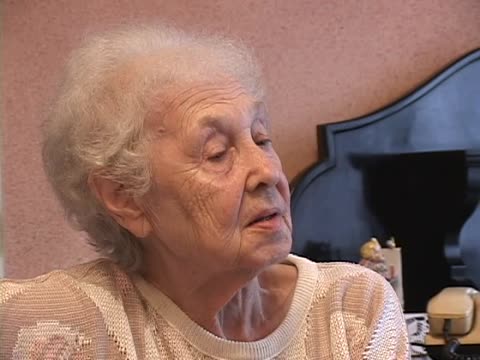
Mezei provides personal information and speaks about her family. She and her husband were deported to Auschwitz in 1944 and returned to Sighetu Marmaţiei after the war. Mezei mentions that she and her husband moved to Oradea in 1958. Her brother made aliyah after the war. Mezei visited Israel three times. Her father owned a textile shop and was born in the Maramureș province. Mezei grew up with one sister and one brother. She explains that she and her sister returned home from the war and her brother was sent to Donbas, Russia, as POW. Her brother was a forced laborer serving in the Hungarian Second Army. He returned home in 1948.
From the machine transcript
Mezei looks at a photograph of her sister and her sister's husband, says that she and her husband, both from Sighet, were taken to Auschwitz, and mentions that she has lived in Oradea for almost fifty years. She names her parents, grandmothers and the work of her father, who had a textile shop. She says she was the eldest of three children, with a sister and a brother. Her brother was taken as a laborer, was held by the Russians in the Donbas until his return in 1948, and later married and lived in Oradea. Her sister-in-law lives in Israel, where Mezei has visited three times.
Names her parents and both grandmothers, and her grandfather as a timber merchant; the sister-in-law's name and where she lives.
Mezei speaks about her childhood memories. She explains how her family lived with her grandmother in a poor neighborhood and then moved to a different house in a better off area. Mezei attended a preschool at three and then a Romanian school, which she finished in 1939.
From the machine transcript
Mezei recalls her childhood in Sighet: the family lived with her widowed grandmother in a poor street and later moved to a better house her father bought. She describes caring for her sick grandmother, going to a preschool at three, and learning Romanian, Hungarian and Yiddish, and some German. She mentions her brother's passion for football and her own school graduation in 1939. She says antisemitism grew once the Hungarians arrived.
Mentions the grandmother's illness, her languages and her brother's football, and the growth of antisemitism under the Hungarians.
Mezei speaks about her life during World War II, in particular the Hungarian occupation (1940), then ghettoization (April 1944) and deportation to Birkenau (May 1944).
From the machine transcript
Mezei and the others briefly speak about the war years: the last Passover seder at home in April 1944, the family being taken into the ghetto in mid-April, and arrival in Birkenau in May. Others in the room also talk about showing a photograph to the camera.
Mezei explains her school grade photo of 1939. She then speaks about her school education at a Romanian school and prewar Jewish life in Sighetu Marmaţiei. Mezei also addresses her activities as adolescent, including dancing and attending meetings Hashomer Hatzair, Hanoar Hatzioni and Trumpeldor. Mezei then speaks about her husband's family. Her husband held a doctorate in law and worked as lawyer.
From the machine transcript
Mezei explains her school photograph from 1939, found at home after her return from Auschwitz, and the languages taught at her Romanian lyceum. She speaks about Jewish life in prewar Sighet: observance in her parents' home, Yiddish games with other children, and the youth organizations she attended, including Hashomer Hatzair, Hanoar Hatzioni and a Trumpeldor club. She then describes her husband's background: he was poor, lost his father early, and studied law in Cluj. His mother came from Vienna, spoke German and was a music teacher. Her husband worked as a lawyer and held a doctorate.
Gives her husband's family background: his Viennese mother, his father's early death and his poverty.
Mezei speaks about prewar Jewish life in Sighetu Marmaţiei and addresses holiday celebration, including Sabbath. According to Mezei, fifty percent of the population was Jewish. She then addresses Sabbath food customs and recalls how strictly her grandmother observed kashrut. She then talks about her husband's life during the war. He was a laborer serving in the Second Hungarian Army and Mezei explains how he was not identified as a Jew and worked at a stone factory.
From the machine transcript
Mezei discusses prewar Sighet, where about half of the population was Jewish and few were rich, and the poor street where she grew up. She describes Sabbath customs in her home, including the cholent taken to the baker, Sabbath foods, and her grandmother's strict kashrut. She then tells of her husband's labor service, his survival in Budapest under a Hungarian name, his work at a stone factory, and his walking home to Sighet in January 1945.
Covers the Jewish share of the population, Sabbath foods and terms, and her husband's labor service and return on foot.
Mezei speaks about her husband's return to Sighetu Marmaţiei. Mezei also mentions how the Jewish community was assembled in the Great Synagogue before deportation to Auschwitz-Birkenau. Mezei then speaks about her father who founded a Zionist prayer house before the war.
From the machine transcript
Mezei says what the husband and his friends found in Sighet on returning, the burnt Reform synagogue, and the Great Synagogue where the Jews were held before deportation. A memorial now stands there. She then recalls her father, a committed Zionist who set up a small Zionist prayer house, and her taking her grandmother to services.
Adds the burnt Reform synagogue, the deportation memorial and her father's Zionist prayer house.
Mezei speaks about Passover celebrations, including food customs, before the war. She also addresses her neighbors and family. Mezei's father learned in the textile industry in Budapest. She then shows a photograph of her father in World War I uniform.
From the machine transcript
Answering Kerler, Mezei talks about Passover in her prewar home: matzo dishes, borscht made by her grandmother, and whether matzo was soaked. She mentions her uncle and a relative who was a Vizhnitz Hasid, and says that her father studied textiles in Budapest and served as a Hungarian soldier in the First World War. She then shows photographs of her father, her school days, her sisters and relatives who died at Auschwitz or live abroad.
Includes the uncle and the Vizhnitz Hasid relative, her father's WWI service, and photographs of relatives abroad.
Mezei speaks about contemporary Jewish press and life, as well as her childhood friends.
From the machine transcript
Kerler asks whether a Yiddish newspaper appeared in Sighet; Mezei says she receives a Hungarian paper from Israel. She shows photographs of friends, including a man from Sighet whom everyone knows and his wife. She also recounts an interview given to students from the university in Cluj about the ghetto and Auschwitz, which lasted for hours.
Mezei speaks about her imprisonment in the Birkenau c-sector and her encounter with Josef Mengele while undergoing selection. Mezei also mentions encounters with other prisoners.
From the machine transcript
Asked by Kerler whether she saw Mengele, Mezei describes being in the Birkenau C sector near the infirmary block, where Mengele came a few times a week and the women feared a selection. She tells how her mother was taken by Mengele in October. She reflects that the world knew and stayed silent, and that men suffered more in the camp, including the Sonderkommando and Russian prisoners of war. She tells of a friend's brother, a lawyer in the Sonderkommando, who asked her through the fence about his sister.
Mezei speaks about her life in Birkenau and then forced labor at a factory in Thuringia, Germany. She also addresses her living conditions and work in Thuringia.
From the machine transcript
Mezei concludes her account of Auschwitz, where she stayed six months, and then describes being moved to a factory in Thuringia. She talks about the mild climate, the heated quarters in an SS garrison, the washing facilities, and the poor clothing issued to the prisoners. She describes the camp barracks and the selection of women by their hands for lighter or heavier work. She had an easy inspection job and says she was liberated by the Americans in April 1945.
Mentions the threat of being sent to Buchenwald for those who failed their work quota.
Mezei speaks about her liberation by the American Army and the previous death march to Waldenburg, Thuringia, with six hundred fellow prisoners. Mezei then mentions that she fell ill with pneumonia three days after the liberation and states that she was therefore saved from "overeating."
From the machine transcript
Mezei recounts the night march from the camp in April 1945 to a village and then to the woods near Waldenburg, where air-raid alarms sounded. Some 600 prisoners, mostly women with a few men, hid in the forest overnight. In the morning the prisoners went down and found American soldiers, which she describes as their liberation. Two or three days later she fell ill with pneumonia and a high fever, which she says kept her from overeating the tinned food, from which many died. Kerler then steers back to the holidays discussed earlier.
Includes the night spent in the forest with her sister and the sister's tea during her illness.
Mezei speaks about holiday celebration, including Passover, Hanukkah and Purim. During Purim, Mezei describes how she dressed up. She also addresses holiday food customs and recalls local boys bringing large baskets of matzo.
From the machine transcript
Answers questions from Kerler about prewar holidays: Passover with two seders, new clothes for children, and the father conducting the seder. She mentions Hanukkah games with the dreidel and gelt for the children, and dressing up on Purim to visit grandmothers and bring gifts of food. She discusses baked goods for Purim and Hanukkah and Passover dishes, and recalls young men bringing large baskets of matzo and an uncle who ate only shmurah matzo.
Also covers Hanukkah dreidel play and gelt, and Kerler's questions about the Yiddish words for potato and for ingredients of Purim pastries.
Mezei sings the song "Vos iz geven iz geven" (What was, was) and addresses prewar cultural performances and a wedding. Mezei then sings the song "A yidish meydl darf a yidishn boy" (a Jewish girl needs a Jewish boy). Mezei also mentions the fate of friends during the war.
From the machine transcript
Sings the song about how what was is gone, with Kerler asking about the refrain's wording. She recalls the summer theater in Sighet, the Hungarian and Yiddish actors Strömer and his wife, and an actress who sang there. She sings a song that a Jewish girl needs a Jewish boy, tied to a woman who married a Romanian and later died in Auschwitz. She mentions her friends' fates after the war, including those who went to Israel, and the judge husband of the woman.
Includes the theater visits in Sighet and the story of a woman who married a Romanian judge.
Mezei shares an episode about a shidduch in her family. She then recalls how women sang Romanian and Hungarian songs during forced labor and then talks about aquaintances from Auschwitz. Mezei also shares episodes about selection for forced labor in Auschwitz, as well as her daily work routine.
From the machine transcript
Mezei tells of an elderly relative's marriage match and her Romanian lesson, then answers Kerler about singing in Auschwitz. She tells in detail of Miri, a Slovakian or Hungarian block elder from Birkenau, who knew her fiancé's family and helped her and her sister with food while they were in forced labor. She describes selections, the transport, twelve-hour day and night shifts, singing Hungarian and Romanian songs with other women, and the final evening when Miri decided not to leave with them. The part also touches on an uprising by the Sonderkommando and her friendship with a rabbi's wife.
Beyond the shidduch and the songs, the passage covers the helping block elder Miri and a fiancé's cousin link.
Mezei speaks about her life before the war and shares an episode about her grandmother's observance. Mezei then talks about the literature she read before the war.
From the machine transcript
Answers Kerler's question on the language spoken at home: her parents spoke Yiddish and Hungarian, the children Hungarian and Romanian, and the grandmother Yiddish only. She recalls her grandmother's shock at her using an umbrella on the Sabbath and a sister who smoked. She says she read in Hungarian and Romanian, including Gorky and Dostoevsky from her father's library, and she begins a joke attributed to Sholem Aleichem about a widow's daughter.
Adds the languages spoken at home, her reading list and a joke.
Mezei shares jokes in Yiddish and Hungarian.
From the machine transcript
Mezei tells jokes, some in Yiddish and some in Hungarian, with the second woman and a third voice helping her translate for Kerler. They include one about two men and their wife and lover and a taxi joke that turns on a brothel. Kerler asks about Yiddish joke tellers of the region and how to say the word for brothel in Yiddish.
Mezei speaks about her return home by train after the war, via Prague, Buda and Timișoara. She recalls how she met her aunt in Buda and cousin in Timișoara. Mezei got married in 1945.
From the machine transcript
Mezei recounts her journey home after Auschwitz, by way of Prague and then Budapest, where she was put up in a hospital. In the yard there she unexpectedly met two cousins, who took her to their mother, her aunt. The aunt gave her a bath and fresh clothes. She goes on to Timișoara, where relatives of hers lived and had not been deported, and travels on by train toward home. She says she had heard in Prague that her fiancé was back; she returned on the first of July and married him on the first of September, and they lived together until his death nine years ago.
Adds the cousins met in the hospital yard, the relatives in Timișoara who were not deported, and the date of her marriage.
Mezei speaks about her return to Sighetu Marmaţiei and recalls how her home was occupied by neighbors.
From the machine transcript
Mezei describes what she found at her home after returning: a woman and a young man were living there. He had asked for the apartment when the family was deported. He found very little in it. She then points out something she made on the wall of the apartment, before she went to the synagogue, at about fifteen. The passage is partly unclear.
Adds the young man who asked for the apartment, and the object she made as a girl on the wall.
The team concludes the formal part of the interview and the camera records family photographs.
From the machine transcript
The talk about the object she made as a girl continues briefly. It then turns into Hungarian-language talk about Budapest: a villa, an aunt, a walk along the boulevard in 1948 and a postcard sent to a friend. The recogniser makes much of this passage unintelligible. At the end the speakers seem to be arranging how to carry on. The catalogue mentions family photographs, but they are not evident in the transcript.
Adds the Hungarian-language talk about Budapest and an aunt, which the catalogue sentence does not mention.