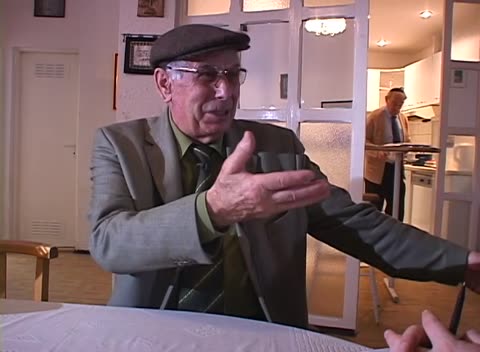
The team greets Weinberger and sets up the interview with him.
From the machine transcript
The team greets Weinberger and sets up. A short exchange mentions a father born in Poland in a place that is unclear (Karczyn (?)), and Kerler refers to Sholem Aleichem's Tevye the milkman, to which Weinberger relates that as a boy he carried milk.
Adds the Tevye the milkman reference.
Weinberger discusses his childhood memories.
From the machine transcript
Weinberger recalls carrying kosher milk to Jewish homes in the early morning as a boy for his uncle's cows. The date of the interview is stated as 18 December 2006, in Kislev, during Hanukkah, and there is a place-name exchange mentioning Mukachevo. He then begins his personal information: his name, father Leyzer, mother Gitl, sister Leah and brother Shmuel.
Adds the date of the recording, the Hanukkah and Kislev reference, and the names of his parents and siblings.
The formal interview begins. Weinberger provides personal information and talks about his family. He grew up with one sister and one brother. His father was born in Poland. Weinberger attended a religious school (cheder) in Stropkov and recalls how his grandmother cooked for him when he came home to Nižna Jedlova.
From the machine transcript
Weinberger describes his family and Nižná Jedľová, a small village near Svidník with about nineteen houses, a few of them Jewish families including his own and uncles. He recalls his grandmother Leah (?) who cooked for him when he came home from cheder in Stropkov. His uncles were taken in 1942 and his father died in 1943 (?), his mother and siblings were deported, and an uncle hid him so that he lived on false Christian papers. He also mentions an uncle with eight small children, married to a woman from Poland, and the nearby border and villages.
Adds the wartime deportation of his family, hiding on false papers, and the grandmother's cooking.
Weinberger shows a book about the Stropkov Jewish community. He remembers several of the photographed people, including the local tailor. Weinberger maintains that he was a forced laborer near Sered' during his military service.
From the machine transcript
Weinberger goes through a book on the Stropkov Jewish community and the many photographs. He remembers local people: a tailor, a shopkeeper he carried milk to, a bank manager, a man who was driven through town with non-kosher sausage, and a Gardist who was a Jewish coachman's son. He also shows wartime Slovak antisemitic publications and speaks of Jews being gathered in the synagogue before deportation, and of selection at Auschwitz. He says he was a forced laborer in Sereď, and that there was Yiddish among non-Jews of Stropkov. He regrets there is no one to speak Yiddish with at home. At the end he gives his birth date (18 November 1927) and says he lives in Košice.
Adds antisemitic propaganda, Yiddish-speaking non-Jews, wartime events and recollections of local people.
Weinberger provides personal information. He moved to Košice in 1960.
From the machine transcript
Weinberger gives personal details: that he lives in Košice and the address and spelling of his name for correspondence. The transcript has no lines of its own for this stretch.
Adds the address and name spelling for correspondence.
Weinberger talks about his life after the war. He worked in Presov for ten years and visited Israel for one week in 1969. Weinberger also addresses the contemporary Jewish community of the region and emigres in Israel.
From the machine transcript
Weinberger says no relatives remain, and that he visited Israel in 1969 for about five weeks (?), at a friend's invitation, and met Stropkov landsleit there. He then speaks about the contemporary Jewish community, including a woman from Breznica in Bratislava who knows Yiddish, an ethnographic project in Bratislava, other survivors of Auschwitz from the Stropkov area, and a book on Stropkov published by a woman in Be'er Sheva. He also mentions the Halberstam family and a Košice rabbi with an ohel in Košice.
Adds the Bratislava community, Stropkov natives and the Halberstam family; the transcript does not mention Prešov or a week-long Israel visit.
Weinberger talks about emigres in Israel. He also addresses a meeting with Russian Jews in 1965, when he also attended a concert of the Barry Sisters.
From the machine transcript
Weinberger talks about Jewish émigrés from Lithuania and Russia who became prominent in Israel, and Kerler comments on Litvak Yiddish dialects. He recalls meeting Jews from Leningrad and Moscow on a visit to Sochi, where a fellow Jew warned him about a suspicious stranger. He also recalls a concert by the Barry Sisters there.
Also covers a discussion of Litvak Yiddish and Israeli leaders' origins.
Weinberger discusses his childhood memories and prewar Jewish life in Stropkov. He then speaks about his life during the war. Weinberger states that he used "Christian" documents and worked as coachman in Stropkov, before he was taken to the Sered' ghetto in 1942. Weinberger then explains how he fled to Pest, Hungary, via Snina and Stakcín during the winter. He maintains that because deportations to forced labor camps stopped in 1942, he decided to escape to Hungary in 1943/44 to avoid death. In Stakcín, he continues, Weinberger stayed at a cemetery overnight, before he stayed in his driver's coop. Weinberger describes the rest of the journey on a sleigh to Ubla and then on foot to Bereznyi, Ukraine, before taking a car to Uzhhorod, Ukraine. In Uzhhorod, Weinberger explains, he stayed at a full-functioning yeshiva, before taking the train to Pest, Hungary. He then describes the train journey and his encounter with a generous man, as well as the arrival in Pest.
From the machine transcript
Weinberger describes Jewish life in Stropkov, where about half the Jews were pious and the rest less so. During the war he lived on false papers as a coachman for a Slovak employer. When transports resumed and he was due to be taken to a labor camp (Sered'), he fled across the Hungarian border in winter via Snina and Stakčín. He describes a night in a military cemetery, a night hidden among chickens in a poor man's shed, going on foot to Bereznyi and on to Uzhhorod, where he stayed in the Jewish community. He then tells of the train to Budapest and a stranger who shared food and gave him money. Kerler asks about words such as kuchtsher and the Slovak for Yom Kippur.
Beyond the flight to Pest, adds the prewar pious/less-pious split, school languages and Kerler's word questions.
Weinberger talks about his family. His father was born in Krosno, Poland. Weinberger's father, ne Kirshner, took on his mother's name because he did not have Slovakian citizenship. He then returns to his arrival and life in Pest, where he stayed at a chapel with other Jewish refugees. In Pest, Weinberger explains, he went to see the Polish Committee. Weinberger, alias Yosef Chibotsky 25:46, describes the meeting, where he received documents and financial support. Until Weinberger received his documents, he worked in the fields. He then recalls his daily life and addresses again his arrival at the Pest railway station.
From the machine transcript
Weinberger names his father, Leyzer Kirshner of Krosno, who was a Polish citizen and so gave his Slovak-born son no citizenship. On arrival in Budapest he stayed in a prayer house with Jewish refugees, learned a little Polish and went to the Polish Committee under the Polish name Yosef Chibotsky (spelled Przybycki in the catalogue). He received papers, money and food, worked in the fields and a bakery, attended services and received meal vouchers from the Jewish community. Kerler also asks about the date of the crossing, which he gives as late December 1943, and about the arrival at the Budapest station. Weinberger also mentions the deportation of Jews from Subcarpathian Rus.
Also covers the date of the crossing, Budapest work, vouchers and Hungarian Jews.
Weinberger talks about Jewish life in the region during the war, as well as how Jewish history was treated after the war.
From the machine transcript
Weinberger and Kerler discuss the fate of Jews in the region during the war. Kerler's family is mentioned: his parents served in the Red Army and his mother's relatives were murdered. Weinberger recalls the Babi Yar massacre and a book on it by Kuznetsov, which he read in Slovak. He says that after the war the Soviet authorities did not allow the killing of the Jews to be spoken of openly.
Adds Babi Yar, the Kuznetsov book and Kerler's own family.
Weinberger talks about his life in Pest and encounter with local Jews during the war. He then describes the occupation of Hungary by Germany in 1944. Weinberger changed his name again from Chibotsky to Panko due to the persecution of Poles. Weinberger depicts his return to Slovakia and his encounter with the Gestapo. Weinberger maintains that he was the only one from his group who evaded persecution at a hotel due to his Russian name Panko. Weinberger then explains how he decided to return to Pest and managed to get on a train. Eventually, Weinberger managed to cross the border to Slovakia and took arranged transportation home. In Slovakia, Weinberger continues, he was taken to the forced labor camp Zemianske Sady, near Sered'. Weinberger also mentions how Polish Jews in Pest underwent surgery to reattach the prepuce.
From the machine transcript
Weinberger talks about life in Budapest, where he spoke Yiddish mainly with Polish Jews and kept apart from the Hungarian Jews. He tells of the German occupation in March 1944, when the Polish Committee was seized and Poles were persecuted. Under a new name, Yosef Panko, he used false papers as a Subcarpathian Rusyn. He recalls going back to Slovakia, being arrested by the Gestapo with a group but released because of his Russian name, jumping on a train in Levice, and a second border crossing. Kerler asks about words such as advent and about money. He also mentions Polish Jews who had surgery to restore the foreskin.
Adds the Gestapo arrest, the train episode, partisans, and prepuce surgery.
Weinberger talks about his liberation by the Red Army on April 2, 1945 near Hlohovec. He was a forced laborer at a brick factory and then, after an injury, he watched apple trees, before working with oxen in the field. Weinberger then explains, how he survived escaping the Germans between September 1944 and April 1945.
From the machine transcript
Weinberger tells of his liberation by the Red Army in April 1945 near Hlohovec in Slovakia. He recalls working in a brick factory, being injured, being assigned to guard apple trees and then to work with oxen. After the Slovak uprising of September 1944 he fled when Germans surrounded the village and spent months hiding in cellars and barns, begging for food. Kerler asks about words such as stodola and a word for wandering. He ends with the first meeting with Soviet soldiers.
Adds hiding in cellars from September 1944, the injury and Kerler's word questions.
Weinberger talks about his liberation by the Red Army. In particular, he addresses his encounter with a Jewish doctor and a Jewish officer.
From the machine transcript
Weinberger recalls the end of the war, when he met Soviet soldiers and a Jewish army doctor who spoke Yiddish and came from Ukraine. A Jewish officer also spoke Yiddish with him, gave him chocolate and explained the front situation. Kerler asks whether they held a Passover seder together, and Weinberger describes his return home and his relief.
The doctor's Ukrainian origin, the officer's chat in Yiddish and Kerler's Passover seder question.
Weinberger talks about his life before the war and his family. His father worked in the field. Weinberger attended a religious school (cheder) in Stropkov for eight years. His uncle lived in Stropkov. He also attended a Slovakian school. Weinberger supported his uncle feeding the animals in the mornings.
From the machine transcript
Answering Kerler's questions about the prewar years, Weinberger describes a simple village family. His father worked in the fields and his mother stayed at home. He then lived with his father's brother, Mordechai Kirshner (?), in Stropkov, where he attended cheder and the Slovak school and fed the cow in the early morning. The uncle suffered from asthma, and Weinberger affirms that he went to cheder.
The uncle's name and illness and the Slovak school.
Weinberger speaks about his cheder education and his family. His father also moved to Stropkov in the early 1940s.
From the machine transcript
Weinberger answers Kerler's questions about his cheder years. He had three teachers in turn, and for his bar mitzvah preparation he went to a German-speaking teacher named Landesmann (?). He says his father also came to Stropkov, around the 1940s, after the family could no longer live in the village, and the brother went to cheder as well. He recalls that Yiddish and Hebrew were learned there, and the passage ends with a half-remembered reference to Rachel's grave.
The three cheder teachers, the bar mitzvah teacher and the dating of his father's move.
Weinberger addresses holiday celebration, in particular Purim, during his childhood. He recalls how the mailman dressed up and an anecdote about matchmaking from his childhood. He then recites a funny Purim shpiel.
From the machine transcript
In answer to Kerler's questions, Weinberger recalls Purim in Stropkov. The mailman dressed up, he himself delivered shalachmones to the rebbe, and he tells a matchmaking anecdote about a rebbe's payments and a groom who would not work. Kerler also asks about the Purim greeting, and Weinberger repeats it and tells jokes about a Purim rabbi's rulings. He says that about ten percent of the town's Jews were rich and many were poor.
The shalachmones episode, the greeting and the jokes about Purim rabbis' rulings.
Weinberger speaks about prewar Jewish life in Stropkov, including occupational structure. He recalls great poverty.
From the machine transcript
Weinberger describes the occupational and economic structure of Jewish Stropkov before the war. He mentions shopkeepers, tailors, and the many families who could barely earn a living, with a small rich minority. He then tells of a stigmatised group of families called kitchers (?), said to descend from a Roma man, whom others would not marry, and of how they were killed in the war. Near the end he begins on Simchat Torah memories.
The stigmatised families and the marriage taboo.
Weinberger speaks about Simchat Torah celebrations and discusses his childhood memories, including theater performances by students. He also remembers his friends and teachers in cheder.
From the machine transcript
Answering Kerler, Weinberger recalls Simchat Torah and Tisha B'Av sweets in his childhood, delivering milk to local candy makers, and a prank by a taxi driver. He describes the Slovak school and its Jewish teachers and the cheder, including a teacher who beat a pupil, and the teacher Jeger, a German-speaking Jew. He says he does not remember performances well but mentions the songs children knew.
The candy makers, the beating in cheder and the teacher Jeger.
Weinberger speaks about prewar Jewish life in Stropkov and Košice. He then addresses food customs and answers dialectological questions from the AHEYM Yiddish linguistic questionnaire.
From the machine transcript
Weinberger compares Stropkov with Košice, where Jews studied at universities and became professionals, and says which languages Jews spoke in Stropkov and in the Spiš area. He then answers Kerler's questions about the Yiddish and Slovak words used at home for vegetables, wall and floor, and 'dove'. Kerler tries to draw him back to the songs he sang earlier.
A comparison of Košice and Stropkov and the languages Jews spoke, and the word questions.
Weinberger recites a snippet of Purim shpiel, he recalls from cheder. He then addresses prewar religious life and education, as well as folk customs.
From the machine transcript
Weinberger recalls songs learned in cheder, including a verse about Rachel's grave that he sang as a child, and describes how the cheders and teachers varied in learning. The talk turns to folk remedies for the evil eye using coals, to Sabbath rules about milking and electricity, and to opinions on modern religious practice.
The coals remedy and the discussion of electricity and Sabbath.
Weinberger talks about Passover celebrations before the war. He recalls questions for his father.
From the machine transcript
Weinberger recalls Passover, when as a boy he asked the four questions and invented jokes about his father. He tells jokes about Passover customs, including snuff tobacco and a Purim rabbi's ruling. Kerler then raises Hanukkah and a few terms, and mentions a local man from Košice who still speaks good Yiddish and whom Kerler might contact.
Jokes and the suggestion of another Yiddish speaker in Košice.
Weinberger answers dialectological questions. He then talks about Isaac Bashevis Singer and Polish Yiddish songs.
From the machine transcript
Kerler asks about the usage of 'or who' and related forms, and Weinberger comments on which are possible in Yiddish. Weinberger then speaks about Isaac Bashevis Singer and his Nobel Prize speech, and about Yiddish and Hebrew and its prospects among Hasidim. He recalls Yiddish songs from Polish records and Kerler asks about his mother's songs.
Singer and the Nobel Prize and the comments on Yiddish's future.
Weinberger addresses prewar cultural performances in Stropkov. He then talks about the best moments with his family on Sabbath during his childhood. Weinberger recalls how he walked with his family to a mikhvah on Sabbath. He then addresses food customs on Sabbath, including wine.
From the machine transcript
Weinberger describes visiting Yiddish performers in Stropkov, among them singers with a harmonica and a Russian-Yiddish singer whose photograph he holds. He names the happiest time as Sabbath and holidays with his family, and describes walking to a mikveh and minyan from his uncle's village. He describes Sabbath and festival food, including fish, cholent and kishke, and says that a drink of schnapps and honey cake was a delight. He also mentions drinking and the preparation of schnapps.
The photograph and visiting singers.
Weinberger answers questions about cultural terminology. He then recalls an episode from cheder and talks about his bar mitzvah.
From the machine transcript
Weinberger describes local Hasidic rebbes and wonder-workers around Stropkov, mostly from Poland, and who visited them. He talks about a baal shem and a dybbuk, and the kitchers, whose lack of marriage prospects he mentions. He tells a story about a child in cheder, and says he read from the Torah at his bar mitzvah. He notes that his family was not very observant.
The rebbes and the dybbuk.
Weinberger speaks about his family and observance. He then answers dialectological questions from the AHEYM Yiddish linguistic questionnaire.
From the machine transcript
Weinberger speaks about his father's observance and a Polish Jew from Kurtshin (?) who fled to Slovakia in the First World War and settled there. Kerler then asks questions about farewell formulas and a verb 'pour', and Weinberger answers. The passage ends with Kerler thanking him.
The Polish refugee story and the farewell formulas.