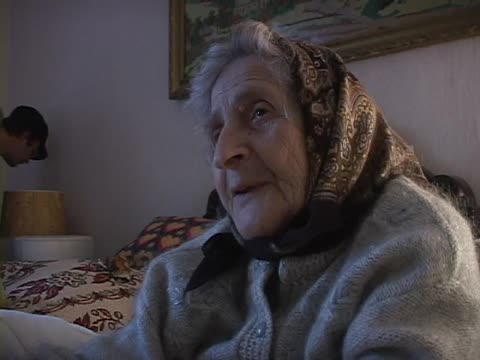
People › Malke Leybovna Snook › conversation

Malke Leybovna Snook

Khust 6 June 2007 45 min · 1 part on 1 tape proposed
Loading the player…
  1. MDV 365 0:00–44:54 · 45 min · not online — MCO · a part of the tape
Passages

0:00

Entering house of Malke Leybovna Snook to set up interview

Informal life today MDV 365 · MCO
From the machine transcript

The team is let into Snook's house by her daughter-in-law, who speaks Russian. Kerler greets Snook and recalls their visit two years earlier. Lemster asks where she was born, and she says it was a village about sixty km away. She mentions that her son is in hospital.

1:49

Family

From the machine transcript

Snook talks about her son, who is in hospital after an operation, and about her daughter-in-law and grandchildren, who live in Israel. She says she has two daughters and eight grandchildren and that her son keeps Jewish tradition. Lemster asks whether a mohel was available when he was circumcised. Snook mentions that her husband died fifteen years ago, that her parents lived in the village, and that she was in Auschwitz.

also covers her children and grandchildren in Israel and Auschwitz

4:14

Prewar life

before the war Daily life (general) MDV 365 · MCO
From the machine transcript

Snook says she was about twenty when she was taken before the war. She tells how a relative's wife, after her brother-in-law's death, asked her to take one of two children when Jews were being taken to the camps. The transcript is garbled about who exactly the relative was.

6:43

Postwar religious life and family

From the machine transcript

Snook says the village had about a hundred Jewish families and a synagogue, and that people went to pray. She compares observance then and now, mentioning her grandchildren in Israel and her daughter-in-law's synagogue-going. Lemster asks how she herself studied.

gives the size of the village Jewish community

7:53

Education

From the machine transcript

Snook says she was able to study little and attended a Czech school, which cost money. Her father was a middle-class man who kept a cow and a pair of horses. She also mentions a rebbe's grave in a nearby place where people go (the name is unclear), where a building has gone up.

12:00

* Religious customs and prewar holiday celebration

From the machine transcript

Kerler and Lemster ask Snook about the 'gut vort', the Saturday-night greeting, and about the blessings that began it, starting with the God of Abraham. She remembers only parts and says she has forgotten much. Lemster then asks what the village Jews did for a living.

14:41

Prewar occupations

before the war Work and trades MDV 365 · MCO
From the machine transcript

Snook lists the village Jews' trades, including a shoemaker, a tailor and a glass cutter. She says the Jews did not dance in the Gentile manner. At weddings there was a 'gramer', a rhymester who was rewarded with thrown coins, but she cannot name one. Kerler asks who taught her to read Yiddish.

21:53

About singing

From the machine transcript

Snook says she sang songs at Purim and at weddings. When asked, she cannot immediately recall a song about a wife who eats too much, and she worries about her son in hospital. Kerler passes on greetings from a colleague who could not come.

26:34

Returning home and family

From the machine transcript

Snook says her belongings were stolen, though the wartime losses are only briefly described. Her husband's parents were taken to a camp in the 1940s and did not return. She has lived in Khust for twenty years and says young people there no longer speak Yiddish but understand it. Lemster asks about Christians who spoke Yiddish.

28:52

gute yidn and religious customs

From the machine transcript

Snook talks about the 'good Jews' and rebbes whom people consulted in Khust and nearby places. She says what was said to them was secret. She explains remedies against the evil eye: extinguishing coals and using challah blessed by the rebbe. She says that Jews did not play cards, that spirits were hardly drunk, and that wine was for kiddush and celebrations.

adds the evil-eye remedies and drinking customs

33:53

Prewar religious life

From the machine transcript

Snook says she went to the village synagogue with her parents, and that her father prayed at length. Her parents kept a cow and horses and worked the land. She describes cheese made kosher with rennet and meat salted at home, with a shoykhet. Kerler then works with her to reconstruct a childhood song about a girl who marries and eats up the household.

adds the recited marriage song and kosher meat

39:58

Family and food customs

From the machine transcript

Kerler and Snook talk about when her son will leave hospital. Lemster asks how she made gefilte fish, and she describes it using carp and chopped fish with pepper but no sugar. Kerler says the team will leave in a day or two. Lemster asks whether she still speaks Yiddish with people in Khust.

42:45

Concluding the interview

From the machine transcript

Lemster thanks Snook and says the interview is finished, and they arrange to take a photograph the next day.

43:18

Snook's daughter-in-law

Informal life today MDV 365 · MCO
From the machine transcript

Outside, Kerler and Snook's daughter-in-law talk about a man named Misha Berger (?), who held the key to the holy place, and about her brother, who died long ago. She says her siblings and children are in Israel. They speak of the children phoning daily and of her husband.