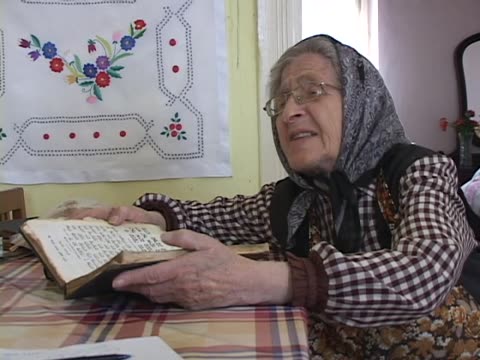
The second part of the tape is a formal interview with Malke Leybovna Snook in Khust. The team enters Snook’s house in order to set up the interview. She talks about life today.
From the machine transcript
The team enters Snook's house in Khust and is greeted. Kerler and Snook exchange greetings and talk about her health and refreshments. She mentions the Yiddish newspaper, which another woman reads for her, and Kerler comments on the small print. Snook says she will sing a song.
Adds the Yiddish newspaper and Snook's health.
Snook sings a Yiddish song about the bride and marriage. Snook then talks about life after the war. In particular, she addresses life during the drought in 1946 and the famine in 1947. Snook then talks about her family, in particular her husband. After the war, she and her husband worked with horses and sold different materials. Her children live in Israel.
From the machine transcript
Snook sings a humorous Yiddish song about a bride and marriage. Kerler asks when it was told; he suggests Purim. She then tells of postwar hardship: neighbours bringing milk and cheese, her husband trading a wagon of wood for flour, the drought of 1946 and the hunger of 1947. She gives the word for potatoes, her husband's piety, and the trades she and her husband followed with horses and goods. Katz asks for another song.
Adds neighbours' help, the potato terminology exchange and her late husband's religious observance.
Snook sings a Yiddish song about the longings of love. She then remembers her return with her husband home after World War II. Her husband slowly rebuilt life. She discusses family and life today.
From the machine transcript
Snook sings a Yiddish song of longing and lovers' letters from America. She recalls returning home from the war naked and barefoot and how her husband slowly rebuilt their life. She speaks of her children and her daughter-in-law, a teacher from Svaliava (?). Her family is abroad. She describes the life of children abroad, and says a Christian neighbour helped her with pills.
Adds the daughter-in-law, a teacher, her children abroad and the neighbour who gave her pills.
Snook sings a Russian song, before she recites prayers and discusses Jewish life after the war.
From the machine transcript
Snook tries to recall a song that Kerler and Katz request, and sings a Ukrainian or Russian folk song. Kerler and Katz then ask whether she has a siddur with large print; she says she knows some prayers, mentions the Rosh Chodesh blessing, and a short prayer is recited. She reflects on how things changed in religious life and life after the war, then begins to tell how Jews were taken from the village.
The passage also includes Snook's remarks on her prayer book and on how life changed, and a first mention of her parents being taken.
Snook talks about her family and her life during the war. She explains how she took care of a child in Auschwitz and attributes her own survival to her young age.
From the machine transcript
Snook tells that her parents were taken in 1941 and that she carried a relative's small child on arrival at a camp. A German separated her from the child, and she saw the crematorium burning. Another woman told her she was spared because of her youth, and she says she was 22 years old. She closes with a remark on how little good is done today compared with the past.
The passage also covers the taking of her parents in 1941 and the family relations (an aunt or uncle's wife and her children).
Snook sings a Sabbath song and recites prayers. She then discusses religious life today and talks about her family.
From the machine transcript
Katz and Kerler ask Snook to recite more from the siddur; she sings a Sabbath song and then speaks of a Russian woman who knows Yiddish and prays half in Yiddish. They go through Lekhah Dodi and Shalom Aleichem, with Katz asking how Kiddush was said. She recalls local characters, Hungarian-speaking Jews at the minyan and the Hungarian period, and Kerler asks about words such as 'oyfhapn' and 'shtramer mentsh', which she explains. The talk turns to the interviewers' work as teachers, and Katz raises Kaddish.
The passage also includes word explanations, the Hungarian-speaking Jews, and the Russian woman who knows Yiddish.
Snook’s son Shloyme arrives. Snook discusses life today and answers a number of dialectological questions from the AHEYM Yiddish questionnaire.
From the machine transcript
Snook talks about Kaddish and a hired person saying it, while a visitor who has come by car (her son, per the catalogue) leaves. She talks about her health, her descendants, relatives in Israel and America, and keeping kosher. Kerler asks the Yiddish words for 'Jew' and for 'non-Jew' or 'fool', and the word for a crowd, which she explains. She offers the guests a drink made of grapes.
The passage also includes family abroad, kashrut and dialect-word questions about 'yehude' and terms for non-Jews.
Snook talks about life today and then discusses life before the war. In particular, she addresses her religious education, when she studied with other girls under the tutelage of an unemployed teacher. According to Snook, as soon as he received aid from America, he stopped teaching the girls.
From the machine transcript
Snook talks about the drink she makes and her garden, then answers Kerler's question about cheder: she studied with other girls under a disabled man who lacked an income, until he received aid from America. She talks about her health, her trips to a mineral spring and a medical examination, then about the high status of teachers under the Czechs. Kerler asks her to turn to life before the war.
The passage also includes her health, a mineral spring and her view of teachers' status under the Czechs.
Snook discusses life at the beginning of the war in 1941, when her family was deported. Snook returned home in 1945. She then talks about life after the war and her family. Her son Shloyme was born in 1946.
From the machine transcript
Snook speaks of 1941, when her parents were taken away; she was staying with a relative and a neighbour, and the family went to Poland (?), where they were killed. Later she was taken to the camp, rescued by a German from the child, and freed in 1945. She returned home and lived hard years after the war; her family relations and her own illness are mentioned. Kerler tells of his birth in Moscow and move to Israel, and Snook talks about children and relatives in Israel and America.
The passage also contains the postwar years, the birth of her son in 1946, and Kerler's account of his own background.
Snook talks about religious life after the war and the demonstrations that she remembers against the closure of the synagogue in Khust. Snook remembers Purim celebrations before the war. She then explains how Ukrainians celebrate Easter.
From the machine transcript
Snook talks about the synagogue in Khust, which the authorities wished to close; some women protested, and people contributed money. Kerler asks about Purim plays and she recalls children going around in disguise for money. She tells about the Ukrainian winter holiday and Easter, and a word for the holiday. She also talks about her woman helper, the guests' travel plans, and a word 'tsekrishet' (?), meaning tired.
The passage also includes Ukrainian Christmas and Easter customs, word explanations, and the guests' plans to leave.
Snook sings a Yiddish marriage song. She then talks about a life today and expresses well wishes.
From the machine transcript
At Kerler's request Snook sings a comic Yiddish song about a gluttonous wife, and explains a word from it. Katz asks about wedding songs. She talks about her health and her son's care, and wishes the interviewers good health, asking about their parents.
The passage also contains an explanation of a word in the song and her own health and her son.
Snook sings a Yiddish song about the pains of emigration. The next song is partially in Hungarian and Yiddish about marriage and work. She recalls several prewar Zionist organizations, after singing a Zionist song.
From the machine transcript
Snook sings a Yiddish song about a lover's letter to America, then a song partly in Hungarian and Yiddish about a wife's refusal to work. She also sings a Zionist song about breaking down the wall of exile and building a Jewish land. Kerler asks about Zionists in her village, and she recalls the pre-war party and the many Jews who left for Israel. She says the community is now small and elderly and that Sunday classes in Yiddish exist, and she talks about her grandchildren's Yiddish and wishes Kerler well.
Beyond the songs, also covers today's Jewish community, Sunday school and her grandchildren's Yiddish.
Snook talks about Jewish life in Israel and America. Then the team concludes the formal interview with Snook.
From the machine transcript
Snook talks about Jews in Israel and America, saying they are decent and speak Yiddish, and she also mentions less observant Jews. Kerler asks what she makes of a word for such people (the transcript is unclear). She expresses thanks and good wishes to the team and speaks of her own health, her late husband and the hard years after the war. Katz and Kerler ask for another song, and the formal interview ends with talk of Yiddish books and her husband's prayer book.
Beyond Jewish life in Israel and America, also covers her health, her husband and her books.
The camera films Yiddish and Hebrew prayer books in Snook’s apartment.
From the machine transcript
The team looks through Yiddish and Hebrew prayer books in Snook's apartment. Kerler and Katz examine a women's prayer book and a siddur, and Kerler reads out a prayer. They read the printing details (printed in Lemberg and in Vilna) and an inscription on a book's owner, who was a ritual slaughterer. Kerler then asks about where Jews lived and the Jewish street, which has shops and factories.
Shloyme Snook goes on a tour with the team to the former Jewish neighborhood, headed to the synagogue.
From the machine transcript
Kerler and a second speaker describe the former Jewish neighborhood as the group walks to the synagogue. Once rich, with factories, it emptied after the war because the Jews left for America and Israel. Part of the talk, partly in Russian, concerns the market and shops nearby, followed by a conversation about Yiddish and a Jewish identity with a man who says he was brought up with Yiddish in the home.
The team enters the synagogue and the camera collects footage. Shimen Repkin explains the history of the synagogue in Russian. The synagogue was built in 1861 and closed down in the 1960s as part of the anti-religious Soviet decrees. The building was used as a social space for the adjacent factory. Repkin then talks about the prayer books in the synagogue and maintaining the building.
From the machine transcript
In the Khust synagogue Repkin explains its history in Russian: construction began in 1861, much of it is original, the paintings are original, the lions part came from Oleksandrivka, and the wiring was replaced two years before the visit. He recounts the Khust Jewish population in 1940 and its losses in the Holocaust, the ghetto from April 1944 and deportations to Auschwitz, and that Soviet authorities tried to close it for a club in about 1965–66 and a protest by women and children, apparently, saved it. He describes the books found there, with stamps from villages in the region and Yiddish, Hungarian and Slovak printings, and his catalogue of owners for a future museum. He also describes the repair of doors, donors from abroad, the mikveh-side rooms and a slaughtering knife found in the building, and talks about his own career at the shoe factory and the synagogue's upkeep, caretaker and minyan.
The catalogue sentences are supported; also covers the Holocaust in Khust, the books' owners and the doors donor.