Interview
From the machine transcript
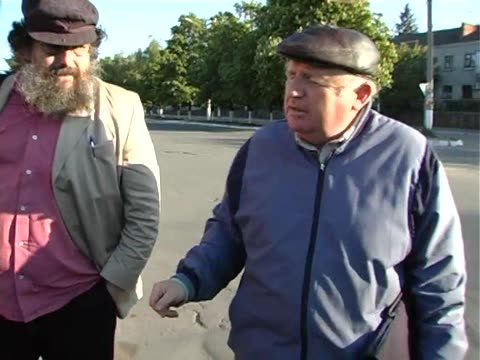
The second man opens by explaining that the synagogues were closed before the war and that after the war only a few were allowed. He recalls that a synagogue building stood on a spot in Bershad', and points out the main street, which became Lenin Street. Sklyarskiy then gives his name and patronymic and says he was orphaned young (his mother died when he was three, his father when he was seven) and brought up by an aunt and uncle in the shtetl Zhornysche, where about two thousand Jews lived. He tells how in 1942 the Jews were driven out by police, he was shot at and wounded, and the family hid in a dugout in a field. His sisters and their children were killed when he went out for food; he then joined the partisans and was wounded again. He describes his father as a carpenter, his sisters, and his schooling: a four-year Yiddish school, then a Russian one. He talks about the shtetl before the war, a rabbi, holidays in the synagogue and the postwar murder of a Jewish man. Kerler asks about the length of the hiding and the number of people in the dugout, and asks him to retell the first shooting and the forced labor under the Germans, including burying dead soldiers.
The catalogue label says only 'Interview'; the transcript shows the street talk on synagogues, then Sklyarskiy's family, school, wartime survival and repeated account.
Sklyarskiy talks about his life during World War II. He also mentions his family and explains how he escaped shootings by the Ukrainian police and his return to Zhornyshche. Sklyarskiy mentions mass shootings in the woods of Illintsi and describes his encounters with non-Jewish classmates near the village Luhava, while being injured. He then continues to describes his escape from Zhornyshche, where he encountered his brother.
From the machine transcript
Sklyarskiy describes the roundup of the Jews of Zhornyshche by the police and the head of the Ukrainian police. He tells how he was wounded and escaped the shooting, and how former classmates from a nearby village refused him bread. He then recounts returning to Zhornyshche, a narrow escape, and meeting his brother Yasha, who had hidden in a tree. He also names the three sisters of his family who were hidden with the children.
Gives the name of the police chief and the names of three sisters.
Sklyarskiy speaks about his family and their fate during World War II. Sklyarskiy also mentions who spent time with him in hiding in March 1943. He then returns to his account of escape from shootings in May 1942, including receiving help from non-Jews.
From the machine transcript
Kerler and Lemster ask Sklyarskiy to sort out who was in the pit: three sisters with their children and Sklyarskiy's brother, with names of the mothers and their children. Sklyarskiy then tells of joining partisans in 1944, a brother's volunteering for the army, and the time in hiding in the forest. He also recalls hiding among trees and in an attic, a non-Jewish man named Vasyl who helped, and how he remembers the date of the shooting.
Adds the long sorting-out of family members in the pit and the non-Jewish helper Vasyl.
Sklyarskiy speaks about the episode, when he hid in a pit with other family members with the help of a Ukrainian Christian near the village Ivanki between spring and fall 1943. He describes how he was sold out by locals and daily survival.
From the machine transcript
Sklyarskiy describes months of hiding in a pit or catacomb with his family near Ivanky, in Lypovets district, until they were betrayed by local people. He explains what they ate while in hiding. He tells of their flight, of a night spent near a river, and of another family's hidden bunker in the forest.
Adds the food in hiding and the neighbors' betrayal.
Sklyarskiy talks about his life and family after World War II. He returned to Lypovets and mentions that his sister, who served in the Red Army, moved to America after the war. He then returned to his hometown Zhornyshche, before moving to Proskurovka. Sklyarskiy continues that he worked there at a field hospital for three months, before moving west with a Red Army field hospital to several towns in Poland and Germany. Sklyarskiy joined his sister who had been working at the front. He states that he was rejected at a military draft in Kyiv due to his injury, whereas his brother (i.e. cousin) was accepted and fought at the front.
From the machine transcript
Asked about the time just after the war, Sklyarskiy says he was in Lypovets, that his older sister served in the army, lives now in America, and that another sister cared for children in the village. He then recounts working in a field hospital in Proskurov for some months. He moved with the hospital to Poland and Germany. He says he was not accepted for front service because of his wound.
Adds Proskurov and the move through Poland and Germany with a hospital.
Sklyarskiy speaks about his life after the war. He and his sister moved to Vinnytsya, where he completed accountant courses. Sklyarskiy worked as an accountant in several towns, including Dzhulinka and Kitaygorod. He was married in Bershad in 1951.
From the machine transcript
Sklyarskiy talks about the years after the war, when he finished bookkeeping courses in Vinnytsia and worked as an accountant in several places. Kerler and Lemster also ask when he married and look for a photograph.
The marriage date is not clear in this passage.
Sklyarskiy talks about his family and shows photographs. He has family in Israel. Sklyarskiy also speaks about his wedding and returns to his life during the war. In particular, he addresses the period when he joined the partisans and was injured. Sklyarskiy then mentions his military awards and recognition from his Ukrainian neighbors. Sklyarskiy raised two sons, one of whom lives in Israel, and as well as one daughter.
From the machine transcript
Sklyarskiy shows photographs of his wife, twin grandchildren, and a son in Israel. He tells of his wedding in Bershad' in 1951 with klezmer music, a second wedding of sorts with partisans in the forest, and his awards as a partisan. Questions follow about relatives still in Bershad', his two sons and a daughter, who died in childbirth in 1980, and the help he receives from Hesed.
Adds the photographs, the marriage in 1951 and Hesed.
Sklyarskiy addresses his life today and charity by the local community. He then returns to discussing his family.
From the machine transcript
Sklyarskiy talks about his flat and Hesed's help in the heating season, then about his sister, who lives in Kaliningrad, and the older sister who went to America in the 1970s with her daughter. Lemster and Kerler ask about her, and Sklyarskiy answers.
The team meets Listengurt and informally speaks with her, before setting up the formal interview. She speaks about contemporary life and work today in Odesa.
From the machine transcript
The team meets Listengurt in Odesa and chats informally before the interview. She talks about a factory that is planned to be sold and its dangerous ammonia.
The factory and ammonia, as the informal topic.
Listengurt speaks prewar Jewish buildings, as well as Jewish life in Odesa during World War II. She mentions, in particular, an event of forced gathering and execution of the local community. Listengurt also speaks about a specific family who escaped.
From the machine transcript
Listengurt recalls a visit in early childhood with her father to a building that was a museum before the war. Kerler asks about the occupation of Odesa. She tells how the Germans gathered Jews, packed them into a warehouse and set it on fire, with one survivor. She also tells of a neighbor family: one man's brother and relatives who escaped and a girl and woman who were killed. She briefly mentions the ghetto.
Adds the museum building and the burning of Jews in a warehouse.
Listengurt touches upon her family's return to Odesa in 1944. An unidentified woman then joins the conversastion and speaks about her family's role in saving Jews during the war.
From the machine transcript
Listengurt says her family returned to Odesa right after its liberation. An unnamed woman joins and, mostly in Russian, explains that she is trying to document the story of her family, who saved people during the war. She tells how two men escaped a death march and were hidden by a German farmer. Kerler asks for names and suggests contacting an association.
The unidentified woman's account of rescue is in Russian.
Listengurt speaks about life today.
From the machine transcript
Listengurt and the team speak about the difficulty of finding information on the Internet and on changed names of children today.