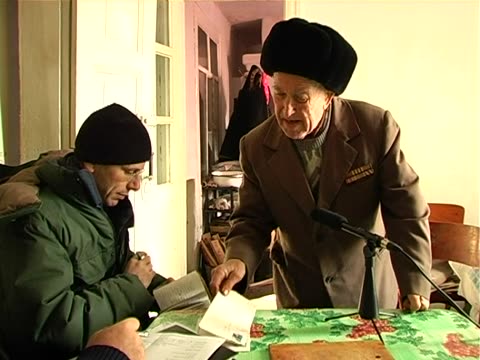
The team walks up to Sklyarskiy's house and meets him at the entrance. The camera collects footage of his house.
From the machine transcript
The team arrives at Sklyarskiy's house and speaks to him at the door. Kerler explains that he spoke with the son the previous day, and they agree to start in ten to twelve minutes. Short exchange with others present; mostly arranging.
The team enters Sklyarskiy's house and sets up the formal interview with him. He provides personal information and speaks about his family. Sklyarskiy grew up with step-siblings (his cousins). The sisters live in Israel and America.
From the machine transcript
Sklyarskiy gives personal details: his Yiddish name was Shloyme, and his sister Khane (Khanshe) is about four years older. A sister lives in America since 1979 (?) and another is in Israel; they discuss her telephone number and how she emigrated. Kerler then asks about his birthplace Zhornyshche and its Yiddish name.
The transcript shows the sisters' emigration and telephone details and a question on the Yiddish name of Zhornyshche.
Sklyarskiy talks about his hometown Zhornyshche, including prewar Jewish life. He states that the synagogue was turned into a kolkhoz during Soviet times. He then speaks about Christian locals who collaborated with the German during the war.
From the machine transcript
Sklyarskiy describes Zhornyshche as a small town in Lypovets district, with perhaps around fifteen hundred Jews (?). The synagogue was later made into a warehouse or kolkhoz store. He names the police chief Zavalinsky, who with a German collected the Jews in May 1942.
The transcript names the police chief Zavalinsky and the synagogue's conversion.
Sklyarskiy speaks his life during World War II; in particular, about the forced gathering of the Jewish community on May 27, 1942, to be taken for mass execution in the nearby village Illintsi. He also mentions a non-Jewish childhood friend who warned Sklyarskiy beforehand and describes his escape from the gathering. Sklyarskiy maintains that a few Jewish artisans were selected to stay behind in Zhornyshche.
From the machine transcript
Sklyarskiy recounts the roundup of the Jews of Zhornyshche on 27 May 1942 to be shot at a place some eight kilometres away. A non-Jewish childhood friend, the son of a village elder, had warned him days before. He tells how a few tailors and shoemakers were left behind, how he ran and was wounded in the hand under fire from Zavalinsky and a German officer, and how he later met peasants who pitied him.
Sklyarskiy continues to describe his escape during which he ultimately joined the partisans. He talks about the year 1943, which included hiding with his adoptive parents in their basement in Zhornyshche, before escaping to Ivanki, where they hid in a pit. Sklyarskiy's parents passed away during his early childhood in Lypovets. He was raised by one of his three maternal aunts in Zhornyshche. Sklyarskiy describes his daily life in the pit and how he and his siblings went out in search for food for a total of approximately two months. One day, he explains, he and a couple of his siblings left the pit and his family was shot on March 8, 1943. According to Sklyarskiy, locals informed on them. He then describes their escape to Zhornyshche and encounter with former classmates.
From the machine transcript
Sklyarskiy tells of being orphaned young and raised by his mother's sister, and of hiding in 1943 with relatives in a cellar and then in a pit near Ivanka, living at night on food begged from villagers. His three aunts and their children were shot there in March 1943 after being informed on, apart from one boy who was wounded and spared. Kerler and the other interviewer ask about dates and names; he also returns to Zhornyshche and meets locals who know of the killings.
The transcript shows the interviewers' questions on dates and names, and the boy who survived the shooting.
Sklyarskiy speaks about his life during the war, addressing the period when he planned to join the partisans with other escapees in summer 1943. He then shares a dream where he was told not to return to the Linnets woods, but rather to hide in the fields. Sklyarskiy then describes his and his sibling's escape from an attack by the Cossacks in the woods between Zhornyshche and Krasnenke. He also mentions his encounter with non-Jewish boys.
From the machine transcript
Sklyarskiy recounts how in summer 1943 a group of thirteen or fourteen escapees set out to find the partisans, carrying bread. He tells of a dream voice that warned him to run to the fields rather than the forest. Cossacks attacked in the woods; he escaped but found two of the group shot dead, and he describes the loss of his shoes and a girl who was wounded.
Sklyarskiy talks about his family's fate during the war. He explains how his step-sister (cousin) was adopted by a non-Jewish family. She later joined the Red Army and was the head of the military pharmacy during the war.
From the machine transcript
Kerler asks about a cousin raised as a sister who was adopted by a non-Jewish family. Sklyarskiy says she worked in a military pharmacy during the war and was shell-shocked at Stalingrad. They discuss his correspondence with her and with the sister in America, and that her daughter studied in Kaliningrad.
Sklyarskiy returns to his life during the war, addressing the period after his third escape, joining the partisans for several months during winter 1943. He then talks about the period when he joined his sister, who worked at an Red Army field hospital, moving along the front. Sklyarskiy worked at the hospital until the end of the war, which he finished in Germany. He then returns to the episode about the Cossacks' attack.
From the machine transcript
Sklyarskiy goes over his three escapes and his time with the partisans for several months in winter 1943, and a cousin who died. His sister found him and took him to a military hospital, where he stayed until the war ended in Germany. Kerler then returns to the Cossacks between Zhornyshche and Krasnenke and asks about the season and the hardships.
The transcript adds Kerler's recapitulation of the three escapes and the war's end in Germany.
Sklyarskiy describes the local Cossacks, who were in conflict with the partisans. He then speaks about a local police officer in Zhornyshche, who collaborated with the Germans and organized forced gatherings of the Jewish community.
From the machine transcript
Sklyarskiy describes the Cossacks, called bandits who sided with the Germans, in conflict with the partisans. Asked about the Zhornyshche police chief Zavalinsky, he says he had been a teacher in the school, fled and returned as police chief. He tells of how Zavalinsky had twelve Jews taken to the school and cinema and beaten.
Sklyarskiy speaks about his life during the last months of the war, as well as his experiences among the partisans. He also mentions fellow-Jews in the partisan group and talks about Jewish and non-Jewish relations.
From the machine transcript
Sklyarskiy speaks about his last months with the partisans: going on operations and the commander of his unit, a Jew. A few Jews were in the partisan group. In answer to questions he says there was no friction with Christians, and he names a partisan brigade of about two thousand men; he served some months and was armed with a carbine.
Sklyarskiy returns to the moment when he slept in the fields and talks about his dream. Sklyarskiy then reads a note, where he wrote down the words in his dream.
From the machine transcript
Sklyarskiy returns to the night in the fields and the dream that told him to run to the fields, not the forest. They also discuss a note where he wrote the dream down. He recounts the Cossack attack, the death of those who ran into the forest, and a thirteen-year-old girl wounded in the leg. A cousin who shared his hiding place later became a partisan hero.
The transcript adds his reading and discussion of a note written after the dream.
Sklyarskiy speaks about his family.
From the machine transcript
Sklyarskiy gives family information. His brother Mikhail, named by his son, died as a hero; his father was Moishe, so he is Moiseyevich. The cousin Yasha was Yakov Gertsovich (?) Varnavitsky (?), three months younger. He also speaks of his children, a son who lives with him and a daughter in Bershad'.
Sklyarskiy addresses Jewish life in Zhornyshche during World War II.
From the machine transcript
Asked whether there was a ghetto in Zhornyshche, Sklyarskiy says there was none. He talks of a rabbi in Jerusalem who sent money, and the attitude of non-Jews toward the Jews. Much of the passage is unclear.
Sklyarskiy explains his military awards.
From the machine transcript
Kerler asks about the medals Sklyarskiy wears; he explains they are for the war and for partisan service, and says he has others at hand to show.
Sklyarskiy explains his military awards and honors, before he describes his work at a field hospital from 1944 to 1945.
From the machine transcript
Sklyarskiy shows his documents and talks about his status as a partisan and war invalid, with a utility benefit that reduces his electricity charges. Kerler asks when his sister took him, and Sklyarskiy says he recovered in the Lipovets district. His sister was an officer in a field hospital, and he travelled with the hospital. Kerler also asks about the person who shot at him.
The transcript shows the discussion of benefits and documents, and his rescue by his sister.
Sklyarskiy speaks about his first injury, shot by the Ukrainian police officer in Zhornyshche. He then returns to his dream in the fields, as well as describes the help he received from Ukrainian locals.
From the machine transcript
Sklyarskiy speaks of the German officer and the shooting after his flight, then of a dream in which a person told him to run into the field and not the forest. He tells how two men who joined the partisans hid in a secret hiding place near the pit where Jews were shot. He mentions help from local people and the driving of Jews on foot and in carts, and begins to speak about the ghetto. Parts of this are unclear.
The transcript shows the hiding place near the killing pit and the two brothers who helped, rather than only the shooting.
Sklyarskiy addresses Jewish life in the Bershad ghetto during the war. Sklyarskiy then returns to his and his family's life at the beginning of the war in May 1941. He was a forced laborer and built roads.
From the machine transcript
Sklyarskiy speaks in Russian and Yiddish about the Bershad' ghetto, the Romanian zone, and the killings elsewhere. He recalls working on roads from 1941 with the police chief named Zavalinskiy (?), and the way the forced labourers were treated. Kerler asks when the Germans entered; he answers that it was at the start of the war. Kerler then asks him to talk about life after the war.
Sklyarskiy speaks about his life, including work, after World War II. He took courses on accountancy in Vinnytsya for six months and worked in several towns, including Bershad.
From the machine transcript
Sklyarskiy says that after the war he studied accounting for six months in Vinnytsya and was then sent to work in bookkeeping, in Bershad' among other places. Kerler asks whether someone had asked him to record what he went through, and then asks about the best times of his life.
Sklyarskiy recalls his best moments during his life after the war. He also addresses his family and remembers the moment when his daughter passed away.
From the machine transcript
Sklyarskiy speaks of the better years after the war, his marriage and the birth of his children. He tells of his daughter, who lived in the Donbas, and her sudden death after a visit to a doctor, and of how he and his sons learned of it by phone. He also mentions her husband, a worker, and his father-in-law, who died at about fifty-four.
The transcript shows details of the daughter's death and of her husband and his father.
Sklyarskiy addresses postwar Jewish life in Bershad. He recalls synagogue services. Sklyarskiy then mentions his traditional wedding in Bershad in 1951. He then returns to his family.
From the machine transcript
Answering Kerler's questions about postwar Bershad', Sklyarskiy says the synagogue was used and many Jews attended, and that Yiddish was spoken in the streets. He says he was married in Bershad' with Jewish music and klezmer, and that kosher meat could be bought. Kerler then asks about his granddaughter Lena in Israel and begins asking for an address for correspondence.
The transcript also shows his granddaughter in Israel and Kerler's request for an address.
Sklyarskiy shows family letters.
From the machine transcript
Sklyarskiy and Kerler, with S2's help, go through letters and addresses, a postal code and a house number. Kerler asks whether Veidlinger, a historian, may write about him in English and he in Yiddish, and Sklyarskiy agrees. Kerler asks where the toilet is. Sklyarskiy mentions Ivanky as a village in the Lipovets district.
Sklyarskiy describes the local geography and life today. He then talks about his family and shows letters.
From the machine transcript
Sklyarskiy speaks about the village of Ivanky, where people were shot, and about a visit there about ten years earlier. He shows letters and talks about his granddaughter Lena, who recorded an interview with his wife. Kerler asks about Lena's surname and city in Israel, where she studied at a university, and about a number abroad.
The transcript shows the Ivanky killing site and the granddaughter's interview with his wife.
Sklyarskiy speaks about his family, before he returns to his dream.
From the machine transcript
Sklyarskiy speaks about his family and again about the dream in which he was told to run to the field. He mentions his wife's fasting and illness near the end of her life and the interview his granddaughter made with her. Kerler arranges to photograph him with those present, and there is talk of his writing. A garbled recogniser loop appears in this part.
The transcript shows his wife's fasting and the arrangements for a photograph.
The team finishes the official part of the interview with Sklyarskiy and he speaks about contemporary, including Jewish, life. Sklyarskiy also speaks about life during the postwar Soviet period, as well as local geography.
From the machine transcript
Sklyarskiy and Kerler finish the formal interview and he speaks of today's life, the market and the neighbours. He recalls a Jewish couple, and a pious man who prayed, and says that few Jews and some non-Jews still speak Yiddish in Bershad'. They discuss the cost of dental care and the polyclinic. He returns to the story of the two hiding places and to the geography of Ivanky and Lipovets. Kerler thanks him and offers blessings.
The transcript shows talk of Yiddish speakers today, medical costs and the Lipovets district, and the return to the hiding story.
Sklyarskiy talks about his family, before the team concludes the interview with him.
From the machine transcript
Sklyarskiy speaks in Russian about his father, who before his death wanted to see his son, and about walking from Lipovets to Ivanky, with a mention of a stepmother or an aunt (?). Kerler and the others then thank him and the interview ends.