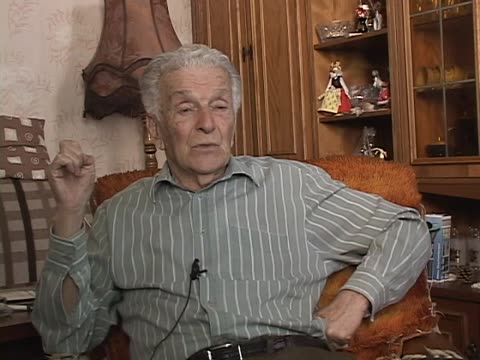
The second part of the tape is a formal interview, recorded in Yiddish and German, with Alfred Benovich Schreier, born 1922 in Drohobych. Schreier provides personal informal and talks about his family. His parents were born in Drohobych and raised him as an only child. His father was a chemist and studied in Germany. He received his doctorate in Zurich, Switzerland. Schreier grew up in Jaslo, Poland until the age of ten. His father worked as the chief chemist at an oil refinery there. Schreier explains that his father lost his work during the Great Depression. His family moved to Drohobych in 1932. His mother was a pharmacist.
From the machine transcript
Kerler opens the interview with Schreier, giving the date and place. Schreier was born in Drohobych in 1922 and says he is the last Jew born there before the war. His father, a chemist, studied in Germany and took his doctorate in Switzerland. The family lived for ten years in Jasło, where his father was chief chemist at an oil refinery. He lost the job in the Depression and the family returned to Drohobych in 1932. His mother, Leontina, was a pharmacist's daughter. The passage ends with the great action of 1942.
Adds that the passage ends with the 1942 action.
Schreier talks about his family’s life during the war. He talks about the largest action in 1942, when 5000 Jews from Drohobych were deported. The majority was exterminated in the Belzec concentration camp and less than half were shot in the Janowska concentration and forced labor camp, according to Schreier. He lost his uncle, father, grandmother, and cousin, who were deported to Belzec. Schreier continues that his mother was saved from the mass deportation, but then shot in a mass execution in the Broniza Woods. Schreier explains that there were five forced labor camps in Drohobych. He was imprisoned in the forced labor camp in the village of Herafka. There Schreier worked as a carpenter in a lumber mill. Schreier maintains that he survived with the skills taught by his teacher Bruno Schulz. He briefly talks about the Polish-Jewish writer. He taught Schreier for four years at the Polish school. His mother was imprisoned in another forced labor camp and worked at the municipal factory. Schreier talks about the mass liquidation and shooting of prisoners of three forced labor camps. He explains that he and five other young Jews were taken away from the assembly point, from where Jews were forced to the Broniza Woods. They went to another forced labor camp, where Schreier worked at ceramics factory for one and a half months. He describes the selection by SS officers after the liquidation the forced labor camp. Schreier was sent to the last existing forced labor camp at the Drohobych town center, where he worked at an oil refinery. He explains that on April, 13, 1944 his camp and another one in Boryslav were liquidated and the prisoners were forced to go to the Plaszow Concentration Camp in Poland. Schreier was imprisoned there for six months, before being sent on a march westward as soon as the Red Army front drew closer. Schreier was sent to the Gross-Rosen concentration camp in Poland and was then selected to work further west by a German factory director. He explains that the building of the forced labor camp Schreier was supposed to go to was not yet finished and was therefore sent to Buchenwald concentration camp. In Buchenwald Schreier stayed at Barrack 59 for a short time undergoing another selection. He was then sent to the Taucha forced labor camp to work at a bazooka factory. He worked there until April 1945, before being sent on a death march. According to Schreier, the death march was organized because the Germans could not provide any food for the prisoners, as the nearby town Halle was already captured by the American army. Schreier talks about the death march with two thousand other prisoners, including Jews, Italians, and Poles. Schreier could not continue to walk after five days. Schreier recalls how he sang in the evenings, which ultimately saved him from execution when he was too exhausted to continue walking. A German prisoner helped Schreier by claiming that he was a well-known opera singer. Instead of killing Schreier, the SS officer pushed him into the trench, where he was found by a young German, who brought Schreier into a nearby village on his bicycle.
From the machine transcript
Schreier tells how in 1942 his father, uncle, grandmother and cousin were deported to Belzec, and his mother was later shot in the Bronica forest. He describes five forced-labor camps in Drohobych, working as a carpenter at a sawmill near Herafka (?), and his teacher Bruno Schulz. He was moved through several camps, then the oil refinery, and in 1944 was sent to Plaszów, Gross-Rosen, Buchenwald (Barrack 59) and Taucha, where he worked in a panzerfaust factory. He describes the April 1945 death march with Poles, Italians and Germans. At about the fifth day, too weak to walk, he was saved from being shot because a German prisoner described him as an opera singer, and a young German found him.
Adds the camps after Herafka, Plaszów, Gross-Rosen, Buchenwald and Taucha.
Schreier describes his life after the war, after he was found by a young German and taken to a nearby village, to a courtyard where the mayor lived. Schreier was then taken to a Soviet prison camp, along with other fellow Jews. He describes his life at the camp and recalls how well he slept. Upon leaving, the Soviet soldiers wanted to take Schreier with them, but had not enough strength to stay on a horse. The local farmer took Schreier to a DP camp in the town of Dobeln, which had already surrendered. Schreier stayed in the overcrowded camp for two days and had to leave. He and other displaced persons, mainly Italians, walked to Rosswein. Schreier explains that the SS officer turned them away because the Rosswein camp was already closed down and therefore no food was available. Schreier recalls how a German woman slipped him some bread. Schreier walked another 35 kilometers to the former Freiberg concentration camp. He stayed there for three days and was liberated by the Soviets on May 7, 1945. Schreier went to the town center to find work at a department store, which was opened up for Soviet officers.
From the machine transcript
Schreier tells what happened after he was found on the road. He was taken to a Soviet prisoner-of-war camp, where he slept well, and then to a town camp filled with displaced persons. He went on with the Italians toward Roßwein, where a German woman gave him bread, and then to Freiberg in Saxony, where he stayed in a former camp for a few days. He was liberated there by the Soviets around 7–8 May 1945. A French and a German doctor tried to help him. Afterwards he looked for work at the department store opened for Soviet officers.
Adds Roßwein, the German woman with bread and the French doctor.
Schreier talks about his life after the war, when he went through several DP camps. Because of Schreier’s insistence, he became the assistant of the department store director and primarily worked as a translator until the end of 1945, when an order came in that all former prisoners had to return to the Soviet Union. Schreier never formally studied the German language at school. Schreier continues that he then went to Dresden with an officer friend from the Soviet Army. He stopped at Hellerau first and then moved further to Dresden Klotzsche. Schreier worked as a translator at the Soviet Trade Administration until fall 1946. Vasily Sokolovsky issued a decree of return. The former camp inmates were taken to the central Soviet military base in Teltow. A German driver took Schreier to the Red Cross in Berlin, where he reported on his relatives in Argentina. According to Schreier, the living conditions were so horrible there, so that he returned to Teltow instead of trying to figure out his relatives’ address, requiring Schreier to stay for a minimum of two months. Schreier then travelled to Grodno, Byelorussia, for seven days, where he stayed at former prisoner camp. Schreier, a professional musician, played at restaurants in exchange for food. Schreier explains that he had to stay in Grodno until all Soviet soldiers born 1922 were released from the army. Schreier received a notification early 1946 permitted to leave. He traveled to Vilnius, Lithuania, joining a fellow musician from Drohobych. They returned to Drohobych together.
From the machine transcript
Schreier recalls the end of the war and the years after it. He worked as a German–Russian interpreter without ever having studied German formally, was in Freiberg until the end of 1945, then went to Dresden (Hellerau, Klotzsche) as interpreter for the Soviet trade administration. He describes being gathered at Teltow near Berlin, the Red Cross in Berlin where he asked about an aunt and uncle in Argentina, and a camp in Grodno where he played in a small orchestra, until he returned to Drohobych via Vilnius with a fellow musician.
Gives the Freiberg and Dresden details, and says that his relatives in Argentina were the reason for the Red Cross visit.
Schreier talks about his life after his return to Drohobych. He found work in a dance orchestra right away, before he studied at the local music institute and then at the Lviv Conservatory. Schreier got married in 1949. Schreier finished his studies he began at the Lviv Conservatory at the music department of the Pedagogical Institute in Drohobych. Schreier continued playing in a dance orchestra and taught at the musical institute for forty-two years. Schreier then talks about his family. He was the only survivor of his family. He also recalls his uncle Rabbi Dr. Bernard Schreier who taught religious studies at the Polish Jewish school.
From the machine transcript
Schreier tells of his return to Drohobych, where he quickly found work in a large dance orchestra and played for the cinema. He studied at the music lyceum and the Lviv conservatory, finished at the music department of the pedagogical institute and taught at the music lyceum for 42 years. He says he is the sole survivor of his family and had no siblings. He mentions his father's sister, wife of Rabbi Dr. Bernard Schreier, who taught Jewish religion at the Polish gymnasium. His marriage and his wife's death are mentioned but the year is unclear.
Adds the uncle's relation by his aunt Matilda (?) and Kerler's questions about aunts and uncles.
Schreier talks about prewar Drohobych and its population structure. He recalls the positive relations among the different ethnic groups. He then talks about the religious education at the Polish school. Schreier recalls how religious instructors from different confessions came in to teach Jewish, Ukrainian, and Polish students. Schreier was taught by his uncle.
From the machine transcript
Schreier describes prewar Drohobych, with about 42,000 inhabitants, now about double, and its mix of Poles, Jews and Ukrainians. He mentions the oil industry, the many Jewish professionals and mild antisemitism such as boycott slogans. In the gymnasium the groups sat together and nobody asked who was what. For religion lessons each group had its own teacher, including his uncle Dr. Bernard Schreier for the Jews; he blames Hitlerism and Stalinism for later hostility.
Adds the antisemitism remarks and the postwar blame on totalitarian systems.
Schreier talks about contemporary life in Drohobych, as well as Jewish life. He then talks about the Choral (Great) Synagogue in Drohobych, which was built in 1865 and was the largest synagogue in prewar Poland. Schreier then talks about life and work during the Soviet period.
From the machine transcript
Schreier speaks about Drohobych today, with few Poles and about 180–190 Jews, and about the Great (Choral) Synagogue, which is being repaired but has no minyan. He gives its date as 1865 and says it was the largest in Poland; it stands on Leon Reich Street. He recalls tolerant Austro-Hungarian times and the Polish period from 1918. He also describes the Soviet influx of village people into the city to work in new factories, and the resulting change in its character.
Adds the Austro-Hungarian tolerance and the Soviet-era migration from villages.
Schreier talks about Jewish life before the war. He then talks about the languages he spoke at home, including Polish and Hebrew for Schreier’s bar mitzvah. Schreier’s father grew up in Yiddish and his mother in Polish. He studied with his uncle for his bar mitzvah, who told him to recite part of his parsha in Polish. Schreier then talks about the poor Jewish neighborhood of Drohobych. He recalls how he visited this neighborhood with his teacher Bruno Schulz, who drew sketches of the buildings there. Schulz worked at Schreier’s school since 1924 without an official teacher’s permit. Only after Schulz passed his exams in 1936 at Cracow University, he received an official permit. Schreier continues to talk about Schulz, who studied drawing and carpentry, including his life during the war and legacy.
From the machine transcript
Schreier talks about Jewish streets and houses and the languages of his home, where Polish was spoken, his father knew Yiddish well and his mother did not; he describes his bar mitzvah in his uncle's small synagogue. He then speaks at length about Bruno Schulz: his walks in the poor Jewish quarter, his teaching of drawing and carpentry without a formal permit until 1936, his family, translations of his work and Schulz festivals in Drohobych. He then describes the German occupation, the 'Black Thursday' shooting, the Gestapo officers Landau and Günther, and Schulz's murder.
Adds the home languages, the bar mitzvah, Schulz's translators and the account of the murder by a Gestapo officer.
Schreier then discusses Jewish cultural life before the war. Schreier then shows a poster, advertising a film about Bruno Schulz. His paintings were hidden during the war. Schreier shows photographs of the synagogues.
From the machine transcript
Schreier speaks about being asked to sing for a visiting group and answers Kerler's questions on Yiddish songs and newspapers in prewar Drohobych; he sings only a Yiddish song about a Kraków carpenter. He describes Schulz's murals in the villa of the Gestapo officer Landau, found by chance in a dining room, and shows photographs of them and of the Great Synagogue and other buildings. He talks about plans for a Schulz museum and a book on synagogues, and the wooden churches of the town. Kerler explains that he is a professor of Yiddish at Indiana University.
Adds the Yiddish song and newspaper questions and the finding of the Landau-house murals.
Schreier talks about his work as a musician. He plays the violin, sings, and studied conducting. He then talks about Jewish life under German occupation, in particular he addresses how the chairman of the Judenrat (Jewish Council) Dr. Izak Rozenblat successfully set up a soup kitchen for children in the Choral Synagogue. Schreier continues to tell the story, when the police barged in on the first meal organized by the soup kitchen and shot all the children.
From the machine transcript
Answering Kerler's question about his music, Schreier says he plays violin, sings and holds a conducting diploma for choir and orchestra. He then tells of the Judenrat chairman, Dr. Isaac Rosenblat, who after the August 1942 deportation of 5,000 Jews asked the Gestapo to allow a soup kitchen for the remaining small children in the synagogue. The Gestapo agreed after two days, and when the children first sat at the tables, police burst in and shot them all.
Adds the August 1942 deportation as background.
Schreier plays a Yiddish song, he sings about a Yiddishe Mame.
From the machine transcript
Schreier talks about a recorded disc and says that more will be redone, and offers Kerler a Yiddish song. A recording or performance of a song about a mother and the golden land is then heard, mainly voiced by Lemster. Afterwards Schreier says he plays and sings it with accompanists, and that the recording is not finished.
Names Lemster as the voice heard in the song and notes that the disc is not finished.