0:00
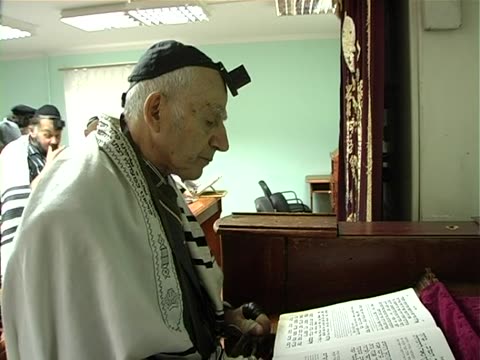
Burshtein praying.
Burshtein is filmed praying in Hebrew; the recognition is very poor. The prayer includes recitation of lists of names in the form 'X son of Y'. A second voice then begins reading a psalm in Russian translation (page 136).

Burshtein praying.
Burshtein is filmed praying in Hebrew; the recognition is very poor. The prayer includes recitation of lists of names in the form 'X son of Y'. A second voice then begins reading a psalm in Russian translation (page 136).
Bukhshtein praying.
A second voice reads a series of psalms in Russian translation, while the Yiddish line in the transcript is only a garbled transliteration of the Russian. Burshtein then recites a list of names again. Russian commentary follows on counting the Omer and on the decline of observance and Torah study.
The transcript shows the Russian reading is of psalms, followed by Russian commentary on the Omer, which the catalogue does not mention.
Service ended.
The service ends and the room turns to confused conversation in Yiddish and Russian. Speakers are hard to tell apart and one phrase loops. Someone seems to recount an exchange with a doctor or visitor, and the interviewers ask what was meant.
(religious) life today and anecdotes.
Lemster and Kerler discuss with the informants the Jewish community and religious life today, including progressive (Reform) rabbis and a woman rabbi in America. Lemster tells a joke about a man who buys a Porsche and wants a 'progressive' mezuzah. Geller mentions people in Zhytomyr who visit a holy man, and then begins to speak about the changes after 1991.
The transcript adds the discussion of progressive rabbis and a joke about a progressive mezuzah.
Politics.
Geller discusses politics and the change after the collapse of the Soviet Union. He speaks of ideology, wages and prices, how people were left poor, and the Joint reviving in the early 1990s. He also speaks of growing old under the new conditions.
Return to Pyatka in 2005.
Geller tells of his 2005 trip to Pyatka with a grandchild (the catalogue says great-grandchild) to visit the Jewish cemetery. A hundred or so gravestones remain. He describes the killing of Jews buried there and the survival of a boy and a girl who later lived in Berdychiv and emigrated to Israel. Kerler asks how many Jews lived in Pyatka, and the passage ends with a Jewish man with a surname like Pastovsky (?) who was killed by a car.
The transcript shows the cemetery visit includes an account of mass killing and the fate of two survivors, and ends with a man named Pastovsky (?).
Prewar Jewish life in Pyatka.
Geller recalls prewar Jewish life in Pyatka. There were about five hundred Jews until the famine of 1932–33, after which artisans (carpenters, shoemakers, tailors) left for Odesa, Moscow and Kyiv. About 200 Jews remained in the mid-1930s, and 169 were drafted into the army. Relations with non-Jews were peaceful. Some non-Jews spoke Yiddish, and Jews and non-Jews lived on the same streets, with Jews mostly on one side.
The transcript gives about five hundred Jews until 1932 and about 200 in 1936. The figure 169 refers to men drafted into the army.
Dialectology and anecdotes.
Kerler and Lemster ask dialectological questions, including the word for grandmother and the word for 'thanks'. Geller answers with reference to Poland and the Czech border. He tells an anecdote about a girl from Pyatka arriving in Zhytomyr with sacks. Lemster and Kerler also comment on the use of the letter alef in Yiddish newspapers.
Yiddish language.
Geller speculates on the history of the Jews and the origin of Yiddish from German. He mentions Jews fleeing Spain to France and Germany, and debates which came first, Yiddish or German. Kerler raises the Yiddish songbook and asks whether it can be bought.
Life today.
A brief, fragmentary exchange mixing talk of someone's daughter with Kerler's remark about the songs being Burshtein's own, recalled by memory. A place near the war front (name unclear) is mentioned as somewhere Yiddish is still spoken but declining.
Songbook and informal chat.
The team looks at Burshtein's songbook, and Kerler asks about photocopying it. Burshtein says some songs date from childhood. A young man named Chaim Dovid joins, and there are remarks about a visitor from America. The talk turns to Litvak and Chabad Jews and the Sabbath guardians, then to Yiddish periodicals that still appear and how to obtain them. Geller's turns include jokes about marital matters and a computer in his family's home.
The transcript adds the arrival of Chaim Dovid, and talk of Yiddish periodicals and Litvak and Chabad Jews.
Informal chat and family.
Informal chat among Geller, Burshtein and Lemster about acquaintances: a man who should find a new wife, someone's two children (a son and a daughter), and arrangements for tomorrow. Parts are in Russian.
The talk concerns acquaintances' family matters rather than Geller's own family.
Yiddish songs.
Burshtein sings a Yiddish song expressing hope for a future in Eretz Israel and a song about longing for his home town, which he says he wrote recently. He mentions that he keeps writing songs and that the radio carries little about Israel.