0:00
Dialectology
Questionnaire session with a woman, partly in Russian, covering Yiddish words for a cross (Ukrainian and Catholic or Polish) and for thank you, plus a few words of farewell chat about the team leaving.

Dialectology
Questionnaire session with a woman, partly in Russian, covering Yiddish words for a cross (Ukrainian and Catholic or Polish) and for thank you, plus a few words of farewell chat about the team leaving.
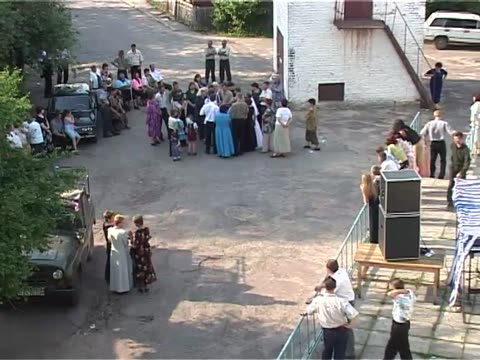
Wedding party on street.
Walking in the street after the interview; only a few words are intelligible, with talk about the way to the hotel in Russian.
Town footage.
Town footage on the way to Ovruch with scattered talk in Russian and Yiddish about a house number; the team ends by greeting a man and asking whether he speaks Yiddish.
Arrival at Dorfman’s house.
The team arrives at Dorfman's house and introduces itself; first names are exchanged, and they explain that they heard there were Yiddish-speaking Jews in Ovruch and ask to interview him and a woman present.
Informal chat.
Preliminary chat about who the team is and about a Jew from Slovechno found in Ovruch; Dorfman says he was born there.
Personal information.
Dorfman gives personal information: he was born in Slovechno, which the Germans burned down in the war so that not one house remained. Katz asks how he is called, and he is Boris Dorfman, called Berl.
Family.
Dorfman talks about his family. His father was born in Slovechno, worked as a shoemaker and later traded in fish and mushrooms; his mother and her maiden name are discussed, and he names his grandfather as a very honest man with a white beard. He had a brother in Israel and two sisters, one in Israel and one who died in Canada.
Education.
Dorfman says he was a boy before the war; afterwards he finished an institute and worked as a supervisor of building repair for nineteen years and as foreman for eighteen. Katz then asks about his earliest childhood memories.
Childhood memories.
Dorfman recalls Slovechno as a Jewish shtetl, about ninety percent Jewish, with shoemakers, tailors and smiths and no antisemitism. He attended a Yiddish school until age six(?), then a Ukrainian school with seven grades before the war. He cannot name children's games, mentions friends Motl and Asher, and begins to tell about the tsaddik of nearby Velednik.
Driving to Volednicker Tsaddik.
Dorfman tells how in 1939, at the time of the war with Poland, a Jewish young man came from Poland, sent by his mother to visit the Velednik tsaddik. They rode by bicycle twelve kilometers to Velednik and a wheel fell off the cart as the young man had half-joked; he describes it as seen with his own eyes and his father's reaction. He then recalls the start of the war and soldiers going out against the Germans.
Beginning of war and prewar Jewish education.
Dorfman says Slovechno was a friendly Jewish town; no cheder or melamed existed in his time, only before. He studied three grades in the Yiddish school (Yiddish, literature, arithmetic), remembers Itsik Fefer, and says there was no hostility to the pious before the war.
Shabes celebration and religious life.
Dorfman talks about Sabbath before the war: his pious grandparents, his mother baking Friday and doing no work on Sabbath, a non-Jewish woman milking the cow, the wooden synagogue that burned, candle blessing and Sabbath foods such as cholent. Kerler asks about sweet fish and Hanukkah latkes of buckwheat flour, and Dorfman names the dreidel and a Purim noisemaker.
adds Hanukkah and Purim items and the wooden synagogue
Volednicker Tsaddik.
Dorfman says the Velednik tsaddik helped people, for example children who could not speak. After the war the little house was repaired, kerosene was sold there and visitors were not allowed. He himself did the first repair, and people from Uman later did a major one. He offers the address of a 98-year-old man who can tell more.
adds the postwar repair of the house and a possible further interviewee
Passover celebrations and postwar religious life.
Dorfman recalls Passover before the war: baking matzo at home, his father's seder, the four questions, Elijah, stealing the afikoman and no chametz in the house. He recalls Yom Kippur and kapores. After the war there were several minyans that the militia dispersed, and kosher meat was available while a shoykhet lived, but none after his death.
Religious life today.
Dorfman describes religious life today in Ovruch. Two young men from Israel, sent from Zhytomyr by Shlomo Vilgenets(?), come for the major holidays and help organize them. They speak Hebrew, not Yiddish.
Non-Jews.
Dorfman says non-Jews in Slovechno spoke Yiddish, citing a school friend, a non-Jewish boy raised among Jews. Some non-Jews in Ovruch understand it today, and a few old Jews still speak it. There were no conversions either way.
Jewish Slovechno.
Dorfman lists the Jewish trades of Slovechno (shoemakers, tailors, smiths, masons, painters), says Jews were not in the fire brigade there although an Ovruch fire chief was Jewish, and says football and volleyball were played informally. He was not in any Jewish youth movement.
Yiddish cultural life.
Dorfman recalls Yiddish periodicals: Sovetish Heymland and Der emes, possibly Der shtern, in the prewar and postwar periods, and talks about actresses (Klara Young) in prewar Slovechno and Ovruch.
Weddings.
Dorfman answers questions about Jewish weddings in Slovechno: the huppah, klezmer music, a freylekhs dance, and the town rabbi. He does not recall other details (the badkhn, a mitzvah dance) or any melamed in his time.
Prewar religious life.
Dorfman answers whether there were Hasidim in town: he did not see men with sidelocks, and there was no rebbe or tsaddik in Slovechno, only a rabbi he does not remember.
Potential Yiddish-speakers.
Dorfman gives the name and address of a possible interviewee in Ovruch, Benyamin Feldman, aged 98(?).
[undescribed content]
Katz and Dorfman briefly discuss how to say a house number in Yiddish (twenty-two), then Katz moves on to further questions.
Dialectology.
Dialectological questionnaire with Dorfman, mostly led by Kerler. Items include a good place, a good Jew, litvak and misnaged, vodka, charms against the evil eye, mourning customs and graveside signs, dybbuk, a clay golem and greetings at different times of day. Other items are Russian phrases for translation (please, thank you, mouse, book, the cold entryway, skin, window panes), and Dorfman often says he does not know the Yiddish.
Yiddish and Polish songs.
A woman sings Yiddish songs about luck and happiness, and a Sabbath-eve song recalling a grandmother and a grandfather at the Friday-night table. Kerler and Katz ask whether she knows Hatikvah. She recalls that Hatikvah was sung in Poland before the war. She sings a Polish school song about passing youth, a song about the Messiah, and a lullaby-like song about longing for home and mother.
Also includes a Messiah song and a lullaby, and Hatikvah is discussed.
Russian magazines and Russian language.
A discussion about a Russian magazine and about language. Katz and Kerler say they understand only Yiddish and want to speak Yiddish. The informant insists she knows Russian and Ukrainian very well, and Katz asks her name.
Personal introduction and family.
Groisburg gives her name and says she speaks Yiddish with no one now. She describes her father as an educated man who studied in Leningrad to become a doctor, and names her father and grandfather (the latter died in Warsaw). She says she was born near or in Berdychiv, in 1906, and that her father worked with the army.
Gives her birth year and the names and origins of her father and grandfather.
Education and prewar Jewish life.
Groisburg recalls attending an army school in Berdychiv and later working as a teacher. She tells of teaching Russian to poor Jewish children in a poor street. A Yiddish teacher came to the home at her father's wish, and she reads Yiddish only with difficulty.
Adds the Yiddish tutor at home and her difficulty reading Yiddish.
Passover celebration and family.
She remembers a Passover seder with an honoured guest, her grandfather, and gives her Yiddish and Russian first names, her father's and mother's names and the family surname. She says her father, a doctor, could not practise after the 1905 revolution and pogroms because of restrictions on Jews, and that she herself later joined the Communists.
Gives names of family members and the father's career blocked by the 1905 events.
Pogroms in 1920s.
Groisburg recalls pogroms in the 1920s, when Jewish families from Zhytomyr fled to Berdychiv and several families stayed in her home. She mentions a local leader whose name is unclear and says that many young people from Berdychiv emigrated to Palestine and America.
Includes a community leader (name unclear) and emigration of the young.
Emigration during 1920s and Zionism in Berdychiv.
She describes Zionist, Communist, Social-Democratic and Bund parties in Berdychiv and recalls an educated young man. The educated Jews spoke Russian, not Yiddish. There was also a Zionist school teaching in Hebrew.
Choral synagogue.
Groisburg remembers the choral synagogue in Berdychiv, with a cantor and choir, and says she went there with her father two or three times. She names the Staromestnaya street synagogue and answers Kerler's questions about the building and its location. She then mentions that she buried her mother elsewhere.
Family and life after the Revolution.
She speaks about her father: a learned man who wanted her to study Hebrew, though there was no opportunity. Under pogroms and poverty he insisted his children study, if need be as external students. He was drafted into the army before the Revolution. She and her mother were left alone after his death, and she then went to work.
Concerns the father's views on education and his army draft.
Life before the war.
Groisburg speaks about her sister, who studied at a technical school, and about the family's move from Berdychiv to Zhytomyr, whose date she cannot recall.
Zhytomyr before the war.
Groisburg describes Zhytomyr before the war as a large provincial city with many Jews and a Yiddish school. She studied in Ukrainian because her work required it, as her father had died and the family was large.
Family and (post) evacuation.
Groisburg lists her siblings, several of whom died. One went to the Caucasus, and a brother died in evacuation. Her mother died in evacuation and she buried her. They were evacuated for five years, and she worked as a specialist. She says the men in her family died young.
Covers siblings, the mother's death and five years in evacuation.
Life today.
She talks about life today: two young Jewish women and the local synagogue help her, and she mentions its rabbi. She says Jewish doctors and many others emigrated to Berlin, Israel and America and did not return. Kerler explains the recording's purpose.
Includes emigration of Jewish doctors.
Holiday celebration.
Groisburg recalls the Passover seder, with her brother asking the four questions to their learned father, who knew five languages. She then remembers Hanukkah and sings a Hanukkah song from childhood twice, mentioning dreidels and doughnuts. Kerler and Katz also talk with S4 about Russian.
Interviewing team.
Kerler and Katz explain their limited Russian and talk about having lived long in America. Katz says he is from Brooklyn, and Kerler asks about Jews' residence restrictions under the tsarist regime. A recogniser loop and mention of Moscow occur.
Studying and holiday celebration.
Groisburg says she learned German and French and that her father wanted her to study English. Kerler asks about Purim and about celebrations before the First World War, but she answers mostly about Passover matzo and holidays at home.
Holiday food customs and holiday celebration.
Answering Kerler's questions on holiday food, she names hamantaschen and pancakes. She says her mother made gefilte fish with raisins, and recalls her father going to synagogue on Sabbath and her mother on Rosh Hashanah.
Includes gefilte fish and the parents' synagogue attendance.
Prewar religious life and Sabbath.
Groisburg says that pews at the large synagogue were costly and her religious family could not afford them. She recalls that her grandmother was at home on Sabbath, which was observed. The children worked on Sabbath, while the father went to synagogue with his tallit, in which he was later buried.
Concerns the cost of seats, her father's tallit and burial.
Family.
Groisburg names her grandfather Shimon (the surname is given as Tatakovsky (?)) and says he died after the Revolution. His wife, her paternal grandmother, died later, and no relatives remain. Kerler asks whether a famine was involved.
Hasidism.
Asked about Hasidim in Berdychiv, she says there were many and describes a rebbe living on Staromestnaya street opposite her family's lodging. The family lodged with someone named Nuz (?). She recalls a Hasidic demonstration and says the rebbe, who had a court and sons who studied, was a good man.
Names the street and the landlord family (Nuz (?)) and mentions a Hasidic demonstration.
Zionist and dialectology.
Groisburg speaks about a Zionist writer, Samuil Marshak (?), who wrote in Russian and about Palestine, and Kerler comments on him. Kerler then asks for Yiddish words and she and S3 try to supply a word for 'ladder' (Russian lestnitsa), settling on a form of the Yiddish word 'loyter' (?). They also try to name the word for 'cross' (kryest/krest), which she says is not a Jewish thing.
Adds a word elicitation for ladder and cross.
Items of the dialect questionnaire asked here; each link plays the moment.