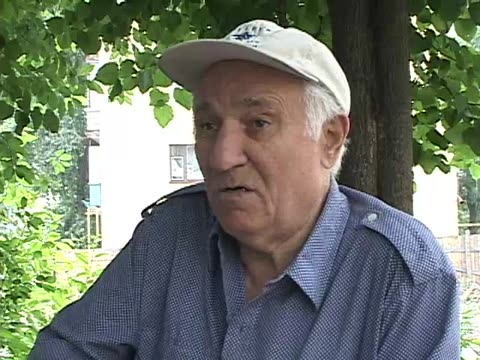
People › Lazar Eilovich Burshtein › conversation

Lazar Eilovich Burshtein; Veniamin Iakovlevich Geller; Khezkel Srulevich Shpitz

Zhytomyr 11 June 2007 Interviewed by Moisei Lemster, Dov-Ber Kerler 1.8 h · 2 parts on 2 tapes
Loading the player…
  1. MDV 799 0:00–53:23 · 53 min · not online — MCO
  2. MDV 800 0:22–53:51 · 54 min · not online — MCO
Passages
MDV 799 0:00–53:23

0:00

Informal chat.

Informal MDV 799 · MCO
From the machine transcript

Opening exchange before the interview proper. Lemster and Geller clarify who is being interviewed, where he lived and in what years, and the interviewers mention another Geller met the day before. Geller says he lived in Pyatka until 1936 and had written down that the town had a synagogue and a beit midrash.

1:36

Prewar Jewish life in Pyatka and family.

From the machine transcript

Geller talks about Pyatka before the war. Young people left the town in the 1930s for big cities, and he mentions a Jewish council (?) and Jewish craftsmen. His father Yankl worked in a factory, which closed during the hunger. Yankl went to look for work elsewhere, fell ill, returned in 1934 and died. His mother lived to 93 and kept house for four children. He then begins on his maternal grandmother, who had no child for ten years and went to a rebbe who promised her one child who would live long; the rebbe's name is not remembered.

Adds the father's death, the mother's age and the childless grandmother.

5:57

Life in 1919.

From the machine transcript

Geller names his maternal grandmother Etl and grandfather Mordechai, who was a ritual slaughterer. He tells of the Civil War attack on Pyatka around the eve of Rosh Hashanah, when the grandmother was shot, the family fled to Berdychiv, and the soldiers plundered the town. His father came from Khazhin near Berdychiv. The grandparents were from Pyatka.

Adds the grandfather's slaughtering, the grandmother's death and the father's birthplace.

8:41

Return to Pyatka.

From the machine transcript

Geller and Lemster compare how the town's name is said in Yiddish and in Ukrainian, and he places Pyatka about twenty kilometres from Berdychiv. He describes returning from flight to the plundered house, where nothing was left and the family was destitute. Lemster then steers toward Jewish life and the synagogue.

Adds the discussion of the town's name and its distance from Berdychiv.

9:43

Education.

From the machine transcript

Geller talks about his schooling. There was a Jewish school, but its lower classes were closed as pupils dwindled; his elder brother finished seven classes there in 1933, and he was moved to a Ukrainian school. He says non-Jewish neighbours spoke Yiddish, and mentions the killing of the town's Jews in 1941 and a list of the victims.

Adds non-Jewish Yiddish speakers and the 1941 killings.

10:59

Holiday celebration.

From the machine transcript

Geller recalls prewar holidays, above all Passover. The family gathered at his grandfather's brother's home to bake matzo, and they cleaned the house beforehand. He describes the communal oven, his mother baking bread on Thursday for the Sabbath, and her blessing and burning of a piece of dough when she made challah. The passage ends as he begins on the 1928–29 kidnapping for the army.

Adds Sabbath bread and challah customs and the start of the khapers story.

14:01

Khapers in 1928.

before the war Army serviceSchooling MDV 799 · MCO
From the machine transcript

Geller speaks about khapers who seized older schoolchildren from the school, taking them away; the text is fragmentary. He remarks that the worst antisemite can be a Jew.

14:54

Wedding.

before the war Marriage and weddings MDV 799 · MCO
From the machine transcript

Geller says he remembers one Jewish wedding, held in the large courtyard by the synagogue under the huppah. He recalls watching it, though not the details of the celebration. He then moves to Komsomol members who gathered older schoolchildren and threw stones at the synagogue on holidays.

16:54

Hunger 1932/33 and Jewish communal leaders.

From the machine transcript

Geller describes how, after the hunger, the beit midrash was turned into a carpentry workshop. A lame man, Itsik der Krimer, a veteran of the Japanese war, carried wood home at night, and a fire destroyed the building. Answering Lemster, he describes the Jewish fire brigade of the Pipchek (?) family, with its horses and pump, and says Jews and non-Jews helped each other and fought fires together.

Adds the carpentry workshop in the beit midrash and the fire.

19:17

Peaceful coexistence before war and return to Pyatka in 2005.

From the machine transcript

Geller says the town's other inhabitants were Ukrainians with a few Polish families, and that no Jews remain. He describes a visit to Pyatka around 2005 with his daughter and grandchild, to his father's grave. The Jewish cemetery's gravestones had been gathered in one place and he could not find his father's. He also recounts the town's early history and a Jew from Berdychiv who began the settlement.

Adds the Ukrainian and Polish population and the cemetery's gathered gravestones.

21:27

Family.

From the machine transcript

Geller talks about his family today. He has a daughter and a son and grandchildren who are teachers, and he mentions a grandson in Kazan. He married in 1949 a woman from Zhytomyr, whose father was a tailor and mother a housewife. He speaks of an old-fashioned Jewish wife's duties and, in garbled lines, of a son's circumcision; Lemster then asks about cooking at home.

Adds his wife's family and the grandchildren's occupations.

25:47

Prewar religious life and family.

From the machine transcript

Geller recalls the synagogue with its women's section upstairs, and his grandfather's brother, who raised the children after the father died and took the child to synagogue each Sabbath. He describes Purim visits and paper masks. He lists his siblings: five children, one died of hunger, a sister in Ashdod, and a brother who went to America and died there. He mentions another Pyatka family in Zhytomyr and a wedding of a fish seller, then ends the interview with thanks.

Adds the siblings' fates and the Pyatka family still in Zhytomyr.

30:37

Yiddish song.

From the machine transcript

Burshtein sings Yiddish songs he composed himself, about his childhood home, about the town of Goworowo and the war, about hope, and about his mother. Kerler asks him about songs, including a coachman's song, and when and how he composed them. He says he composed the last song years ago, remembers lyrics from 1939, and has not written all of them down. A woman at the Jewish Agency office in Zhytomyr has transcribed twenty-two songs.

44:03

Murder during World War II and concluding interview.

during the war Mass killings MDV 799 · MCO
From the machine transcript

Burshtein talks about prewar Goworowo and its destruction. There was one large synagogue, where cobblers and tailors also had prayer rooms; the town had a police commandant, and bandits burned the synagogue and killed people. He mentions a letter from a man in Vilnius, and Kerler asks about Polish school. He then recites a Polish children's poem on washing in the morning.

Adds the annihilation of the community and the Polish school recitation.

48:09

Chatting in Polish.

Informal MDV 799 · MCO
From the machine transcript

Burshtein chats in Polish, with Lemster and others speaking Polish too. He says he is pleased to speak Polish and left school after four classes, before 1939. He names his birthplace Goworowo and nearby towns, and says he now has no one to speak Polish with. He mentions a letter from someone in Bobruisk and another Polish speaker in Zhytomyr, then recites rhymed Polish verse.

51:59

Yiddish songs and footage of the old synagogue in Zhytomyr.

SingingFootage Songs and music MDV 799 · MCO
From the machine transcript

Burshtein finishes his Polish recitation, and Kerler applauds and calls out praise. Kerler's words to the camera operator close the recording.

Adds the end of the Polish recitation and the closing remarks; the transcript shows no Yiddish song or synagogue footage.

MDV 800 0:22–53:51

0:22

Personal information and family.

From the machine transcript

Shpitz gives his surname and says he was born in Zhytomyr. He recalls going to synagogue with his father as a child. His father was a poor cobbler with eight children. He began factory work early, around the fifth grade, and the passage ends with a muddled mention of the post-war years.

adds the father's synagogue visits and the poverty of the eight-child family

1:45

Work after the war.

after the war Work and trades MDV 800 · MCO
From the machine transcript

Shpitz is asked about his work after the war and answers that he was a turner who loved his work. He also mentions working on some kind of machine. Lemster redirects him to tell about his own and his children's years.

2:43

Yiddish school.

From the machine transcript

Shpitz recalls attending a Yiddish school before the war, on a street whose name is unclear in the transcript. He mentions subjects such as physics and chemistry, and that he was poor. Asked about Yiddish literature, he says he read the classics, Mendele and Sholem Aleichem among them, and loved Yiddish books. Kerler notes that he still reads Yiddish today, and the passage ends with a turn to Passover and the four questions.

adds Mendele and Sholem Aleichem as his reading and the turn to Passover

4:59

Holiday celebration.

From the machine transcript

Shpitz describes the poor Jewish life of a shoemaker with eight children. Lemster asks about Purim, Purim plays and masking, and Shpitz says little about them. He recalls Passover preparations with new dishes brought down from the attic. He says Jewish life passed quickly and thanks God for his years.

adds Purim questions and Passover dishes from the attic

6:30

Life today and family.

From the machine transcript

Shpitz says his wife is Jewish and that they have two children, one an engineer. His children understand Yiddish. Lemster asks about grandparents, which he does not remember, and about his siblings. Shpitz lists six brothers and two sisters by name, one of them in Kyiv, and says he was the youngest.

adds the list of siblings by name and his own children's occupations

8:56

Work.

From the machine transcript

Shpitz says he left school to work in a felt-boot factory, whose director, Bukhshteyn, was Jewish. He had no chance to study because his father could not support it. He was drafted for the war in Poland in 1939. He recalls his mother coming with a letter, in a passage that is garbled and includes a Russian phrase.

adds the Jewish factory director and the 1939 draft

9:37

Prewar cultural life and family.

From the machine transcript

Shpitz says his brothers were killed in the war. He speaks Yiddish with his parents at home. Asked about Yiddish theater, he answers only vaguely. He describes his father as an honest man, a poor cobbler and a synagogue gabbai. He mentions a brother Yasha who was an artist and painted. Lemster asks about his two sons, and a Russian aside interrupts the exchange.

adds the father as gabbai and the brother who was a painter

12:20

Dialectology and life today.

Questionnaire life today Yiddish language and dialectLife today MDV 800 · MCO
From the machine transcript

Lemster puts questions about the words golem and dibbuk, and Shpitz explains a dibbuk loosely in his own terms. He talks about life today, with its pension and easier living. His children understand Yiddish, and he speaks it at home with his wife. The passage ends with a question about the theater he saw.

adds the golem and dibbuk questions

13:48

Yiddish cultural life.

From the machine transcript

Shpitz says he went to Yiddish theater and liked Yiddish plays, but he cannot recall which ones or the songs sung there. Lemster asks about differences between kinds of Yiddish. Shpitz says American Yiddish differs from his own and that Litvak Yiddish is different, but he speaks as he always has.

adds the Litvak and American Yiddish comparison

15:13

Red Army during the war.

during the war Army service MDV 800 · MCO
From the machine transcript

Shpitz speaks of his war service, in Poland and Finland, ending with the defeat of the Germans. He is a war veteran with an order and about ten medals, and also some for his work. Asked when he married, he answers 1949 (?). A Russian-recogniser line in the span is mostly noise.

adds the medals and the date of his marriage

16:10

His wedding and prewar weddings.

before the war Marriage and weddings MDV 800 · MCO
From the machine transcript

Shpitz says there was no Jewish wedding for him, because he had returned home and simply registered. Asked about prewar Jewish weddings, he talks about guests arriving by horse and a hall. He says he attended a Jewish wedding in Israel and that a badkhn led weddings. Lemster asks about the word gramer (wedding jester), which Shpitz does not know. He recalls being about twelve at that time.

adds Shpitz's own registered marriage and the wedding he attended in Israel

18:01

Life today and family.

From the machine transcript

Shpitz says he loves Yiddish but is one of two Jews in the village where he lives. One child lives in Berdyansk (?) and one with him, and he has three grandchildren, one relative in Israel. Lemster asks about words for 'sick' or 'asleep'. He says his wife was born in Zhytomyr, her father was a carpenter and her mother a bookkeeper. Lemster then asks his name, closing the interview.

adds Yiddish word questions and the wife's parents

21:11

Personal information and family.

From the machine transcript

Burshtein gives his name and patronymic, notes his Yiddish name Luzer, and says he was born in Gorovo, about 80 km from Warsaw. He lived in Poland until 1939. He gives details of his father, who died in 1943 (?), and his mother Rokhl Leye bat Yitskhok, who was a housewife. He does not remember his grandparents. He names his brothers and sisters, five children in all, and says he was the youngest.

adds parents' names, the grandparents and the sibling list

24:45

Work after war and beginning of the war.

after the warduring the war Work and tradesWorld War II (general) MDV 800 · MCO
From the machine transcript

Burshtein says he worked in a printing house in Zhytomyr after the war, after arriving in June 1944 from the Urals. He tells how the war began in Gorovo, with bombing and the family sheltering in the beis-medresh. They fled toward Ostrów Mazowiecka, where an aunt lived. There the Germans entered, rounded up the Jewish men, and drove his father and brothers away. Only one brother died, in Bobruisk, and the others survived.

adds the German entry, the roundup and the fate of the brothers

29:41

School education.

From the machine transcript

Burshtein says he went to kheyder and recalls prewar Poland: Piłsudski's time, and the antisemitism that grew after his death. He tells how Jews hid Piłsudski in the synagogue wrapped in a tallit. He says his melamed ended badly and describes meeting the rebbetsin, who began to weep when he asked about the rebbe.

adds Piłsudski and the rebbetsin

31:18

Evacuation.

during the war Evacuation MDV 800 · MCO
From the machine transcript

Burshtein describes the German entry into Gorovo, when the synagogue was undermined and the Jews were herded together. He says a great rebbe had blessed Ostrów Mazowiecka, and that many people tried to flee there. The rebbe was thrown into a fire. He was a child and studying gemara at the time and does not remember details.

adds the rebbe's death and the German destruction of the synagogue

34:11

Jewish political and religious life in prewar Gorovo.

From the machine transcript

Burshtein describes Jewish political life in Gorovo, with Zionists, Bundists and Betar members who marched in uniform with a Star of David. He sings a song of longing for Eretz Israel, and says German Jewish refugees came to Gorovo and walked the streets with it. He describes Gorovo as a small town of several hundred or a few thousand Jews, with tailors, shoemakers and other trades, and mentions Yiddish newspapers. He begins a refugee song.

adds the Zionist song, the German refugees and the town's trades

37:38

Yiddish songs by refugees from Germany and his own.

From the machine transcript

Burshtein sings songs of the German Jewish refugees, about poor wandering refugees and a lonely street singer. He then performs two songs of his own about his home town Gorovo, one of them written in 1939 and expressing longing for home. He says he composed them himself.

adds his own songs about Gorovo, one written in 1939

44:20

Purim shpil and Polish songs.

From the machine transcript

Burshtein recalls going around in masks, probably at Purim, and says he knows Polish songs from the Polish school, which the children sang at the end of the school year. He sings a Polish school song. Asked about a Purim song, he does not recall one.

adds the Polish school songs and a Purim question

46:10

Anecdotes from childhood.

From the machine transcript

Burshtein tells stories from before the war: a naked man in the woods who predicted the war, his father the tailor traveling to fairs, and a sack of salt on the road. He tells how his father was followed by silent figures, and a madman dug up his father's body before a holiday. He recalls fear of demons as a child and how he wore tzitzit to go out. He explains how people were buried in Poland.

adds the father's fair-going story and the burial customs

50:16

Weddings.

From the machine transcript

Burshtein recalls that Jewish weddings in prewar Poland took place outdoors, with music, horse-drawn carriages and a procession for the bride. He sings two songs, one a wedding song and the other about a flirtatious woman. He is asked about the badkhn and the word gramer, which he does not know. Kerler asks about further songs, and the passage ends in confusion.

adds the two songs and the badkhn and gramer questions