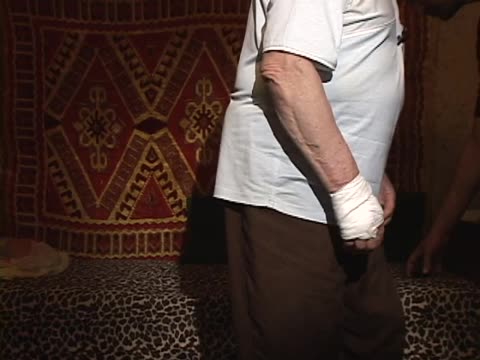
This tape consists of a formal interview with Aba Davidovich Kaviner, born in 1921 in the town of Derazhnya, Ukraine. He received a double education in his youth, graduating from a Soviet Yiddish school, while simultaneously attending a yeshiva. At 19 years of age, he was drafted into the Red Army, a year before the war broke out. With his entire family killed, after the war, Kaviner moved to Khmel'nyts'kyy, where he got married. His wife died four years ago. Kaviner shares his attitudes towards “loshn-koydesh” (the “holy tongue” of scripture) that he learned in yeshiva, in comparison with the “Sephardi dialect” of Modern Israeli Hebrew.
From the machine transcript
After some opening talk about arranging the meeting, Kaviner confirms his birth in Derazhnya, where he finished ten classes of school while studying in a yeshiva in parallel. He was drafted into the army a year before the war, lost his parents and family, and came to Khmel'nyts'kyy, where he married; his wife died four years earlier. The interviewers explain who they are and where they work, and Kaviner comments on his knowledge of Ashkenazi versus Sephardi Hebrew pronunciation and says he knew loshn-koydesh from the yeshiva.
Adds the informal opening exchange about the visit, the interviewers' identities and the discussion of Sephardi versus Ashkenazi Hebrew.
Kaviner describes prewar Derazhnya as a "yidishe shtut” (Jewish town) full of artisans and craftspeople. Kaviner completed a Soviet Yiddish school in 1939 just before it was closed. At the same time, he learned in a yeshiva, stating he had “no childhood” because he spent so much time studying. The yeshiva was an open secret that the authorities “pretended not to know about,” according to Kaviner. Once the yeshiva was closed down in 1934-5, it went underground and continued to function clandestinely until 1939. The director and teachers were able to receive successful employment after the school was closed because they were very intelligent, educated people. There were also semi-secret “kheyder” schools (religious schools for young children) that operated in the town until approximately 1932. After this, melamdim (religious teachers) continued to teach children in private homes. The yeshiva was Hasidic, but associated with no particular rebbe, except the Baal Shem Tov. Kaviner states that the shtetl had about 5000 Jews. He also lists all the significant rebbes that were active in the region.
From the machine transcript
Kaviner describes Derazhnya as a Jewish town of artisans and some merchants, poor but cheerful. He talks about the Yiddish school closed in 1939 and the yeshiva he attended in parallel, which the authorities knew of but tolerated before closing it; its teachers took other jobs, and kheyders went private until the war. He names the head of the yeshiva (David Nissenbaum) and many rebbes of the region (Medzhybizh/Baal Shem Tov circle, Zinkiv, Volodarka(?), Chernobyl, Bratslav), and says about 5,000 Jews lay in the mass graves.
Adds the named yeshiva head David Nissenbaum, the kheyders going private, and the list of rebbes with their lineage.
Kaviner briefly describes the yeshiva curriculum.
From the machine transcript
Kaviner lists what was studied in the yeshiva (Rashi, Gemara, Tanakh, Mishnah, Midrash) in answer to Kerler's questions. He then begins to recall the counting song about the numbers one to five.
He recites the traditional Passover song “Ekhod mi yoydeyo” in loshn-koydesh.
From the machine transcript
Kaviner recites the traditional counting song (Ekhod mi yoydeyo); the transcript for this stretch is almost empty. Kerler then asks how Purim was celebrated.
He describes how Purim was celebrated in his town, emphasizing that it was observed in people’s homes and not in a collective community-wide manner. He also mentions singing, dancing, the wearing of costumes and the sending of “sholekh-hamunes” (traditional Purim gifts).
From the machine transcript
Kaviner says Purim was celebrated at home rather than communally, with costumed visitors, purim-shpil, dancing, singing, and sending shalekh-munes. The visiting masqueraders sang Hasidic and Hebrew songs, which he was too young to remember. Kerler tries to prompt him with known Purim rhymes, and then turns back to the rebbes.
Kaviner comments on the concept of “gite yidn” (righteous Jews), and talks about pilgrimages to various rebbes. He also tells a story about his great-grandfather, the rich merchant Yidl, and his dealings with the town’s dishonest khevre kadisho (burial society).
From the machine transcript
Kaviner explains that people traveled to rebbes and good Jews for blessings, and tells a story about his great-grandfather Yidl, a rich merchant and Zinkiv Hasid, who was made to join the dishonest burial society by the Zinkiv rebbe, who knew from afar what was going on in Derazhnya. When asked, he says he knows many stories of the Baal Shem Tov.
Kaviner shares a detailed story/folktale about the Baal Shem Tov [Besht] and his encounter with a hospitable, impoverished innkeeper.
From the machine transcript
Kaviner tells a long tale of the Baal Shem Tov and an honest innkeeper near Brody who lodged him. The Besht left a note for a Yankl in Brody, the innkeeper forgot it and was later ruined, and found it when asked for his last bottle of vodka. He delivered it to the newly chosen synagogue warden Yankl.
He also tells a short story about the Vildeniker Rebbe and another tale about the Baal Shem Tov, about reviving a girl from the dead.
From the machine transcript
Kaviner says the Volodarka(?) rebbe's grave is in a small house that survived the Germans, and people still send notes there. He then starts a tale of the Baal Shem Tov and his coachman Aleksei, in which the Besht has a dead girl buried with a golem to test whether she is revived.
Adds the grave of the Volodarka(?) rebbe in a small house surviving the war.
He tells a longer tale about how the Baal Shem Tov story saved the life of Aleksei Dorbush.
From the machine transcript
Kaviner continues with a long tale of the Baal Shem Tov, who lived as a hermit in the Carpathians healing people and animals. He saved a man frozen in the snow who turned out to be the orphan Aleksei, who had worked for a landowner, burned the estate after the landowner killed the woman he loved, and then became the Besht's coachman. Kerler praises the story and asks about unfamiliar words, and Lemster asks if he knows more such stories.
The tale in fact continues from the previous one and ends with Kerler asking about words in it.
Kaviner details the history of the first writings by and about the Besht and their connection to Nakhmen Bratslaver.
From the machine transcript
Asked for a story of the Bratslaver, Kaviner explains that the Baal Shem Tov wrote no books himself. He says his grandson Moyshe Khayim Efrayim wrote the theory of Hasidism and Nakhmen of Bratslav continued it, discussing the Besht's descendants, with Kerler asking for the title of the book.
Kaviner reports that he knows all these stories from his reading them in Yiddish both before and after the war.
From the machine transcript
Kaviner says he knows the Baal Shem Tov stories from reading them himself in Yiddish, since there was no one to tell them. After the war he obtained two Yiddish books of Besht tales, and read stories of good Jews in Hebrew in a collection.
Kaviner lost all his childhood friends in the war. In the postwar period, he had a daughter; his grandson now works in Hesed (a Jewish communal organization). His grandson is uncircumcised because there was no one to perform the ritual.
From the machine transcript
Kaviner says his yeshiva study partners all perished in the war and he does not know how he survived himself. After the war he had a daughter and now has a grandson who works in Hesed; the grandson was not circumcised because there was no one to do it.
Adds the study partners lost in the war.
During Kaviner’s childhood, even under the Soviets, his town still had circumcisions performed and traditional wedding ceremonies. The last rabbi of the town was Rov Mekhl Rozhanski, who played violin and worked as a moyel (performing circumcisions).
From the machine transcript
Kaviner says that until 1939 weddings under the canopy and circumcisions were still carried out in Derazhnya, even under the Soviets. The last rabbi was Mekhl Rozhanski, who also served as moyel and played the fiddle.
Kaviner talks about prewar Jewish weddings with music by local klezmer musicians and performances by the town’s badkhn (wedding jester) Itsik-Meyer.
From the machine transcript
Answering Lemster and Kerler, Kaviner says local Jewish klezmorim played at weddings, along with a badkhn named Itsik-Meyer who recited rhymes to the bride. He is asked about the badkhn's other livelihood and Kerler asks about wonder-workers in the area.
Kaviner recalls that he had heard of “trefers,” or people who could predict the future, in his childhood, but does not remember them in detail.
From the machine transcript
Asked about people who could foretell the future, Kaviner says he did not know them in detail, though he had heard of such "trefers". Kerler also asks about visiting preachers in Derazhnya, and Lemster begins asking about the golem.
When asked about “goylems” (golems), Kaviner recommends the stories of Yitskhok Bashevis Zinger (Isaac Bshevis Singer) that he read in Yiddish before the war. In the postwar period, Kaviner collected Yiddish books from older Jews.
From the machine transcript
Asked about golems, Kaviner recommends the stories of Isaac Bashevis Singer, whom he read in Yiddish before the war, and mentions the Nobel Prize. After the war he borrowed Yiddish books from older Jews. They also discuss dybbuks and Ansky's play, and Lemster asks whether Yiddish theater came to Derazhnya.
Kaviner recalls the local Yiddish theater in Derazhnya, as well as visiting Jewish theater troupes, such as the Hebrew group HaBimah (which performed a Goldfaden piece) and other troupes.
From the machine transcript
Kaviner says Derazhnya had its own Yiddish theater and was visited by Yiddish troupes from Odessa, including Habimah(?) with its Goldfaden-type production and other named companies. He emphasizes that Derazhnya was a Jewish town before the war and compares its size with Proskurov, then Kerler asks what else he read.
Kaviner talks about the other Yiddish writers he has read, including Mendele Moykher Sforim, Sholem Aleichem, Y. L. Perets and numerous Soviet Yiddish writers. Prewar Derazhnya had a Yiddish library for the town, as well as another, larger collection in the synagogue. These books were burned during the war along with the town’s Torah scrolls.
From the machine transcript
Kaviner lists Yiddish authors he read: Mendele, Sholem Aleichem, Peretz, Hasidic tales, and Soviet writers including Bergelson, Kvitko, Markish, Nute Lurie and Orland. Derazhnya had a Yiddish library and a large one in the synagogue; the books and Torah scrolls were burned, and he says Jews took part in lighting the fire.
Adds the burning of the books and Torah scrolls, with Jews also taking part.
This tape is a continuation of a formal interview with Aba Davidovich Kaviner (b. 1921 in Derzhanya, Ukraine). Kaviner recalls seeing the Torah scrolls burned in his town during the war, a traumatic moment for him. He also comments on the fact that all the non-Jews in the town spoke Yiddish.
From the machine transcript
Kaviner recalls the destruction of the synagogue in his town, where Torah scrolls were thrown on a fire and burned, and how he wept as he walked by. He says that nearly every non-Jew in town could speak Yiddish, and tells of a non-Jewish neighbor who saw him crying and spoke to him. He also mentions that the Germans paid well for something.
adds the non-Jewish neighbor who spoke to him and the point about Germans paying
Kaviner discusses the literature he has read in “loshn-koydesh” (biblical Hebrew), including Chaim Nachman Bialik and Shimon Frug.
From the machine transcript
Kaviner says he read Hebrew (loshn-koydesh) literature, naming Shimon Frug, Bialik and Ravnitski. In exchange with Kerler about Bialik's Yiddish poems, he says Bialik did not write in Yiddish and that Ravnitski translated him, and that the two men emigrated together.
Kaviner further describes the system of learning in his yeshiva, based on “taytsh” (translation) and both individual and collective learning.
From the machine transcript
Answers Kerler's questions about how study in the yeshiva was organized: reading alone, reading together with the teacher, who explained texts such as Mishnah. Kaviner says he studied alone, though some students studied in twos and threes. Lemster then turns to ask about his work.
adds the exchange about studying alone or in pairs and groups
After the war, Kaviner worked as a wood technician/carpenter.
From the machine transcript
Kaviner has trouble finding the Yiddish term for his profession and says it in Russian; with the interviewers' help it emerges that he made wooden articles, furniture and similar items. He worked at this after the war, from 1948 until 1982. He then comments on reading and writing Yiddish and on needing his glasses.
adds the years of his work and the difficulty finding the Yiddish word
Kaviner reads the research team’s notes on the interview that they keep in Yiddish.
From the machine transcript
Kerler explains that he records notes on the interview in Yiddish, sometimes phonetically, and that he is paid for this. He says there are a few more questions and moves to ask about the Yiddish school Kaviner attended in Drazhnya.
Kaviner further describes the curriculum of the Yiddish school he attended, stating that each subject had its own teacher. He lists the writers he read in school, including the Soviet Yiddish literati later murdered by Stalin. He then recites poetry from Osher Shvartsman, as well as a fragment from Hofshteyn. Kaviner and the research team begin a discussion about Hofshteyn, his influence and his family, as well as the sons and daughters of Soviet Yiddish writers and their activities today. Kaviner often read the poetry of Yoysef Kerler (Professor Kerler’s father) in the journal Sovetish Heymland.
From the machine transcript
Kaviner describes his Yiddish school, where each subject had its own teacher, and names David Reznik as his literature teacher. He lists the Yiddish writers studied, from Mendele, Peretz and Sholem Aleichem to Soviet writers such as Bergelson, Kushnirov(?), Fefer and Kharik, victims of Stalin. He recites a poem by Osher Shvartsman and discusses with the interviewers David Hofshteyn, his family, and other Soviet Yiddish writers' children. Kaviner recalls reading Yoysef Kerler's poems in Sovetish Heymland, and Kerler promises to bring him his father's book.
adds the poem recited, the list of writers and the discussion of Hofshteyn's family
Kaviner subscribed to Sovetish Heymland and knows well the body of Soviet Yiddish literature. Professor Kerler and Dr. Lemster talk about their recent creative work in Yiddish. Kaviner also shares his opinion that he does not hold Arn Vergelis’ work in high regard.
From the machine transcript
Kaviner says he subscribed to Sovetish Heymland. Kerler and Lemster tell him that Lemster is a Yiddish writer who published there from the 1980s, and Kaviner asks what Lemster wrote. Kaviner says he does not think much of Arn Vergelis, the editor, who died in Moscow, and mentions another writer from the region. Kerler promises to send a book.
adds the interviewers' own work and Kaviner's opinion of Vergelis as editor
Kaviner wrote his own original Yiddish prose and poetry before the war, but burned all his works after the war because “such were the times" and he was afraid of being sent to prison. Before the war, Kaviner had trouble getting his writings published, but points out that Perets could not get his first works published either.
From the machine transcript
Kaviner says he wrote Yiddish prose and poetry before the war but burned all of it, because of the times and fear of being jailed for owning Yiddish books. He did not write after the war. In reply to Kerler's question about publishing, he notes that Peretz also could not publish at first, and the talk turns to Peretz's early poems and Nakhmen Mayzl.
adds the discussion of Peretz's early poems and Mayzl
Kaviner asks the researchers their opinion about literature, asking if they can compare anyone with Bialik. He shares with the team quotes from Maksim Gorki praising Bialik as a second Pushkin.
From the machine transcript
Kaviner asks the interviewers whom they would set beside Bialik, even among non-Jewish writers. He recounts that Gorky praised Bialik, noting his poor origins and mostly self-taught learning, and called him a second Pushkin, with some phrases quoted in Russian. He also mentions reading Frug's Hanukkah poems in Yiddish.
Kaviner comments on the works of Shimon Frug and says that the stories live within him to this day.
From the machine transcript
Lemster asks Kaviner to tell something about the war years. Only this question falls in the passage.
the transcript has only Lemster's question about the war years, not comments on Frug
Kaviner shares his wartime experiences. After finishing school in Leningrad, he served as an aviation engineer in the army. Over the course of his eight years’ service he received many awards and medals.
From the machine transcript
Kaviner says he is an aviation engineer who finished the Second Leningrad aviation technical school, and shows his badge and decorations. He served eight years, from 1938 to 1947, and names several orders and medals, partly in Russian. The passage ends with talk about a door and Kerler's father's book, and Lemster begins to ask about Kaviner's father.
adds the years of service and the specific decorations
His father, Duvid (b. 1889), worked as a barrel maker and his mother, Ester, was a housewife. He does not remember his grandparents, but he had two siblings: Milke (b. 1920) and Shmilikl.
From the machine transcript
Kaviner gives family details: his father David was a barrel maker (born 1889(?)), his mother Ester a housewife. He did not meet his grandfathers and remembers only one grandmother, Leye. There were three children: Milke (born 1920), Shmuel (Shmilikl), and himself as the third. He says he hardly worked before the war.
Professor Kerler gives Kaviner a copy of his father’s book. Kaviner reads the poems aloud, commenting on the difference between Soviet and Standard Yiddish orthography. The research team arranges a subscription to the newspaper Forverts for Kaviner, and he talks about the Soviet Yiddish writers now working for the Forverts newspaper. They also talk about non-Jewish writers who knew Yiddish.
From the machine transcript
Kerler gives Kaviner a copy of his father's book; Kaviner reads a poem aloud and comments on Soviet orthography versus the Hebrew-derived spelling of the Forverts. Kerler offers to arrange a Forverts subscription, and Kaviner says papers reach him rarely, once in three months. He mentions Soviet Yiddish writers who later worked for Forverts, among them Khayim Beyder, Yoysef Sandler (?) and Paris Sandler, and non-Jews who knew Yiddish, such as Belousov and Tolstoy.
adds the Forverts subscription arrangement, the poem read aloud and the non-Jewish Yiddish speakers
The research team explains the mission and goals of AHEYM more in depth.
From the machine transcript
Kerler explains that AHEYM is building an archive of such interviews from Ukraine, Romania and Hungary, now many hundreds of hours. Kaviner asks about the project and then about the origin of the surname Kaliner, which Kerler discusses.
adds the discussion of the Kaliner surname
Kaviner recalls how he once met with Soviet Yiddish writer Shmuel Halkin in Moscow in 1948, and how he helped a friend publish his book of poetry.
From the machine transcript
Kaviner says he once spoke with the Yiddish writer Shmuel Halkin in Moscow, around 1948 or 1949. The meeting came through a historian and Yiddish writer from his area, whose book was never printed, and Kaviner says he helped him. The writer was a history teacher and Kaviner's wife a literature teacher.
adds the historian friend whose book was not printed
Kaviner briefly recounts his lack of marriage ceremony in 1949.
From the machine transcript
Asked about his wedding, Kaviner says he and his wife simply registered, with no ceremony, in 1949; she went to teach at the school and he went to work. He then mentions a book about the Gulag from those years.
Kaviner further talks about literature and his desire for more books, a wish the researchers will fulfill.
From the machine transcript
Kaviner says he has few Yiddish books, only some journals, and the interviewers offer to send him some. Kerler explains that AHEYM values dialect speakers who cannot read Yiddish. Talk turns to dialect and word usage: the word for bread, the term litvak for a Belarusian, and the expression tseynem kop for a learned person in Drazhnya. Lemster asks about a joke with a litvak.
adds the dialect discussion of litvak and other words
Kaviner asks if the researchers are religious, stating that he prays, although he is not too religious ("ikh bin oykh nit keyn tsodik, keyn fanatik"). He has held onto some very old sidurim (prayerbooks).
From the machine transcript
Kaviner asks whether the interviewers are religious; Kerler says not very. Kaviner says his father taught him to keep Jewish tradition, that he prays but is neither a saint nor a fanatic, and that he owns very old prayer books. He says he is old and sick and would devour Yiddish books if he had them, and Lemster and Kerler promise to send some.
adds Kaviner's wish for Yiddish books and the interviewers' promise to send them
The tape ends with scenes of Khmel'nyts'kyy from the researchers’ car.
From the machine transcript
The recording ends with the interviewers leaving and talking in the car, with Yiddish and Russian speech about a synagogue and a theater building in Khmel'nyts'kyy. The speech is largely garbled in the transcript.