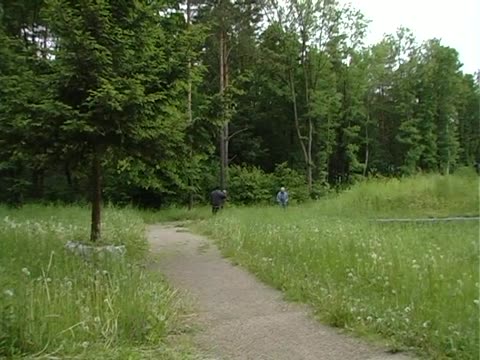
This tape begins at a Holocaust monument in a forest or park near Khmil'nyk.
From the machine transcript
Opening at a memorial site near Khmil'nyk; the speech is largely garbled, with a Russian remark about burial places and an unclear exchange about the Nazi period and evacuation.
Little can be made out beyond a Russian comment on burial places.
The tape cuts to the cemetery in Medzhibozh and the grave of the Besht.
The tape then cuts to the home of Aba Davidovich Kaviner (b. 1921, Derazhnya). The researchers and Kaviner greet each other warmly. Professor Kerler gives Kaviner a few books in Yiddish. Kaviner reports that he read the book by Yoysef Kerler that Professor Kerler gave him in the previous interview already numerous times and cried while reading it. Kaviner offers a brief analysis of Yoysef Kerler’s work. He also gives updates on past AHEYM interviewees in the area and discusses the difficulty of finding new people to interview among the “Jews who don’t want to know they are Jews,” and the intermarried Jews that remain.
From the machine transcript
Warm greetings at Kaviner's home. Kerler gives him Yiddish books, and Kaviner says he has read the book by Yoysef Kerler several times and wept over it, commenting on the writer's fate under the party. He asks after earlier interviewees; Kerler and Kaviner discuss how few people in the region still speak Yiddish. Kaviner says many Jews do not want to know they are Jews and stresses the importance of keeping Jewish identity.
Also covers the death of a former interviewee and which nearby towns still have Yiddish speakers.
Kaviner tells a story about an encounter he once had with an old Jew who intermarried and who was later disowned by his children in his later years.
From the machine transcript
Kaviner tells of an old Jew who brought goods to his workplace and wept that his gentile wife and children had thrown him out in old age. Kerler and Kaviner then discuss sending publications, Kaviner's address, and the name of the town Khmel'nyts'kyy in Yiddish and Russian. Lemster asks about the places the team has visited.
Adds an exchange about sending journals and the address, and the Yiddish and Russian names of the city.
The research team discusses their route, the people and the communities with whom they have come into contact on their expeditions.
From the machine transcript
Kerler, Lemster and Kaviner talk about the places the team has visited and the Jews found there, including Bershad', Odesa, Balta and Nikolaev. They discuss who still speaks Yiddish and mention Chabad and yeshivas. A woman in Khmel'nyts'kyy is described who read Yiddish and whose daughter speaks it.
Kaviner reports that his daughter, who lives in Khmel'nyts'kyy, understands, but doesn’t speak Yiddish.
From the machine transcript
Kaviner says his daughter, who lives with him, understands Yiddish but does not speak it, which he regrets. He mentions that he was taught Jewishness by his rabbi.
Kaviner shares his attitudes towards different dialects of Yiddish and discusses a work by Soviet Yiddish author Dovid Bergelson: “Der toyber” (The Deaf).
From the machine transcript
Kerler asks about the Yiddish dialect in Derazhnya, such as forms of address and 'thanks', and Kaviner contrasts it with Belarusian and Polish dialects and gives examples of pronunciation. They then discuss Dovid Bergelson's story "Der toyber" and its stage adaptation.
Includes dialect questions on forms of address and word pronunciation.
Kaviner talks about the death of Shloyme Mikhoels, and about how people suspected that he was murdered. He also recalls Mikhoels’ funeral and his eventual rehabilitation. Kaviner also speaks about numerous other Soviet Yiddish writers and cultural figures.
From the machine transcript
Kaviner talks about Mikhoels's death, saying he was murdered in a staged accident after being sent to Belarus, and about his lying in state at the Yiddish theatre. He recalls his rehabilitation and that of Yiddish writers, and names writers from the region, including some from near Medzhibozh and Starokostyantyniv. He also says Sholem Aleichem stayed in Derazhnya and wrote there, and mentions Mendele.
Adds Sholem Aleichem in Derazhnya and writers from nearby villages.
Kaviner shares his views on “Di klasiker,” the three classic Yiddish writers in Yiddish literature, as well as his analysis of the history and development of Yiddish literature.
From the machine transcript
Kaviner and the interviewers discuss the three Yiddish classic writers, Mendele, Peretz and Sholem Aleichem, and the earlier history of Hebrew and Yiddish writing. Kaviner notes that Hebrew words filled their works. He says he read Eliezer Steinberg before the war but cannot recall it, and begins a story about a neighbour's library.
Kaviner tells the story of one of his most memorable reading experiences: When he was twelve years old he visited a local rich man’s large library from where he obtained Avraham Mapu’s “Ahaves Tsiyen" (Love of Zion) in “loshn-koydesh” (Hebrew). He remembers hiding in the attic in the summertime to hide from his father in order to read it. Kaviner further discusses “Di klasiker” and the Soviet Yiddish writers that he read in his youth.
From the machine transcript
Kaviner tells how at about twelve he borrowed a Hebrew book by Avraham Mapu from a rich neighbour's library and read it hidden in the attic from his father. Kerler and Kaviner then discuss Mendele's beginnings in Hebrew and name Soviet Yiddish writers he read.
Adds Mendele's Hebrew beginnings and a list of Soviet writers.
He recites a poem by Itsik Fefer.
From the machine transcript
Kaviner recites from memory part of a poem about the civil war by Itsik Fefer, at Kerler's request, and comments on Fefer's participation in the war and his execution.
He recites poetry by Osher Shvartsman.
From the machine transcript
Kaviner recites a poem by Osher Shvartsman and says the poet was killed at the front in the civil war at age twenty-six.
He recites a fragment from Dovid Hofshteyn and discusses his life and work, including the work of his sister Shifre Kholodenko.
From the machine transcript
Kaviner speaks of Dovid Hofshteyn as a great classic poet and mentions his sister, also a poet. Lemster asks about a Russian poem and whether it was sung, and Kerler asks about a song about green trees, which Kerler identifies as Bialik's.
Kaviner states that Bialik was a writer of incomparable talent and discusses his work and biography with Professor Kerler.
From the machine transcript
Kaviner says that no writer can be compared to Bialik and mentions Bialik's translation of the Bible into Yiddish with Ravnitsky and his commentary on the Torah. Kerler asks about Bialik's poems; Kaviner finds them hard to read. They discuss Bialik's Yiddish poems, his Hebrew writing and his study at the yeshiva in Volozhin.
Kaviner also talks about Shimon Frug's works and biography.
From the machine transcript
Kaviner talks about Shimon Frug, whom Gorky called another Pushkin, saying he died poor and in hunger in Odesa, having married a gentile woman. Lemster asks about Yankev Fikhman, and the speakers discuss whether he was in Soviet Yiddish schools and his anthology.
Adds Lemster's question about Yankev Fikhman and Yiddish school curricula.
Kaviner discusses how the curriculum of Soviet Yiddish schools was decided, and lists writers who lived outside the Soviet Union who were read and not repressed like many of those who stayed behind.
From the machine transcript
Kaviner explains that writers who praised Soviet power were still shot, while others were labelled reactionary and not published. He lists writers who fled and survived, such as Bialik, Maurice Winchevsky and Maurice Rosenfeld, and says those who stayed were destroyed. Itsik Manger is mentioned as read in Soviet literature.
Adds the list of writers who emigrated and survived.
Itsik Manger, according to Kaviner, was part of the Soviet Yiddish literary curriculum in the 1930s because he wrote “simply about Jewish life”.
From the machine transcript
Kaviner and the interviewers discuss whether Itsik Manger was part of Soviet Yiddish literature in the 1930s. Kaviner says writers who left wrote simply about Jewish life, and that is why they were published then.
Kaviner states that he has read the complete works of Yekhiel Shraybman and comments on several other postwar Soviet Yiddish writers whose works he has enjoyed. Kaviner speaks about the history of the journal Sovetish Heymland and its editor Arn Vergelis. Kaviner states that he met several times with Khayim Beyder. Although he does not hold the latter’s work in high regard, he knew his family well, having served in the military with his brother. Kaviner talks about his meeting with Soviet Yiddish writer Shmuel Halkin in 1948 and recites some of his poetry.
From the machine transcript
Kaviner says he read the complete works of Yekhiel Shraybman and discusses other postwar Soviet Yiddish writers and the journal Sovetish Heymland and its editors, including Arn Vergelis. He met Khayim Beyder several times, thinks little of his poetry, and knew his family. He served in the army from 1939, met Shmuel Halkin after the war, and recites lines about mass graves.
Adds Beyder's two wives and Kaviner's army service from 1939.
Kaviner comments on his life today, focusing on his health problems, his daughter’s career and his pride in his grandson, who used to work in Hesed (elderly welfare organization), but now works in a Ukrainian government agency.
From the machine transcript
Kaviner talks about his present life: failing legs and eyes, his daughter's broken leg and her work as a doctor, and his one grandson. The grandson finished school with a gold medal and an institute with distinction, worked in computing and administration, and now works at a state inspection agency.
Adds Kerler's promise to send publications and the grandson's career details.
Kaviner reports that before the war, he published a few poems in the journal “Der Shtern.” After the war, he also wrote two novels about Jewish life before the war and during the evacuation, but later burned these works as he feared the consequences if someone found that he was writing in Yiddish.
From the machine transcript
Kaviner says he printed several poems in the newspaper Shtern before the war under his family name. After the war he wrote two Yiddish novels, one on prewar Jewish life and one on life in evacuation, and burned them out of fear of arrest. Kerler offers to find his poems and they briefly discuss Russian.
Adds Kerler's offer to find the printed poems and the novel title borrowed from Bergelson.
Kaviner briefly comments on his relations with non-Jews throughout his life and in the army.
From the machine transcript
Kaviner briefly recalls army years and how non-Jewish comrades reacted when they asked about his name and he said he was Jewish; Lemster then asks about lesser-known local writers.
Adds Lemster's question about little-known local writers.
Kaviner speaks about the lesser known Soviet Yiddish writers he knew personally, including his friend Itsik Sokol, who published a book of poetry after the war, and Moyshe Zibnberg, who published in the school newspaper before the war. Kaviner also briefly comments on Yiddish and drama circles in his town before the war.
From the machine transcript
Kaviner names lesser-known local writers: Itsik Sokol, a Yiddish teacher who published a book after the war, and Moyshe Zibnberg, who wrote in the school newspaper and was killed during the occupation. Lemster asks about culture leagues, and Kaviner says there was a Yiddish theatre and Jewish circles in the town.
Adds the question about culture leagues.
This tape is a continuation of a formal interview with Aba Davidovich Kaviner (b. 1921, Derazhnya). Kaviner comments on how the documents pertaining to prewar Yiddish institutional life in the Soviet Union were likely burned or lost. He also briefly discusses the curriculum at his Soviet Yiddish school, and the two minor local Yiddish writers he knew, Moyshe Zibnberg and Itsik Sokol.
From the machine transcript
Kaviner says that documents of the Derazhnya Yiddish school were probably thrown out or burned during the occupation after the school was converted to a Russian one, along with books and textbooks. He recalls Yiddish literature and the local Yiddish writers Zibnberg (?) and Sokol, who settled in Khmel'nyts'kyy after the war. He then names a gifted teacher at his school, Tentsermann (?).
adds the fate of the school's books and the teacher Tentsermann
Kaviner talks about his Yiddish school teachers as well as the science and mathematics curriculum in those institutions. At the request of the research team, he shares the terminology used in these classes for mathematical concepts.
From the machine transcript
Kaviner recalls his teachers, including a teacher who went to Odessa to take external exams and a physics teacher named Tayman (?), and says science was taught in Yiddish. Asked by Lemster and Kerler, he gives the Yiddish mathematical and physical terminology, such as the definition of electrical voltage and arithmetic terms for plus, minus and fractions, and notes numerals in several languages.
Kaviner comments further on the Soviet Yiddish school curriculum as it pertained to literature and language, explains the logistics in obtaining enough books for all the students, and notes the storyteller-performers who would come visit the school. Kaviner shares his mostly negative attitude towards Israeli Hebrew. He recites the lyrics of “HaTivka” (The Hope) in Ashkenazi Hebrew pronunciation, then sings the song.
From the machine transcript
Kaviner describes the Yiddish grammar and literature reader in his school, how every pupil got a textbook free from the school, and the reciter Vinogradski who visited and performed Sholem Aleichem from memory. They discuss other writers who visited. He says he dislikes Israeli Hebrew, then recites and sings Hatikva.
adds Vinogradski the reciter, other visiting writers and the Hebrew text of Hatikva
Kaviner shares a folktale-style story about the Jewish shepherd boy who wrote HaTikva and how it became the Jewish national hymn.
From the machine transcript
Kaviner tells a folktale about a Jewish shepherd boy in the Diaspora, beaten by his Arab master, who composed Hatikva on his pipe, and how it became the Jewish anthem. He and Kerler talk about Jewish pride and striving toward Zion. He then mentions Mark Varshavski as another composer.
adds the discussion of Jewish pride and Zion
Kaviner talks about Mark Varshavski and Sholem Aleichem, and the genesis of the song “Afn pripetshik”. Speaking of other contemporary composers, Kaviner talks about the nature of Jewish identity in those people, such as Vladimir Vysotskii, who do not outwardly express their Jewishness.
From the machine transcript
Kaviner says Mark Varshavski, a trained jurist, wrote "Afn pripetshik" and that Sholem Aleichem took it from him and published it. They discuss contemporary singer-songwriters such as Aleksandr Rozenbaum and Vladimir Vysotskii, whom Kaviner learned was partly Jewish and did not deny it, though not observant. Kerler then asks how long Kaviner attended the yeshiva (to age nineteen).
adds the yeshiva question at the end
Kaviner recalls the anti-religious propaganda and actions that were promoted in the Soviet Yiddish School as well as the “openly secret” nature of the yeshiva he also attended.
From the machine transcript
Answering Kerler, Kaviner says there was constant anti-religious propaganda and that Jews themselves closed synagogues. His yeshiva was half legal and half illegal; the authorities knew of it, then ordered it closed in 1937–38. Lemster asks about repression of Yiddish school teachers, and Kaviner says they were mostly not repressed but went into Soviet service jobs, such as the yeshiva head becoming chief accountant at the state bank.
Kaviner shares his memories of prewar Jewish weddings that were celebrated in a traditional manner. The town’s rabbi was Mikhl Rozhanski, a very learned and handsome man, who spoke several languages and played the fiddle. He was arrested three times by Soviet authorities, but always quickly released. He was later killed during the war. The rabbi’s children went to the Ukrainian-language school instead of the Yiddish school because of a wider conflict within the town’s Jewish community. Kaviner states that he remembers many anti-religious songs from those years, but would prefer not to sing them.
From the machine transcript
Kaviner recalls prewar weddings with a huppah and the rabbi Mikhl Rozhanski, a handsome, learned man who spoke Russian and German, played the violin, was jailed several times and released, and was killed by the Germans. His children attended the Ukrainian school because of a quarrel with the director of the Yiddish school. Kerler asks about anti-religious songs and the red Haggadah; Kaviner does not want to recall them but starts reciting the song about Rebbe Reb Shneyer.
adds the Rozhanski children's school change and the red Haggadah question
Kaviner recites the words to the anti-religious Soviet Yiddish song “Rebbe Reb Shneyer”.
From the machine transcript
Kaviner recites the text of the anti-religious Soviet Yiddish song about Rebbe Reb Shneyer, in which a rabbi gives absurd rulings on a non-kosher knife. He comments that such propaganda mocked Jewish belief.
Kaviner reports that there were no Yiddish-language religious songs taught in his yeshiva, but he did participate in the choir in his Yiddish school, which sang patriotic Soviet songs.
From the machine transcript
Kaviner says no Yiddish religious songs were taught in the yeshiva or in Soviet times. In his school choir they sang Soviet patriotic songs on Yiddish texts by poets such as Pfeffer, Bukhshteyn and Grubian. Kerler asks about a Sevastopol song and a Yiddish song by Itsik Pfeffer, which Kaviner does not recall.
Kaviner states that he met with writer Hershl Polyanker in Kyiv after the war. After briefly discussing his works, Kaviner tells a story about the writer’s release from prison and induction into the Ukrainian Union of Writers.
From the machine transcript
Asked about meetings with writers after the war, Kaviner says he once met Hershl Polyanker in Kyiv, a hard man, and mentions his books. He tells how Polyanker, freed from prison, went in his prison clothes to a Ukrainian writers' union congress and was reinstated while his denouncers stood by.
Kaviner returns to the subject of prewar Jewish weddings, commenting on the dances, religious ceremony, and role of the "bodkhn" (master of ceremonies and jester). He then tells a short story about the folk-hero Hershele Ostropolyer as a “bodkhn”.
From the machine transcript
Kerler and Lemster ask about wedding customs, and Kaviner says a high round loaf was called a "malkhes broyt" (?). They discuss the badkhn who led the wedding, naming Shmuel Moyshe and Penia Sinderovich as badkhonim in Derazhnya. He then tells a short story about Hershele Ostropolyer as badkhn of a rebbe.
adds the naming of the badkhonim and the malkhes broyt (?)
Kaviner then tells three longer Hershele Ostropolyer stories. He reports that he read these stories in books, but that people would also tell such tales all the time, even in synagogue during services.
From the machine transcript
Kaviner tells several Hershele Ostropolyer stories, including one where he tricks a peasant woman over Passover honey, one about a night at an inn with varenikes, and one about a peasant selling chaff at the mikveh. He says he read these in books and that such stories were told everywhere, even in synagogue during services. Kerler and Lemster also ask about the idiom "to lead someone into a bud" and about Chelm stories.
Kaviner also shares a folktale from the town of Chelm.
From the machine transcript
Kaviner tells a Chelm tale about a rabbi who was thought to have no head, since no one could say whether he had one.
When asked about the stories and folktales about the Jews of his shtetl, Kaviner recalls the tales about the great peasant thief Karmaliuk, who would hide from the authorities in Jewish homes. The Jews of Derazhnya were thus call “Karmalyukes.”
From the machine transcript
Asked about stories on the local Jews, Kaviner explains that Derazhnya Jews were nicknamed Karmaliukes after the peasant robber Karmaliuk, who hid in Jewish houses and the forest. He tells of the Santes family in Litychiv, whose house was burned when the authorities searched for him. Kerler asks whether the robber spoke Yiddish.
Kaviner states that every Jew in his town had a nickname and shares several examples.
From the machine transcript
Kaviner says every Jew had a nickname and gives examples, such as his great-grandfather called Tarlivke and a clever man called Khayl Mat. He discusses the word "mat" (clever, sharp) with Kerler, who asks about its origin. Lemster then asks about the town madman.
Kaviner briefly discusses Nakhmen Bratslaver and his influence in the history and development of Hasidism.
From the machine transcript
After mentioning the town madman Khaim and legends about the Derazhnya rabbi, Kaviner answers Lemster and Kerler about Rebbe Nakhmen of Bratslav, great-grandson of the Besht, buried in Uman, a great theorist and philosopher of Hasidism. His secretary Nosn was also discussed. He says his daughter has a Russian book of Nakhmen's tales, and says he once saw a lamed-vovnik.
adds the rabbi legends and the secretary Nosn
Kaviner mentions that he once met a “lomed-vuvnik” (one of the thirty-six righteous figures hidden among the Jewish people in any generation). He begins the story describing one of his town’s mentally-handicapped residents; the tape cuts off the story in mid-sentence.
From the machine transcript
Kerler asks how one can see a lamed-vovnik, and Kaviner begins a story about a madman in his town who wore ragged clothes and sang, danced and jumped while small children gathered. The tape ends mid-sentence.
adds Kerler's question on recognizing a lamed-vovnik
This tape is a continuation of a formal interview with Aba Davidovich Kaviner (b. 1921 in Derazhnya). He continues a story about a “lomed-vuvnik” (one of the thirty-six righteous figures hidden among the Jewish people in any generation) he once met. He recalls seeing one of his town’s “crazy” residents who once brought a girl back to life and then disappeared by morning.
From the machine transcript
Kaviner finishes the story of a local holy madman in Derazhnya, seen as a boy on his way to yeshiva, whom children mocked. He tells how the man revived a watchmaker's dying daughter, who had a bridegroom from another town. The man vanished by morning, leaving only his tracks.
The transcript shows the revived girl was a watchmaker's daughter with a bridegroom, and that the madman vanished the next morning.
Kaviner begins to tell a story about how his father once saw Eliyahu haNuvi (Elijah the Prophet).
From the machine transcript
Kaviner says his father saw Elijah the Prophet and that he knows two stories of Elijah being seen. He begins the first, which is set in Bessarabia.
Kaviner takes a break
From the machine transcript
Short pause in the interview while Kerler suggests a break. The informant remarks on the strain, and Kerler asks him to return to the story of his father and Elijah.
Kaviner continues the story about his father and Eliyahu haNuvi as well as another tale by Avrom Reyzen that he read in Sovetish Heymland.
From the machine transcript
Kaviner tells the story of his father, a cooper who made barrels in Bessarabia. A beggar who orders dumplings at the home of a kind householder vanishes, and a rabbi tells the couple they have seen Elijah. He then tells a second story, from a poem by Avrom Reyzen that he read in Sovetish Heymland, of Reyzen's Passover seder in Warsaw after the war, where a stranger guest vanishes. Kerler asks whether Kaviner read Reyzen.
The transcript gives the father's cooper's trade in Bessarabia and a first Elijah story before the Reyzen poem.
Kaviner comments on the work of Soviet Yiddish writer Eli Shekhtman and also talks about the content of his own novels, one of which, entitled “Erev,” had the same title as one of Shekhtman’s works.
From the machine transcript
Kaviner talks about the Soviet Yiddish prose writer Eli Shekhtman and about his own novels, which he wrote after the war. He says he borrowed the title of one, "Erev", from Shekhtman, and the other title from David Bergelson (?). Lemster asks about the novels' heroes and prototypes; Kaviner says they are ordinary petty-bourgeois Jews in the shtetl before and after the war. Kerler then asks about a tombstone in Kopaygorod and the Ludmir maid.
The transcript shows the novels cover the prewar shtetl, evacuation and the postwar years, and that Kerler asks about the Ludmir maid.
Kaviner speaks briefly about wedding customs and terminology.
From the machine transcript
Kerler asks how Derazhnya Jews spoke of an engagement party and the wedding gift ceremony. Kaviner says he was too young to attend one but knows it preceded the betrothal contract, and names the gift custom. Kerler also asks about a song sung at the bride's seating.
He also describes how Purim was celebrated in his town with “sholekh-hamunes,” (traditional Purim gifts), drinking, dancing, singing, and noise-makers (“gragers”).
From the machine transcript
Kaviner describes how Purim was celebrated in Derazhnya: sending gifts of food, eating and drinking well, dancing and singing, and exchanging good wishes. Children sang songs and rattled noisemakers. Kerler recalls a Purim song, and the two mention Sholem Aleichem.
Kaviner comments that “upshpreykhers,” or woman folk-healers were on almost every street in his town. He then mentions some of their different healing customs.
From the machine transcript
Kerler asks about women folk healers, and Kaviner says almost every street had one. He describes some forms of the cure: spoken in verse or in prose, with coals quenched in a bowl of water and the face smeared. He cannot recall the words said.
The transcript shows the cure involved quenching coals in a bowl of water.
Kaviner tells a short story about the town of Satanov, a shtetl named for Satan and the dibek (dybbuk).
From the machine transcript
Asked about a dybbuk story in Derazhnya, Kaviner talks instead about the nearby town of Satanov. A synagogue fortress there stands to this day as four walls, and he explains the town's name through Satan and the dybbuk. Kerler asks whether he knows An-sky's play about the dybbuk.
Kaviner remembers seeing Yiddish theater performances in Derazhnya before the war, including plays by Goldfaden and Sholem Aleichem, performed by visiting troupes as well as local actors. In the postwar period, Kaviner saw performances by famous touring actors and singers, such as Sidi Tal and others.
From the machine transcript
Kaviner recalls Yiddish theater in Derazhnya before the war: plays by Goldfaden and Sholem Aleichem put on by visiting professional troupes and by local amateurs. He names several touring actors and companies. Kaviner also describes postwar performances in Khmel'nyts'kyy by touring singers and cantors such as Sidi Tal.
The transcript shows postwar concerts by singers and cantors in Khmel'nyts'kyy and names several touring troupes.
Kaviner comments on the various shtetl types and characters in his town, including scholars, rich and poor people, actors, card players and water carriers.
From the machine transcript
Lemster and Kerler ask about Jewish types in his shtetl. Kaviner talks about the wealthy and the poor, a learned man who worked as an employee (Moyshe Zilberman, as the transcript has it), a professional actor, card players and the water carrier.
Kaviner reports that mixed marriages between Jews and non-Jews happened before the war, but were much more rare than they became during and after the war.
From the machine transcript
Answering Lemster, Kaviner says marriages between Jews and non-Jews did occur before the war but were rare. They became common during and after the war.
Kaviner briefly describes postwar Khmel'nyts'kyy where he settled in 1947. He comments that Jews from shtetlekh moved to bigger cities after the war seeking economic opportunities. Since mass emigration was allowed, there are few Jews left, only “narunim, kaptsunim in goyishe makhetunim” (lit., fools, paupers, and non-Jewish relatives).
From the machine transcript
Kaviner says he settled in Khmel'nyts'kyy after the war and the army. He explains that many Jews came there from the shtetlekh, which were emptied, and then emigrated when it became allowed, some fleeing to Bessarabia, Chernivtsi and America. Nobody returned, and only a few remain.
The transcript shows some left for Chernivtsi and Bessarabia and only a few remained, with no one returning.
Kaviner and the researchers briefly discuss issues related to sociolinguistics and dialectology.
From the machine transcript
Kerler and Kaviner discuss Yiddish dialect points. Kerler asks about the Podolian word for "back" and the forms for "hither" and "thither". They discuss the Podolian dialect area, the boundary with Polish Yiddish, and the Litvish forms for "bread" and "small".
Kaviner discusses being Jewish in the Soviet army and encountering anti-Semitism there. He also details the scope of Jewish service in the Red Army during the war.
From the machine transcript
Lemster and Kerler ask whether Kaviner, serving in the Soviet army, felt his Jewishness. He says he did, and he met antisemitism there, with soldiers openly voicing it. They discuss Jewish officers and generals, including Moshe Zilyankin (?), who served with him, and Soviet Jewish heroes. Kerler promises him an almanac article. Kerler then asks him to sing a song he remembers, and he starts on a ghetto hymn.
The transcript shows talk of Jewish generals and Soviet heroes, then a request for a song.
Kaviner sings the song “Avek di yinge yurn” in Yiddish, and then in a mixed Yiddish/Ukrainian version.
From the machine transcript
Kaviner sings the Yiddish song "Avek di yunge yorn", then a mixed Yiddish and Ukrainian version of it. Kerler comments that he finds it well adapted and that it stuck deeply in memory.
The transcript shows two versions: one Yiddish and one mixed with Ukrainian.
Kaviner talks about and sings the song “Afn pripetshik.” He discusses the relationship between Sholem Aleichem and Mark Varshavski and the “folklorization” of the latter’s oeuvre with Professor Kerler.
From the machine transcript
Kaviner recites and sings the song "Afn pripetshik" by Mark Varshavski. He and Kerler argue over whether Varshavski performed with Sholem Aleichem and over the folklorization of his songs. Kerler says Varshavski's songs came out in a volume.
The transcript shows a recited and sung version of the song and the argument over whether Varshavski performed with Sholem Aleichem.
Kaviner explains the lack of love stories or conversion tales in Soviet Yiddish literature and folklore.
From the machine transcript
Kerler and Lemster ask for a love or romantic story. Kaviner says Soviet Yiddish literature has no significant love stories, and he explains conversion to Christianity before the war. The two ask about town legends. The tape winds down with talk of further interviews, a telephone number and travel plans.
The transcript shows the passage ends with talk of the phone number and travel plans.
Entering apartment.
Education of the Jews.
From the machine transcript
Kaviner discusses how Jews entered higher education under the Tsarist regime. Admission was highly competitive, and some Jews, he says, converted to qualify. He names several well-known figures, among them Rubinstein and others, mentioning that one died abroad. He begins a story about Jewish converts who became priests in Khmel'nyts'kyy.
Names several Jews who converted in order to study.
Conversion today.
From the machine transcript
Kaviner talks about a priest of Jewish origin who comes to the Hesed and visits him, and about another convert whose father had hidden among non-Jews during the occupation and married a non-Jewish woman. Before death, the father told his sons they were Jews. Kerler and Lemster ask about the church and about the priest's languages. Kaviner says the priest knows Polish, English and Hebrew prayers and reads Scripture with him.
Concerns a priest of Jewish origin visiting Kaviner and the family story of a convert.
Showing book.
From the machine transcript
Kaviner and Kerler look at a book with Hebrew and Polish text, apparently a prayer book of 1929. Kerler comments that Jews who translated prayers into Polish were assimilating, as prayer in Hebrew was dying out. Kaviner then returns to how Jews obtained higher education under the Soviets.
Kerler comments on assimilation and Polish translation of prayers.
Education of the Jews.
From the machine transcript
Kaviner and Lemster discuss quotas for Jews in Soviet higher education, in the 1960s–70s especially in Moscow, versus easier admission elsewhere. Lemster asks if anyone in Starokostyantyniv can speak Yiddish. Kaviner mentions a man who survived the ghetto but would know little of Jewish tradition. They also touch on the songs Shalom Aleichem and Friday evening singing, and on his war service.
Raises potential Yiddish speakers in Starokostyantyniv.
War medals.
From the machine transcript
Kerler and Lemster give advice about taking a vitamin once a day after meals. Kaviner says the medals are still with him. Kerler suggests his daughter, a doctor, would explain.
The passage is mostly about health advice and vitamins, not medals as such.
Photographs and wife.
From the machine transcript
Kaviner recalls how Jews obtained education and shows a photograph of his wife. She died five years earlier and was from Kopayhorod. Kerler recalls that they visited Kopayhorod and asks about her Yiddish and her name, Khantshe.
Showing machzor and prayer.
From the machine transcript
Kaviner and Kerler look at a holiday prayer book (machzor) for Rosh Hashanah and Yom Kippur, which Kerler notes is printed in non-Hebrew letters. Kaviner then chants a prayer and explains it. He mentions that a grandson brought a cross and a relic from Moldova or Romania.
Kaviner chants a prayer from the book.
Artifacts and concluding the interview.
From the machine transcript
The team concludes the visit with Kaviner. Kerler sends greetings to Kaviner's daughter, and they discuss sending photographs taken during the visit.
Covers farewell and plans to send photographs.
General introduction.
From the machine transcript
Kerler opens the interview with Roza Klein, who gives the date and her name and her patronymic. She says her father was Shmuel, and the town is called Olt-Konstantin in Yiddish. She was born in 1923 and was evacuated during the war.
Childhood memories and education.
From the machine transcript
Klein recalls her school: a Yiddish school that became Russian, with the same teachers. She mentions the Yiddish literature taught — Sholem Aleichem, Mendele and Peretz — and Yiddish theater visiting the town. She mentions that non-Jews spoke Yiddish, and that only Jewish children attended the Yiddish school. She notes that about 20,000 Jews were killed in the town.
Adds the theater, literature taught, and non-Jewish Yiddish speakers.
Family.
From the machine transcript
Klein speaks about her family. Her father Shmuel, born in 1894, worked as a carpenter and furniture maker and later headed an artel. He was evacuated to Omsk as a specialist. She gives the names of her mother Rivke, grandmothers Mirl and Beyle, and her siblings, and describes their street, the synagogues and her grandmother's attendance at the Beys-Medresh. Kerler also asks about a Yiddish library before the war.
Covers her father's work and evacuation to Omsk, her grandmothers, siblings and the street.
Yiddish literature.
From the machine transcript
Klein talks about the library and about reading Yiddish after the war. She subscribed to Sovetish Heymland until it ceased in 1991 (?). Kerler mentions that he was an editor of a journal.
Adds Klein's subscription to Sovetish Heymland.
Family.
From the machine transcript
Klein and Kerler speak about Yiddish after the war: older people spoke it but children were raised in Russian. Kerler explains where he is from. Klein worries about how her words will be used, and Kerler says they are for learning about the town. She says there were two Yiddish schools, a seven-year and a ten-year one.
Family.
From the machine transcript
Klein explains why the Yiddish schools were closed, then speaks about the Yiddish press she read, her mother's piety (candle blessing until death), and Sabbath cooking such as cholent and gefilte fish. She says there was a rabbi's absence today but a synagogue and Hesed, and that the shoykhet died years ago. She notes that her parents were both from villages, Hrybenynka and Sakhnovtsy.
Covers the Yiddish press, her mother's observance and Sabbath food.
Hebrew.
From the machine transcript
Klein and Kerler discuss Yiddish classes in America and the Hebrew language. Klein says Hebrew was not needed, as few knew it and the Torah was only prayed.
Passover celebration.
From the machine transcript
Klein answers Kerler's questions about Passover: matzo baking, her father leading the seder, and kosher observance. She also answers about Purim, saying the children did not go to the synagogue, and about masked performances.
Prewar and postwar Jewish life and family.
From the machine transcript
Klein describes Olt-Konstantin as a Jewish town with a fortress and castle of the Ostrogski family. She recalls weddings she attended as a child, including customs involving the bride and a cake and the 'malke's broyt'. She also speaks about her mother lighting Sabbath candles until her death, going to the shoykhet, and her Yad Vashem testimony.
Covers the fortress, weddings, candle lighting and the shoykhet.
Prewar education and family.
From the machine transcript
Klein speaks about her schooling and examinations, and about her sister who married a Russian man who loved Jewish food. Their daughter lives in Israel and speaks Yiddish.
Adds the sister's family.
Life today.
From the machine transcript
Klein speaks with Kerler about the project: he explains the team has visited over sixty towns and collected memories. Klein mentions a book of testimonies from 6,000 people compiled for Yad Vashem and people searching for relatives. Kerler assures her that her recollections are valued.
Yiddish plays.
From the machine transcript
Klein and Kerler talk about the Yiddish plays shown in the town, performed by Moscow Yiddish theater. She names plays including 'Tkies-kaf' (?), and mentions that Goldfaden was born in Starokostyantyniv. They also discuss a street naming and a Soviet writer from the town.