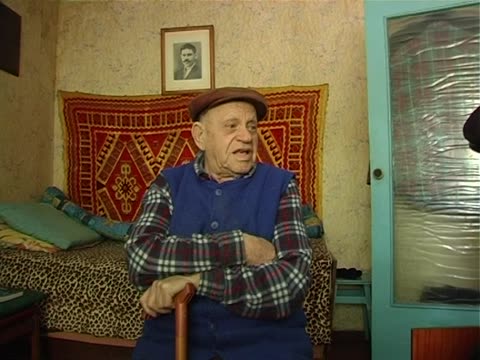
This tape consists of a formal interview with Aba Davidovich Kaviner (b. 1921, Derazhnya). The research team searches for Kaviner’s apartment.
From the machine transcript
Opening of the tape, with Kerler and another person in the team talking about finding the apartment and a phone number; mostly garbled, with some English.
The formal interview begins. Kaviner discusses contemporary Ukrainian politics of memory as well as his own health issues.
From the machine transcript
The interview begins. Kerler and Kaviner settle how the name Proskurov is said in Yiddish and that the town is now called Khmel'nyts'kyy, and Kaviner talks about the postwar renaming and the state's memorial observances for the victims. He also speaks of his broken leg, its operation and its costs, and of present-day Ukrainian politics and hardship.
also names Proskurov/Khmel'nyts'kyy in Yiddish and the cost of his operation
Kaviner talks about the types of people who lived in his hometown of Derazhnya. He tells a story about a village madman named Shmil-Leyb and how he once cured a dying young woman from tuberculosis.
From the machine transcript
Kaviner talks about the madmen of Derazhnya, saying that one village madman, Shmil-Leyb, was known in the street. He tells a long story of a tailor's daughter dying of tuberculosis and how the barefoot madman brought her back to life, by calling her fiancé's name. Kerler then asks about the terms for a girl who has been cursed or declared unfit, and Kaviner answers.
the story told, and the questions about terms for a girl
Kaviner discusses the yeshiva where he studied in his youth, describing the curriculum, its teacher and its status as an “open secret” to Soviet authorities. He also mentions that he studied in a “kheyder” (elementary boys’ religious school) and a Talmud Torah (religious school for older boys) before entering the yeshiva.
From the machine transcript
Kaviner describes his studies in the yeshiva: Pentateuch, Rashi, Gemara and the Prophets, studied by a fixed method with a teacher. He says he went to kheyder until age ten or eleven, then Talmud Torah to twelve, then the yeshiva. He recalls that the teachers later took Soviet jobs when it was closed, and that the authorities knew of it but pretended not to until they closed it.
the earlier kheyder and Talmud Torah stages
Kaviner talks about how Purim was celebrated in his shtetl before the war, and also discusses Yiddish theater before and after the revolution.
From the machine transcript
Kaviner answers Kerler's questions about Purim in the shtetl: children singing and dancing in the street and a carnival, though he did not take part because he was studying. He says he knows of a play, the sale of Joseph, and discusses it with Kerler. He recalls that professional troupes performed such plays before the revolution and in the 1920s, mentioning the Odesa actress Ester-Rokhl Kaminska.
Kerler's questions on the Purim play and the sale of Joseph
Kaviner speaks about the Yiddish theater troupes who visited the area in the years before the war. He also delves into the history of Avrom Goldfaden’s life and works, the career of Khayim Beyder and Soviet Yiddish literary history in general.
From the machine transcript
Kaviner names Yiddish theater troupes that visited before the war (Federovsky, Segalovsky, Bugova, with the names uncertain). He speaks about Avrom Goldfaden as founder of the Yiddish theater, said to be from Starokostyantyniv. He then turns to Khayim Beyder, who was from Kupel and worked in Moscow, and to other Soviet Yiddish writers such as Itsik Fefer, Dovid Hofshteyn, Oyzer Varshavsky and Vegelis (?).
Goldfaden's life and the Soviet Yiddish literary circle, with writers' careers
Kaviner then turns to poetry, speaking in particular about Shmuel Halkin and his work. He also comments on the careers of Hershl Polyanker, Itsik Fefer and other literary figures, focusing on their relations with the Soviet system and sentences in the Gulag.
From the machine transcript
Asked to recite Yiddish poems, Kaviner says he remembers a few lines of Fefer and others. He talks about the poets Shmuel Halkin, Markish, Hershl Polyanker, Fefer and others. He discusses their arrests and sentences, their camp poetry and postwar release, and Polyanker's speech about the murder of six million Jews. He also discusses faith and God after the Holocaust, and ends with a story on Jews' residence rights, mentioning Berdychiv.
Polyanker's speech on the Holocaust and the discussion of God
Kaviner tells several stories about Hershele Ostropolyer.
From the machine transcript
Kaviner tells several stories about Hershele Ostropolyer: his search for the rebbe's nose, his eating the varenikes the hostess left on the oven, his trick at the Passover market to bring down a peasant woman's price and his dealing with a peasant selling straw at the mikveh. Kerler then begins to ask about a two-language Yiddish-Ukrainian song.
He speaks in further detail about “Yinge yurn/Gody molodye,” the Yiddish/Ukrainian song he sang in past AHEYM interviews. He heard several recordings of the song, but says that he learned it by hearing it sung live. He comments on the life, career and deaths of many singers, including Epelboym, a performer who died on stage. Kaviner relates a story about how Epelboym’s life was spared during a Petliura pogrom on account of his beautiful singing voice.
From the machine transcript
Kaviner and Kerler discuss the Yiddish-Ukrainian song "Yunge yorn / Gody molodye" and which singers performed it, including Epelboym and Shulman (?); Kaviner says he knew it from live performance, not records. He tells how Epelboym died on stage, and how Epelboym was spared in a Petliura pogrom because his singing moved the ataman. Kerler asks him to sing a prayer, and he declines.
the Epelboym story and the sung prayer request, with the song itself discussed
Professor Kerler asks Kaviner about a particular idiomatic expression he uses.
From the machine transcript
Kerler asks about an idiom Kaviner used for a hat or cap with "drikes"; Kaviner explains the word drik as a wooden pole or thing and the two compare it with Polish and Ukrainian equivalents.
This tape consists of the end of a formal interview with Aba Davidovich Kaviner (b. 1921, Derazhnya). Kaviner asks the research team about the AHEYM project, their other interviewees and the route of their travels.
From the machine transcript
Kerler talks about telephone calls made to the interviewee's household that went astray, and checks a phone number. This is arranging talk before or around the recording, not an interview about the project.
Only Kerler speaks, about a phone number; Kaviner does not ask about the project or the route.
Kaviner speaks about his family life in the postwar period, specifically talking about his wife, daughter and grandson.
From the machine transcript
Answering Kerler's questions, Kaviner says he spoke Yiddish with his wife after the war. She left home early, finished school and studied at an institute in Leningrad. His daughter, a doctor, lives close by in the same courtyard. They then discuss his grandson, who works for the state in an inspection office, though the details of the work are unclear in the transcript. Kerler closes by saying the team has a long road ahead and hopes to come back.
Also covers the wife's studies in Leningrad, the grandson's job, and Kerler's closing remarks about the team's route.