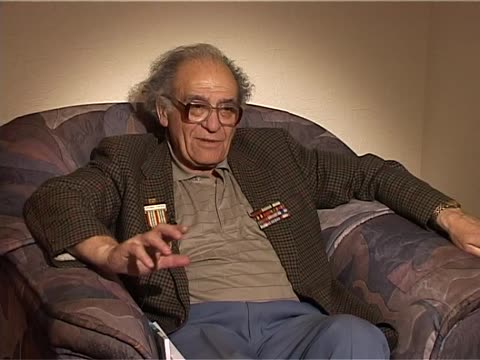
People › Boris Naumovich Khandros › conversation

Boris Naumovich Khandros

Kyiv 2 May 2003 – 3 May 2003 Interviewed by Dov-Ber Kerler, Jeffrey Veidlinger 3.0 h · 3 parts on 3 tapes
Loading the player…
  1. MDV 505 0:00–59:41 · 60 min · not online — MCO
  2. MDV 506 0:00–1:01:53 · 62 min · not online — MCO
  3. MDV 507 0:00–1:00:52 · 61 min · not online — MCO
Passages
MDV 505 0:00–59:41

0:00

Research about his family.

From the machine transcript

Khandros talks about his genealogical research in archives, where he is brought bundles of documents, including Russian-language census-type records from Ozarinets. He explains that Jewish children were named after grandparents (himself after his paternal grandfather, his brother after his maternal one), which let him trace his great-grandfather and his children. Kerler comments on the value of this naming custom for Jewish genealogy.

Gives details of the archival documents and the naming custom.

2:36

Formal introduction.

From the machine transcript

Kerler fills in the interview form: the town is Ozarinets, which administratively belonged to Kamianets-Podilskyi province before the Revolution and later changed district, and Khandros considers speaking some Russian as well as Yiddish. Kerler notes the date and that it is the second expedition. Khandros explains his Russian name Boris Naumovich Khandros, shared with his brother, whose Yiddish name was Berl while his own is Barukh. His father was Nakhman Moshe, and he says the family's own history is interesting but long.

Covers the naming of him and his brother in school and army, and the brother's grave.

6:54

Formal introduction and family.

From the machine transcript

Khandros gives his birth date and those of his parents, who were both born in Ozarinets; his father was a melamed until 1922 and then became a teacher and head of a Yiddish school, where Khandros studied for four years. His mother Mintsi was his father's pupil and later a teacher too. He names his brothers (one the younger Berl, born 1926, and Hershele, now a mathematics teacher in a Ukrainian town) and a sister Sarah who died in 1988 (?), all of whom went through the ghetto.

Gives the parents' ages and the siblings, including a brother alive now, and the sister's fate.

12:06

Life during the war.

during the war World War II (general) MDV 505 · MCO
From the machine transcript

Asked about the ghetto, Khandros says he was in the ghetto and in the Pechera camp and escaped from it, and that he was shot at and wounded. He refers to his published book for the full story. He speaks of five people who saved him at different times and are honoured at Yad Vashem, whom he regards as his own family, and offers to show photographs.

Adds the rescuers recognised at Yad Vashem.

13:08

Education before the war and beginning of war.

before the warduring the war SchoolingWorld War II (general) MDV 505 · MCO
From the machine transcript

Khandros says he finished tenth class in Ozarinets in 1941, after four Yiddish classes, then Ukrainian school. He recalls the graduation evening and fishing with a friend when the war began. He later taught briefly after the war and, before the war, worked as head of the school library.

Mentions that he worked briefly in a school after the war.

14:57

School library and Yiddish school.

From the machine transcript

Khandros describes the school library he ran as a splendid cultural centre where young people met and discussed. His father's Yiddish school was famous in the area and was the last Yiddish school in Ukraine, closed in 1945. Until he was eight he knew no Russian, only his mother tongue and the many Yiddish folk songs his father knew.

Adds the language of his childhood and the father's repertoire of folk songs.

17:09

Yiddish songs.

From the machine transcript

Khandros sings parts of Yiddish songs his father knew, including one about a hammer and one about ringing bells. He says his father sang at family gatherings until about ninety-three and that he recorded his father's voice from 75 on, offering to let Kerler hear the recordings. He also mentions the school library and the many books his father loved.

Includes the recordings of his father and the singing of two songs.

19:46

Yiddish and prayer books.

From the machine transcript

Khandros recalls a Yiddish library at home: his grandfather's old cabinet held Talmud and other books. His father studied with his own father, knew Hebrew well, and was more devout than the grandfather, who had been a cantonist and came from Chernobyl. Kerler asks about the generations in Ozarinets.

Adds the home library, the father's Hebrew learning and the grandfather's cantonist background.

21:53

Family.

From the machine transcript

Khandros relates how his grandfather, from a family of melamdim in Chernobyl, was orphaned in an epidemic, was taken as a child by cantonist recruiters and served in the army for many years. Afterwards he studied in Zhytomyr, and Khandros tells why he came to Ozarinets: as a boy he had been a friend of a tsadik's grandson of the Twersky dynasty, who later became the tsadik of Ozarinets. Khandros discusses the tsadik's grand wedding and says he will tell more in the third part of his book. Kerler also asks whether the Russian term for the Pale of Settlement existed in Yiddish.

Adds the grandfather's cantonist army service and the question of a Yiddish term for the Pale.

28:42

Terminology.

Questionnaire Cultural terminology MDV 505 · MCO
From the machine transcript

Kerler asks about the Ukrainian word for a unit of weight (pud) and Khandros says Ukrainian uses the same word; they also discuss a word for a dove. Khandros then begins on the origin of the name Ozarinets, mentioning his father's older friend, a brilliant teacher named Krevitsky.

29:31

Market in Ozarinets.

From the machine transcript

Khandros explains theories of the name Ozarinets, which an older teacher derived from a lake, though he now thinks it comes from the word for bazaar. He recalls the fairs held in the town until the late 1920s, twice a year, with peasants coming from many villages and separate places for selling cattle, pigs and clay pots, and Jews earning a great deal in three days. Kerler then asks him to recall his childhood between ages three and six.

Adds the etymology of the town name and the fairs' details.

33:34

His newspaper articles and his father as a teacher.

From the machine transcript

Khandros says the fairs ended with collectivisation, then shows articles and a book on the famine by a Ukrainian writer and a Russian one, complaining that he has never been invited to conferences on the Famine because he is a Jew. He praises his father, who was so loved as a teacher that his name alone sufficed in the village. He reads, in Russian, accounts he recorded from a widow in 1988 about the village where documents survive and about a death in 1933, mentions his two films and his writings, and says most pieces are about 1933.

Adds his father's reputation and the Russian passages he reads aloud.

43:44

Great Hunger in 1932.

From the machine transcript

Asked for memories of the Great Hunger, Khandros describes documents and a letter from Berdychiv in which a Jewish factory worker, who later died, begged for help, and he says it shows that Jews starved too, against claims that they did not. He discusses the Torgsin shops, where gold was exchanged for flour, and how his mother's gold was broken into three parts. He relates a butcher's story about gold and a hiding place, the mobility of Jews who could travel to Moscow and Leningrad, and relatives in Leningrad who sent rusks. He describes death registers from 1932–33, deaths from eating in summer 1933 and a dysentery epidemic which he survived because his uncle kept him at home instead of sending him to hospital. Kerler remarks that many informants deny Jews died, and Khandros reports letters in Russian that deny the famine.

Adds the gold and Torgsin themes, uncle's help, and debate over whether Jews died.

MDV 506 0:00–1:01:53

0:00

Shloyme Roytman.

From the machine transcript

Khandros talks about the poet Shloyme Roytman, secretary of the Yiddish section of the Soviet Writers' Union. Kerler asks about his role. Khandros says Roytman's brothers were shoemakers in Mohyliv, where Roytman survived hard months, and that Khandros organised an evening about him there. He then turns to his own army posting after the war, which brought him to Grabovets and Bialy Wody.

Also covers Roytman's family of shoemakers and his survival in Mohyliv.

4:01

Serving in army after the war and encounter with Roytman.

after the war Army service MDV 506 · MCO
From the machine transcript

Khandros recalls his service as a commissar in a cavalry regiment, quartered in the park of an estate at Bialy Wody in summer 1945. He describes the ruined town of Grabovets, where pavements were laid with Jewish gravestones, and a local priest who told him the history. He tells how he found a cellar with Jewish belongings and the names of an owner, his wife and two children, shot for hiding Jewish families. The Ukrainian police were alerted by a neighbour. Kerler establishes that this was summer 1945.

Gives details of the destroyed town, gravestones used as pavements, and the family shot for hiding Jews.

10:24

End of war.

From the machine transcript

Khandros describes how he experienced the end of the war: 1 May 1945, with the cavalry advancing toward the Elbe, German equipment and scattered newspapers, and his first hearing grass grow. He heard the Berlin radio announce Hitler's death. A friend who rode ahead to announce the German surrender was shot by a German. Khandros explains a term from the interrogation of prisoners, with Kerler asking about a word, and says he served as German interpreter.

The end of the war is set near the Elbe, with the death of a comrade and German interrogation work.

19:12

School education.

From the machine transcript

Asked whether he studied German before the war, Khandros describes his village school, where German teachers were intermittent. In the tenth class, in 1940, a young Komsomol member with only a few months' training came to teach it. His father also wrote out the paper Rote Fahne for him.

20:36

Newspaper Rote Fahne (red flag) and postwar Soviet cultural life.

From the machine transcript

Khandros talks about a poem he read in Rote Fahne, a Moscow newspaper for children in German, which became a key to his later life. He mentions Heine. He talks about his decade of work on a Soviet council for aesthetic education and his teaching in an evening school. He speaks about Yiddish writers' descendants who cannot read Yiddish, including a grandchild of Sholem Aleichem whom he visited in New York. Kerler asks about Yiddish terms and then redirects the interview toward Khandros's memories.

Also covers Heine, the descendants of Yiddish writers and the decline of Yiddish.

28:56

Yiddish school and family.

From the machine transcript

Khandros and Kerler turn to the Yiddish school in Ozarintsy and the teachers. Khandros says his father attended courses in Kyiv in 1926 with the Reznik brothers, Lipe and Yoyse, and that the writers Lipe Reznik and others visited in 1934. The school ran from 1922 to 1945 and was the last one left. He recalls his grandmother Sure, his own illness at that time and the first time he saw writers. He also mentions his grandmother Miriam and the loss of Yiddish schools in the Vinnytsia region. He ends by mentioning the Black Book.

Adds details of the Reznik brothers, the 1934 writers' visit, the school's closure and his grandmother Miriam.

41:09

Grandmother Sure.

From the machine transcript

Khandros talks about his grandmother Sure, who died in 1935 and knew Yiddish literature well. She was from a family from Snitkiv, daughter of David Grinfeld; her first husband was a friend of Goldfaden; her second husband was Berl Vaynshtok, Khandros's mother's father. He recalls her love of the written word and his other grandmother Miriam. He describes a fire in the house, and an incident in which his baby brother nearly drowned at a mill. He also mentions the mikveh.

Gives grandmother Sure's family background and two childhood memories.

49:25

Prewar religious life.

From the machine transcript

Khandros talks about his father's religiosity, from fanatical devotion to a turn toward freethinking. He recounts that his father was denounced for attending synagogue while a Soviet teacher. He describes the rabbi in Ozarintsy, Gedalye Roytberg, who was learned, and the church built in the 18th century by Polish magnates, which closed in 1931. He recalls the Poles, Ukrainians and Jews in Podolia. The Yiddish writers read at school are named.

Adds the story of the denunciation to the district, and the church and mixed population of the town.

55:28

Yiddish and Russian literature at school.

From the machine transcript

Khandros names Yiddish and Russian writers he read at school and later, and quotes a poem of Usher Shvartsman. He tells how he and his wife, both journalists, visited a Russian poet in Leningrad. He describes the Ukrainian teacher Alexei Krevitsky, who organised the Ukrainian school. Krevitsky mentored Khandros's father in ethnography and folklore, and the ethnographic circle of 1926 in Ozarintsy. A Ukrainian ethnographer's expedition to the town gave him a view of his shtetl from outside.

Includes the recited poem and the Ukrainian ethnographer's expedition to Ozarintsy.

MDV 507 0:00–1:00:52

0:00

Life today.

life today Life today MDV 507 · MCO
From the machine transcript

Khandros says the Yiddish school opened his eyes to the world. He describes meeting Bratslav Hasidic pilgrims in Uman (?), who understand Yiddish. One of them sat with him for hours and wrote down the songs his father sang. These Hasidim read no Sholem Aleichem or other Yiddish literature. Kerler comments on the writing-down of the songs and asks which kind of Hasid he was, and the answer is Bratslav. The Hasid gave Khandros his address and invited him to Jerusalem.

2:27

Prewar religious life.

From the machine transcript

Answering Kerler's questions, Khandros says Hasidim lived in Ozarintsy in the early 1900s, but the tzaddik died when he was a child and the community declined. He remembers praying with the tanner Hershl Koyfman and Koyfman's old mother Rachel, who told him and his cousin Lusia Bible stories. He wrote these down in his booklet. He recalls the mikveh near the mill, where his father's elder brother Itsik Khandros, who lived in Mohyliv, took him as a boy. He also describes the town's three prayer houses, among them the beys-medresh, whose walls still stand.

8:25

Synagogue at beginning of occupation.

From the machine transcript

Khandros describes the first day of the German occupation of Ozarintsy, which he did not witness himself. The Germans drove the Jews of the town into the synagogue, and a German on a motorcycle brought petrol to burn it. Villagers took belongings from the houses and later brought some back. A maid in his family's house took their sewing machine and returned it in October 1941. Kerler asks whether she spoke Yiddish, and Khandros says she did not.

11:31

Non-Jewish Yiddish-speakers.

From the machine transcript

Khandros speaks of a non-Jewish Sabbath helper who grew up in the town and spoke good Yiddish. The Jews had helped his family in a famine, yet he was the only villager who took part in the action against the Jews on the first day. He was later imprisoned for ten years. Khandros says he wrote about this in his book and that the man's son told the story in front of the camera when a film was made in the early 1990s. He mentions that he has made more than thirty documentary films, including one on the history of the town.

15:01

Khandros’s work.

From the machine transcript

Khandros shows a photograph of a gravestone about two hundred years old, taken for his film and book. Kerler asks whether a copy of the film can be bought. Khandros talks about the film's reviews, the English version he hopes to obtain, and his friend Borys Zabarko, a Yiddish-speaking man from Sharhorod. He says he has made more than thirty documentary films and has two feature-film projects that the actor Bohdan Stupka liked. Jerzy Hoffman is mentioned.

19:21

The blacksmith Roznblit.

From the machine transcript

Asked by Kerler, Khandros recalls the blacksmith Kive Roznblit, a long-armed, very poor Jew and friend of Khandros's parents. His daughters studied in Khandros's father's school. Khandros recounts Kive's sayings and his habit of raising his hands in curses and questions. He recalls Kive's last words, which became his own motto: go, stand, or die. Kive died in a ghetto, in a place the transcript renders as Dashinets (?). Khandros ends by introducing a friend he met in Kyiv on the day the American president came.

22:47

Life today.

life today Life today MDV 507 · MCO
From the machine transcript

Khandros tells how he and other Jewish war veterans were bused to Babi Yar when the American president and his wife visited Kyiv in 1991. Afterwards he met in the Jewish library a man who had survived five camps and learned Yiddish in them. He wrote an article about him, and in the mid-1990s took it and his film about his town to Israel, where a Sokhnut official recorded him. Kerler then says it is late and proposes another meeting. Khandros ends with a story of a New York foundation director who did not answer about the film.

31:19

Education.

From the machine transcript

The speaker is now Derbaremdiker, who lived in Berdychiv and studied in Kyiv. He explains that his father, Levi Yitskhok, advised him to enter a technical institute rather than the humanities, given the times. He arrived in Kyiv in 1936. Kerler remarks that it is the second day of the expedition.

33:06

Formal introduction and family.

From the machine transcript

Derbaremdiker gives his personal data while Kerler fills in the form. He fled Berdychiv in early July 1941, and the Germans entered the next day and seized documents, among them his birth record in Yiddish and Hebrew. He names himself as Mordkhe, son of Levi Yitskhok, and his mother as Perl. His birthplace was the Kachanivka district of Berdychiv. He also tells what his younger brother in New York recalled of a house where Mendele Moykher Sforim once lived.

35:58

Childhood experiences.

From the machine transcript

Derbaremdiker recalls childhood in Berdychiv. He describes Kachanivska Street, the Carmelite monastery fortress with a museum that had rooms for Shevchenko, Sholem Aleichem and Balzac, and the church where Balzac married. At about four he was carried in his father's tallis to cheder, where he studied only a few years, as the cheders were closed in 1927. That year he entered a Yiddish school. He says he now speaks Russian most of the time and has hardly anyone to speak Yiddish with.

37:51

School and kheyder education.

From the machine transcript

Derbaremdiker names his Yiddish school as School No. 13, in a former commercial-school building on the central street. The Russian school was on the second floor and a pedagogical institute on the third. After seven grades he moved to a model school. He went on to a technical school in Kyiv in 1936 and received his engineering diploma on 20 June 1941, two days before the war. He answers Kerler's questions on his cheder years: two synagogues in the Kachanivka district, a melamed of the Golyetski (?) family, and a younger brother now in New York.

41:26

Family.

From the machine transcript

Derbaremdiker names his brothers: an elder brother born in 1913, now in New York and about to turn ninety, and a younger one, Yontl (Yontev). Yontev was named after the grandmother Yente, his mother's mother. The elder brother, Avrom, went to a Ukrainian school because no Yiddish schools existed in 1921, then studied in Berdychiv's Yiddish technical school and later at the Progress machine factory and in Kyiv. Derbaremdiker says he had a bar mitzvah in a secret prayer house in 1933, because officially it was impossible.

44:26

Famine.

From the machine transcript

Derbaremdiker describes his secret bar mitzvah, for which he was taught by a melamed, and explains why it had to be hidden: parents risked losing the bread ration and work. He then speaks of the famine of the early 1930s, which struck the Ukrainian population and the Jews of the small towns. Jews survived by relatives sending parcels from Moscow and Leningrad. He recalls his father working as a soap boiler, a friend's tailor father who had no work, and his school friend Avrom Goldenberg, killed in the war. Kerler asks the melamed's name and which Torah portion he learned.

48:29

Religious education.

From the machine transcript

Derbaremdiker describes his cheder lessons: Chumash beginning with Vayikra, the letters, and the prayers. He says he can still read the siddur fluently but does not understand every word. He now goes to the synagogue because it is the only place to speak Yiddish, with the rabbi Yakov Dublikh (?). He mentions the languages he studied: English, German and French. He adds that after the war relatives in Canada found the family's address, which was in the Urals, through the evacuation centre.

50:19

Family.

From the machine transcript

Derbaremdiker tells how, once he was in postgraduate study in Kyiv and his brother had come back from the war, he wrote to relatives in Canada in English. They were surprised that anyone knew English so well, and he says his English is only fairly simple. Kerler then asks about Jewish holidays.

51:18

Holiday celebration.

From the machine transcript

Derbaremdiker says Passover was observed in his family despite pressure, and that groups from the school were sent to check homes, though the Jews kept silent. He describes matzo from flour, a hidden box of Passover dishes, strict kashrut kept by his mother, and his father's search for hametz. After the war the family baked matzo in Kyiv themselves, and later queued for it. He then recalls a favourite mathematics teacher whose surname was Lemberg.

54:39

School education.

From the machine transcript

Derbaremdiker continues about his teachers: a gravestone of the mathematics teacher Lemberg, which he found in Kyiv, and the director of the fifth school, a Jew from Poland named Yarman who taught Yiddish language and literature. Yarman once read the class Peretz's "Three Gifts". He says he now teaches at a Sunday school, where he recently recited this story from memory to students. He then begins to retell it.

57:29

Retelling Peretz story “Three Gifts”.

From the machine transcript

Derbaremdiker retells Peretz's story "Three Gifts" in Yiddish from memory. The soul of a dead Jew is weighed in the heavenly scales, with an angel in white holding his mitzvot and an angel in black holding his sins. The scales stand level, so the soul may enter neither paradise nor Gehenna and is condemned to fly between heaven and earth, until the tale reaches the soul's long flight. The retelling breaks off as the soul sees a light below.