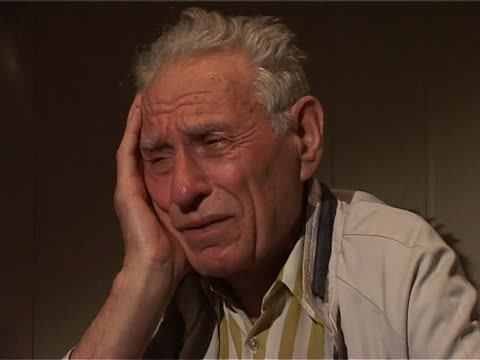
Dorfman speaks about contemporary life and community members. He then speaks about postwar Yiddish press, as well as contemporary writers and religious figures. Leibel turns to the contemporary community in Dnipropetrovsk and addresses local intellectuals.
From the machine transcript
Dorfman talks about Yiddish writers, journalists and editors he corresponds with, and about a film and a Lviv acquaintance who wrote to the Black Book. He discusses Yiddish periodicals in Poland and Birobidzhan and antisemitism. He then describes Jewish life in Dnipropetrovsk — its rabbi, synagogue, wealthy patron, Jewish gymnasium and press. Kerler and Dorfman also talk about exchanging Yiddish publications and about meeting Lviv scholars.
Adds Dnipropetrovsk's synagogue and school, Yiddish writers and journalists, and talk about sending publications.
Dorfman talks about his life during World War II. He studied at a technical college for construction in Chişinău in 1939. Dorfman describes how he experienced the beginning of the war, before speaking about articles regarding the war and Jewish and non-Jewish local figures.
From the machine transcript
Dorfman recalls the outbreak of the war on June 22: he had finished his third year at the technical college and was living in Bessarabia, and the Soviet army was unprepared. He tells of two articles he published on Polish Jews, one of them an officer who posed as a Ukrainian. He then talks about his work documenting rescuers of Jews for Yad Vashem, including a woman rescued as a child and the Polish antisemitism she knew.
Adds Dorfman's work on Yad Vashem documentation of rescuers and the Polish officer story.
Dorfman returns to his life at the beginning of the war. He was drafted into the Red Army, shortly after the outbreak. As the leader of his division, Dorfman went through Tiraspol, Odesa, Rostov, Stalingrad and Saratov. Dorfman then explains that he was sent to Siberia since he originally lived in newly occupied territory.
From the machine transcript
Dorfman describes being mobilised with his fellow students at the start of the war and building fortifications at the front. He retreated with his unit as the Germans took L'viv, via Tiraspol, Odesa, Rostov and Stalingrad to Saratov. As someone from newly annexed territory he was then sent elsewhere, where he commanded a group of about three hundred men.
Adds the building of fortifications and the age of about seventeen at mobilisation.
Dorfman speaks about his life during the immediate postwar period, which he spent in Siberia. He worked as coachman. He then returned to Chişinău in 1946 and continued his studies. In 1949, Dorfman continues, did he escape to Lviv. Dorfman was the chief engineer of a factory for thirty-five years. He also worked in theaters.
From the machine transcript
Dorfman tells of his work at the end of the war with a horse and cart, then of returning to Chişinău, where the technical college was in ruins, and finishing his studies. In 1949, when his mother was arrested a second time, he fled to L'viv, where his father's family came from. He worked thirty-five years as chief engineer of a regional enterprise employing thousands, and also in a theater.
Dorfman speaks about his family, particularly his wife's biography. He raised a son and a daughter. Dorfman also addresses his Hebrew language skills.
From the machine transcript
Dorfman talks about his family: a son and a daughter, and his wife, a teacher and director of a Sunday school. She comes from the Vinnytsia area, was evacuated to Samarkand, and understands Yiddish. He describes her learning Hebrew after they came to Israel, and his own role reading Yiddish and Hebrew letters for others. He also mentions evaluating books and prayer books among Jews leaving the country.
Adds his wife's wartime evacuation and his advising on books and prayer books for emigrants.
Dorfman talks about his work as chief engineer at the Lviv theater after the war. He was in charge of rebuilding the theater. He then speaks about contemporary intellectual life.
From the machine transcript
Dorfman talks about his work as chief engineer at a L'viv theater: night duty, technical responsibility and the reconstruction of the building. He then turns to contemporary intellectual life, criticising a book on Yiddish theater by a local author and discussing his own writing and reviews.
Dorfman speaks about researchers and exhibitions at the Museum of Ethnography and Art Crafts in Lviv. He also addresses contemporary endeavors regarding exhibitions. Dorfman particularly addresses festivities of the 130th anniversary of Sholem Aleichem's birth.
From the machine transcript
Dorfman speaks about museum people in L'viv, including a Ukrainian professor and Goldstein's prewar Jewish museum, and about a joint exhibition of Jewish art with its controversy over Israel. He describes his articles on the museum and on Sholem Aleichem's residence in L'viv, and the celebrations of the writer's 130th anniversary, which marked the first Purim and a concert, and the founding of a Jewish society.
Adds the Goldstein museum, the exhibition dispute and the first Purim.
Dorfman talks about postwar religious life in Lviv. He also shares his findings in the KGB archives. He explains how the community rebuilt one of the synagogues after the war, which was closed down in 1945 due to antisemitic agitation. Dorfman continues that the agitors went to jail and the synagogue continued to operate. Dorfman recalls full attendance on major holidays. According to him, the synagogue was eventually "unoffically" closed down during the later postwar Soviet period, and reopened in the 1980s. Dorfman then describes the community.
From the machine transcript
Dorfman talks about postwar religious life in L'viv. He recalls a nationalist Jewish youth group whose papers he read in the KGB archive and the aid organisations Bricha and Chabad. He describes the postwar reopening of the synagogues, the 1945 accusation of ritual murder and closure, the synagogue's later unofficial closure and conversion into a sports hall, and the minyanim formed until perestroika. He recalls packed holiday services and the local community's way of keeping the synagogue going.
Adds the youth group found in KGB files, the blood-libel accusation and the Soviet authorities' pressure to close the synagogue.
Dorfman speaks about postwar religious life. He mentions Cantor Eleazer Schulman and other local religious figures. Dorfman describes how the community repossessed the synagogue in 1992.
From the machine transcript
Dorfman talks about religious figures in L'viv after the war: Cantor Shulman of the great synagogue and his family, an old man buried near his mother who had studied in Italy, and a later cantor with a good voice. He describes how, in the early 1990s, the community was given a second synagogue building instead of the original one, which had become a warehouse. The building was cleared and renovated, and a rabbi was brought from America.
The synagogue he describes is a different building from the one the community sought; it is a former warehouse; the new rabbi came from America.
Dorfman addresses contemporary religious life.
From the machine transcript
Dorfman and Kerler discuss the new rabbi and the local religious factions, including the Lubavitch. They then work out which shoykhet Kerler has spoken to, a man named Melekh(?), who lives on a certain street, and Dorfman gives his telephone details.