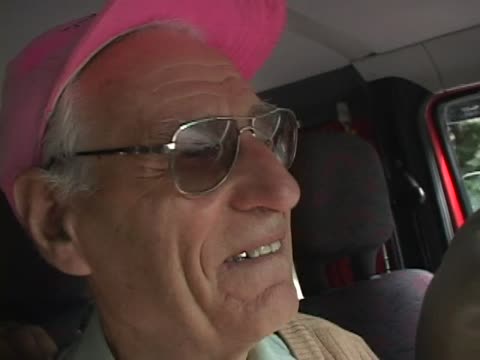
The team and Dorfman travel to the new cemetery. He provides historical background information on the cemetery, as well as regional Jewish life before the war.
From the machine transcript
At the start, bystanders in Russian and Ukrainian talk about a local boxer and a teacher; Katz then asks Dorfman to say in Yiddish where they are. Dorfman explains that they are driving to the cemetery and that the old cemetery, one of the oldest in Europe, is now a market. He mentions the street's former name and the nearby Yanov rabbis, and says the older cemetery was closed in a time of cholera and plague.
Includes a bystander conversation in Russian/Ukrainian about a boxer before the cemetery talk.
The team and Dorfman arrive at the cemetery and take a tour, while Dorfman explains how the Jewish and non-Jewish cemeteries were combined. They were combined in 1962, after the synagogue was closed down, Dorfman explains.
From the machine transcript
Dorfman explains that the old Jewish cemetery was cleared and moved, and that the Jewish and Christian burial grounds were joined after the synagogue was closed, in 1962. He begins to tell how a small monument was put up in Soviet times, although forbidden, with money collected by Jews who had come from Poland and Bessarabia.
Dorfman speaks about a memorial, which was erected in the early 1970s. Dorfman explains how the community collected money for the monument and his involvement in rebuilding Jewish life after World War II.
From the machine transcript
Dorfman tells how a monument was built over bones found during factory construction, and how the inscription was in Yiddish and Russian. He recalls the first Jewish demonstration at the time of perestroika, when a thousand people came, and the founding of the Jewish society with ten or twelve people, including the writer Alexander Lizen. He talks about the cemetery's age and lack of space, and shows two old gravestones from Polish times to Kerler.
Adds the founding of the Jewish society and the cemetery's age and lack of burial space.
They arrive at the old part of the cemetery from the prewar Polish era, before visiting Alexander Lizen's grave, a Soviet Yiddish Writer.
From the machine transcript
The group looks at the old gravestones from the Polish period, with Kerler and Katz reading dates, and Katz speaks Russian with a cemetery worker. Dorfman then takes them to the grave of the Yiddish writer Alexander Lizen. He tells of Lizen's work, translations into German and role as first chairman of the Jewish society, and says he was his teacher.
Adds Lizen's grave, biography and his relationship with Dorfman.
The camera collects footage of the cemetery, while Dorfman talks about local figures.
From the machine transcript
Dorfman points out graves and talks about people, including a teacher and school director from the Odessa region who was imprisoned in 1941 and whose brother edited a Kishinev Yiddish paper. He shows the grave of the cantor Baruch Shulman, father of the singer Zinovy Shulman, who was jailed for fifteen years. Kerler and Katz ask about dates and inscriptions, and the camera records the cemetery.
Dorfman speaks about his parents. His father died in a prison in Karagandy, Kazakhstan. Dorfman's mother was imprisoned for fifteen years along with his father. The camera continues to collect footage.
From the machine transcript
Dorfman says his father died in a prison in Kazakhstan and his mother served fifteen years. He then leads the group on past graves of a colonel and others and of a charity collector.
Adds the mother's fifteen-year imprisonment and the graves visited next.
The team and Dorfman continue the tour and are headed to the railway station "Kriparev," from which East European Jews were deported to the Belzec extermination camp.
From the machine transcript
On the way, Dorfman describes the Kleparov railway station, from where Jews from Lviv, Czechoslovakia, Poland and Hungary were sent on to Belzec; he gives the figure of half a million and the memorial there. He tells of a man who escaped from a wagon as a boy and later became a professor in Melbourne. He then begins to talk about the Janowska camp.
Adds the Belzec deportations, the memorial and the story of the boy survivor.
The team and Dorfman continue the tour and he shows the site of the former Janovska concentration camp, built exclusively for Jews. Dorfman also mentions an uprising of the inmates and points out that the stone memorial was built with German support.
From the machine transcript
At the Janowska camp site, Dorfman describes the sand pits, the camp for Jews, the uprising of November 1943 led by a poet, and the burning of corpses with a mill. He talks about the stone memorial put up with help from Freiburg, the Munich professor Alexander Schwarz, plans for a larger monument that he opposes, and Ukrainian recognition of rescuers. He also describes the camp's labor and the Nazi report that Galicia was free of Jews.
Adds the uprising, the mill, Italian soldiers and the memorial plans.
The team and Dorfman travel to the site of the former Lviv ghetto, while Dorfman points out buildings of the former ghetto. They then visit the former ghetto site and camera collects footage. Dorfman then explains how the community built memorials to remember the sufferings in the former ghetto. He also speaks about postwar Jewish life in Lviv and the high unemployment rate.
From the machine transcript
Passing the former ghetto area, Dorfman and bystanders discuss, in Russian and Yiddish, the killing of Jews by the Ukrainian police. He describes the conditions in the ghetto and the memorials: a monument unveiled in 1992, funds from Jews abroad, the Soviet-era plan for three monuments, and the sculptor and architect. He also speaks about prewar Jewish life in Lviv, the numbers in the city, the Soviet arrival and deportations, and what happened after the war, including the museum collection and the bridge known as the Gate of Death.
Adds postwar Jewish life in Lviv and funding of the memorials.
The team and Dorfman continue the tour of the former Jewish neighborhood, while he points out memorials and individual buildings.
From the machine transcript
Dorfman points out old Jewish houses, a former Jewish school, and the former Kraków market, now moved to the old cemetery. He shows where Uri Grinberg lived and says he put up a memorial plaque.
They arrive at the former "New Hasidic Synagogue," which is used as the community's cultural center. Dorfman gives a tour of the former synagogue and provides historical background information. During the war, the building was used as stable and then as gym after its closure in 1962. Dorfman then addresses the community's cultural activities and teachings.
From the machine transcript
At the great synagogue, Dorfman explains that it survived the Holocaust because the Germans used it as a stable, and that after its closing in 1962 it became a sports club. He describes the present cultural centre with its library, Sunday school, Yiddish theatre studio, ulpan and veterans' section, and shows photographs of events. He mentions the opening of the memorial with Israeli and American representatives and the donors from Vienna, Tel Aviv and London.
Adds the Sunday school, theatre, veterans' section and donors.