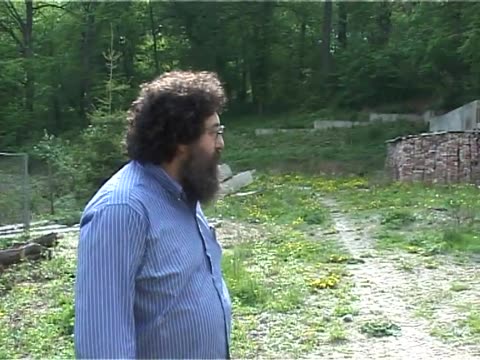
The tape begins with the AHEYM team driving around L’viv with Boris Mikhailovich Dorfman (b. 1923 in Cahul). They stop at an abandoned lot where a prewar building once stood and that Professor Kerler remembers from his childhood. The team then continues driving through L’viv.
From the machine transcript
The drive through L'viv with Dorfman, mostly in Russian with some Yiddish, consists of looking for street numbers, stopping at a lot where an old building stood and recalling its former residents. The speakers comment on the old Yiddish speech of the city and on a Polish-speaking Jewish man in his eighties who might be visited. The Russian parts also touch on what is built there and on the place of childhood games.
Adds a Polish-speaking Jewish man in his eighties whom they discuss visiting.
The camera cuts to the square in front of the L’viv Opera House. The team continues their drive, while Dorfman indicates various points of interest, including the site of the former wartime ghetto and Jewish historical sites.
From the machine transcript
Dorfman points out the monument and the site of the L'viv Jewish ghetto, and says a memorial was put up in 1992 (?). He describes the crowded housing, the twenty months of the ghetto and the number of Jews who died. He also recalls a London filmmaker and a family that survived in the sewers, the Margolis (?) family. Kerler asks him to tell it in Yiddish for the others.
Adds the survivors of the sewers and the London film.
The team continues driving into the countryside outside L’viv, while Dorfman relates further stories about the sites they pass, about the region’s history and contemporary visits by foreign tourists. Upon entering Zhovkva, Dorfman relates the Jewish history of the town.
From the machine transcript
The drive leaves L'viv for Zhovkva. Dorfman tells how the Russian printer Ivan Fedorov took his press from the Jews of Zhovkva, and mentions the Jewish cemeteries and the visits of tourists. He also talks about the nearby border at Rava-Ruska, the rebbe of Zhidachov, the old monastery and the Jewish houses of the town. They arrive at the house of the interviewee.
Adds the printer Fedorov, Rava-Ruska and the rebbe of Zhidachov, plus the cemeteries and tourists.