0:00
The tape begins with a number of false starts and audio problems for the first thirty seconds.
The tape begins with a number of false starts and audio problems for the first thirty seconds.
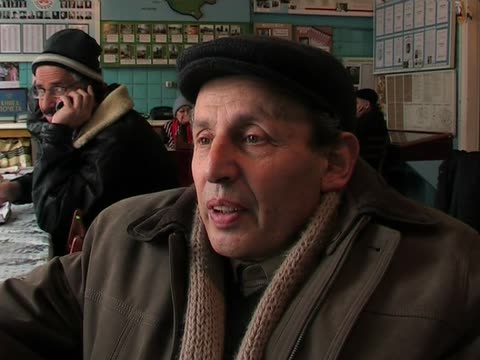
The next part of the tape consists of a formal interview with Mikhel-Shmiel (Misha) Gilevich Leger (b. 1935). He is officially registered, i.e. legally named “Mikhel-Shmiel”, although Misha is his nickname. His father Gilel worked as an accountant/bookkeeper, while his mother Faye worked as a nurse. He was born in Feburary 1935 in Mohyliv-Podil’s’kyy. Leger claims to have learned to speak Yiddish in the wartime ghetto, because before that his family spoke to him only in Russian. During the war, his father was on the front, while he and his mother tried to escape to the nearby village of Chernivtsi (Kleyn Tshernovits), but Germans had already captured it. Leger recalls how his mother gave birth to a stillborn daughter in that town. After a few months there, his father found them there, and they all went back to Mohyliv-Podil’s’kyy, ending up in the ghetto. With upwards of 30-40 people living in one room in the ghetto— including Bukovinan and Bessarabian Jews— there was great fear of a typhus outbreak and so Leger was moved with a cousin into another house with fewer people. The children would hide when the Romanians and Germans would come rounding up Jews for work, but his parents had to labor. After the war, Leger continued to speak Yiddish with his parents and other children. The interviewee also describes his Russian-language schooling and how, although he is illiterate in Yiddish, he is now trying to learn how to read Hebrew characters. Leger reminisces about traditional celebrations of holidays such as Passover and Simkhes Toyre (Simchat Torah) (audio problems: 13:50-14:01; 14:09-14:12). At the conclusion of the interview, Leger addresses post-war and contemporary Jewish life in Mohyliv-Podil’s’kyy. In the Soviet period, according to Leger, prayer was legal and took place in private homes, but only older people went to services since most people were afraid of the consequences. His father, for example, would go only on yortsaytn (commemoration of a relative's death). Today, in Leger’s estimation, there are 300 Jews in the town, a figure which includes families of mixed backgrounds
Leger gives his name, patronymic, birth year and the names of his parents and grandparents. His father was a bookkeeper and his mother a nurse. He says he learned Yiddish in the ghetto, after the family had spoken Russian at home. He recalls trying to evacuate with his mother, her stillborn child in a nearby village, the return to the ghetto, overcrowding with Bukovinian and Bessarabian Jews, typhus, fear and hunger, and his mother's work in a hospital. He then describes language after the war, his work as an engineer, Soviet-era prayer, the destroyed synagogue, and the 300 or so Jews in the town today. In the final part Kerler and Lemster ask about songs, stories, folk customs and Yiddish writers, which he does not remember.
The transcript adds the recalled hospital for Bukovinian Jews, his work as an engineer, the sister Gitl (?), the destroyed synagogue, and the closing questions on songs, stories and writers.
Items of the dialect questionnaire asked here; each link plays the moment.