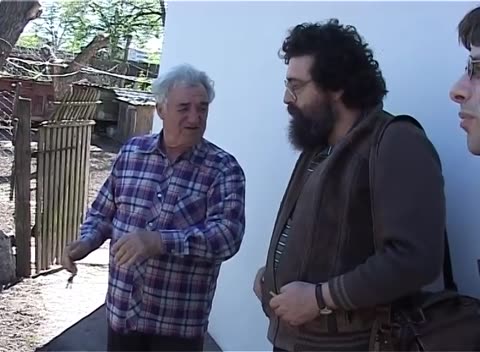
Yiddish song
From the machine transcript
Geller sings or recites a Yiddish song about a revolutionary being led to execution, who addresses his wife Malka (?) and asks her to name a child after him. He says he remembers it from his mother. Kerler asks about the confession scene, discussing the Ukrainian and Yiddish words for confession, and Geller explains the main character.
Kerler asks the Ukrainian and Yiddish words for confession
Outside footage
From the machine transcript
Outside, Geller shows his yard and garden to the camera, including flowers, hens, a rooster, ducks, former rabbits, potatoes, onions, apple and walnut trees, raspberries and the stones removed from the ground. Kerler asks the Yiddish names of plants and animals. At the end he asks Geller for a Kotovsky story.
Life today and showing photographs
From the machine transcript
Back inside, Geller shows something that was bought and made to be sturdy. Kerler points to the pictures on the wall, and Geller names his mother (Leah, Leike) and his first wife, Faige. Kerler again asks for a Kotovsky story.
Names mother and first wife in the photographs
Kartovsky and holiday celebrations today
From the machine transcript
Geller tells of Kotovsky as an extremely strong man who could eat half a calf at one sitting and handle horses. Kerler remarks that he was good to Jews. They then turn to holidays: Kerler asks about Hanukkah and Purim, and Geller says they ate homentashn.
Purim pastries rather than present-day celebration
Entering the house of Maria Isaakovna Liberzon and introductions
From the machine transcript
The team enters Liberzon's house. Russian talk about the recording equipment and where to sit follows. Kerler explains that the interview is in Yiddish so that future generations can learn about Yiddish and Jewish life, and asks whether she was born in Slavuta.
Family
From the machine transcript
Liberzon says her father was a rabbi, and he or the family is said to descend from the Ba'al Shem Tov (the transcript is unclear). Kerler says he and the other interviewer come from America, he from Moscow originally. She mentions Shepetovka and Reb Pinkhas of Koretz, and Kerler confirms they are in Slavuta.
Father a rabbi; Ba'al Shem Tov descent unclear
Historical pictures of Slavuta
From the machine transcript
Short exchange about historical pictures, apparently the Slavuta print and printing house, with Kerler reassuring her that she need not be shy.
Family
From the machine transcript
Liberzon begins with Reb Moshe Shapiro and the Slavuta printing house. Kerler says they are not strangers and invites her to sit down.
Formal introductions and family history of the printing house
From the machine transcript
Formal introduction: after the date (5 May 2003) is given, she gives her name as Malka, in Russian Maria, Liberzon. She says her mother was a Tverski, her father a Liberzon, and his mother a Shapira, linked to Reb Moshe Shapira, the Slavuta rabbi. She tells of the Slavuta press, its fine paper and print, and the Russian bookbinder Yuri. The owners were accused when he died, flogged and exiled to Siberia, in 1835, and pardoned after Nicholas I died in 1855.
Return of brothers and first Yiddish school
Religious life in Slavuta
From the machine transcript
Liberzon describes how after the war her father had a small wood or square planted over the old cemetery, whose stones were used for pavements. Kerler asks whether the shtibl of Reb Pinkhas Koretz was a shtibl or an oyel. She lists the many synagogues of prewar Slavuta, such as the Pritsker and Rabinovitsh kloyzn, and the family's wealth, naming her grandfather Reb Khayim Shapira.
Cemetery stones used for pavements; list of Slavuta synagogues
Family
From the machine transcript
Liberzon tells the family story of her ancestor Reb Liber, who was thrown from his horse and beaten in the woods while praying by a river. He healed a squire's son in return for a promise not to harm Jews, and this is connected to the founding of Berdychiv. She links her mother's side to the Tverski family of Chernobyl. Kerler asks the year she was born.
Life in 1930s
From the machine transcript
Liberzon talks about the 1930s, when the campaign against religion began and her rabbi grandfather was sent away. She mentions the Polish border near Slavuta and the passports needed to reach it. He was sent to Zhytomyr, returned after the 1936 constitution, and stayed until the war.
Yiddish school education and anti-religious agitation
From the machine transcript
Liberzon remembers attending the Yiddish school for five classes and being told in 1941 to buy Russian textbooks as Jewish schools were closed. She recalls anti-religious agitation: an anti-religious meeting poster on the eve of Passover, and a teacher giving her sister money to buy a roll. After evacuation to Krasnoyarsk she attended a Russian school, where a teacher made an issue of pork. Russian remarks by others interrupt.
School years and evacuation to Krasnoyarsk
Religious life after war
From the machine transcript
Liberzon says that during the war the family was in Siberia while Jewish theaters and schools were closed across the country. Her father was highly respected, and the Slavuta synagogue was the only one in the country not closed, opened at the end of 1947, after the war. Kerler asks about the permit required, then turns the conversation back to her mother's side of the family.
Family
From the machine transcript
Liberzon names her mother (Tsipoyre?, a Tverski) and her mother's father, and says her father's father was Moshe Mordkhe. She speaks of relatives in America, including one in Philadelphia, of the Rokeach family, and of a book sent from there. She says her father believed in educating his children, and that she finished Odesa University as a historian.
Relatives in America and her Odesa studies
University education and friends in America
From the machine transcript
Liberzon explains she studied history at Odesa but could not work in the field since she was not in the Communist Party and did not know Ukrainian. She taught in one school for many years, 45 by one account. She is interested in Yiddish and is asked to translate letters from relatives in America who do not know Russian. A second voice speaks briefly, apparently about teaching, with mention of the Rokeach.
Her teaching career and translating letters from America
Showing documents
From the machine transcript
Liberzon shows Kerler documents from Israel and America about her rabbinic lineage, including a journal on rabbis. Kerler reads aloud the Hebrew text, naming Liberzon, Reb Liber of Berdychiv, Rabbi Khayim Shapira the Slavuta rabbi, Reb Pinkhas of Koretz, and the Chernobyl and Belz rebbes. He also notes the yeshivas, including Zvill (Novohrad-Volynskyi). Names and relations are uncertain in the transcript.
Brothers Shapiro
From the machine transcript
Liberzon returns to the Shapiro brothers: Reb Pinkhas Koretz, his son Moshe, and brothers Shmuel and Pinkhas, who quarreled over who should go first. Their descendants moved the printing house to Zhytomyr. She tells how relatives from London visited Slavuta to find their roots, and how her father made wooden fences for graves after the war. The wooden fences were burned in wartime for heating.
Family
From the machine transcript
Liberzon recalls her mother in Krasnoyarsk during the war, and visitors from Slavuta who came to her father about relatives in America. Kerler asks about gravestones and fences, and she explains the Jewish custom of fencing a grave and of wooden fences, with stone monuments added a year later. Kerler then asks her to tell about the Yiddish school.
Showing documents.
From the machine transcript
Liberzon and Kerler look at her school report cards and certificates from the Yiddish school. They name the subjects, such as arithmetic, algebra, geometry, history, geography, physics, chemistry, drawing, music and singing, and note the excellent marks, including for conduct.
Life during the war and evacuation.
From the machine transcript
Liberzon recounts the start of the war and how her family left Slavuta around the tenth day, with German paratroopers already there. They went on foot to Shepetivka, took few belongings and a school satchel, and sheltered under railway wagons during the bombing at Kozyatyn. A grandmother's bundle and the family's things were lost or taken.
Documents.
From the machine transcript
Liberzon goes through documents and school books that survived. Some date from after the war, and she mentions a younger sister who died three years earlier. Kerler discusses getting a portable copier for the papers.
Informal chat with team in Russian.
From the machine transcript
Informal talk with the team, partly in Russian, about drinks and tea, and about a visiting Polish photographer who publishes albums on Jewish sites. A microphone test follows. Liberzon remarks that Yiddish today is mixed with Russian words and that Yiddish speakers are rare.
Yiddish press.
From the machine transcript
Liberzon says she read Soviet Yiddish magazines and spoke Yiddish at home. Kerler steers her toward memories of the Soviet school. She then speaks of her father's love of music and singing, and of a gift she bought him while he was ill.
Family.
From the machine transcript
Liberzon continues about her sick father and the gift she bought him. She mentions his fine voice and his study with a cantor, and an apartment where a recording could be heard. She names a Rozenblat (?) in connection with his singing.
Childhood memories and Yiddish culture.
From the machine transcript
Liberzon talks about the hard years after the revolution and the war, when many rabbis died, including relatives, some of them with relatives in America. She says that after the synagogue in Shepetivka was closed, people travelled to Slavuta for the High Holidays.
Postwar religious life.
From the machine transcript
Liberzon describes how worshippers from nearby towns came to pray after the war, with talk of cantors and music. A relative named Margolis (?) used to stay and the rabbis sat up talking all night, which she as a child could not follow. She also mentions her father's brother, a great scholar.
Family and rabbis.
From the machine transcript
Liberzon talks about her father's brother, a learned man who after the war headed the Jewish religious community. He is called a shamash, and she says he later gave up the post and worked in schools. She mentions another, younger brother who was killed at the front. Kerler asks about the relatives.
Adds her uncle's work after he left the community and a brother killed at the front.
Family’s post-Soviet life.
From the machine transcript
Liberzon and Kerler discuss her uncle's Hebrew learning, which almost no one knew about until the 1980s. She says he hid it for fear of the authorities. After his wife's death he left his main work and took on school jobs. Kerler then asks about Yiddish literature teaching at school.
Adds fear of the authorities and his move to school work.
Yiddish school education.
From the machine transcript
Liberzon names her Yiddish school teachers: the literature teacher and director with his saying to get pupils to study, and teachers of mathematics and history. She says that in school they learned poems by Kvitko and Peretz and passages from Sholem Aleichem and Mendele by heart, and that she finished the early grades under one teacher. Kerler asks what she remembers of the verses.
Adds the names of the teachers and the authors she learned by heart.
Interviewees and teacher Berlman.
From the machine transcript
Liberzon and the team discuss familiar interviewees and the writer-teacher Berlman, who lives in Germany and writes about Slavuta klezmers and food. S4 mentions an old man who prayed in the synagogue and his wife. They also talk about where Berlman publishes.
About AHEYM.
From the machine transcript
Kerler explains that the interview goes into a video archive for researchers and students of Yiddish history and culture. Liberzon then begins to speak about her father, one of the last rabbis, whose age she gives when the war began, and whom she places at the front after the war. A phone call and lunch are mentioned.
Adds Kerler's explanation of the archive.
Father chanting.
From the machine transcript
Mostly chat about practical matters, the equipment and travel to Rivne, with Russian speech. Liberzon tells about her father, who used to travel to a tsadik's grave, and a neighbour who advised him. A tale of two strangers buried near the grave of a holy man is told, and a Hasidic site was fenced in. A recorder is brought in, and the transcript shows no clear chanting.
Prewar religious life in Slavuta and family.
From the machine transcript
Liberzon discusses whether people in Slavuta were called pious or honest, with Kerler explaining the term. She says that before the war Slavuta had some great scholars and a yeshiva once existed. Her father prayed with older men and wore two sets of tefillin; her grandfather was more devout still. She recalls the pioneer's conflict with her religious grandfather.
Adds the terms for pious and honest Jews and the two sets of tefillin.
Gentiles before the war.
From the machine transcript
Liberzon recalls a Polish count whose estate and factories gave work to Jews and who helped the Jewish poor at Passover and the synagogue. A street in Slavuta bears his name. She says Poles and Gentiles who worked with Jews spoke Yiddish, and she mentions Jews working in the surrounding forests.
Prewar life.
From the machine transcript
Liberzon recalls the old Sabbath before the revolution: the shamash warning against carrying, the fence round the town, and young people picking berries in the forest. A forest owner knew Yiddish and Hebrew. She says she was a representative for a holiday (?).
Converts.
From the machine transcript
Kerler asks about converts to Judaism and about Jews who became Muslims, and Liberzon tells of a man who was taught prayers in a hospital. She says her father knew much about such matters.
Cultural terminology.
From the machine transcript
Kerler asks about Yiddish words for a good place, a holy place and the cemetery, and Liberzon says she knows beis-oylem and beis-khaim. Talk about the Polish cemetery and church in Slavuta follows, with some Russian.
Sabbath celebration.
From the machine transcript
Liberzon describes Sabbath at home, with her grandmother putting the cholent into the oven and the household eating when it was ready. She says the grandparents lived with them.
Sabbath celebration.
From the machine transcript
Liberzon talks about Sabbath at home: heating the oven and keeping food warm in the town, and how Kiddush was not allowed in her father's synagogue, so people came to his house to make it, with a cold kugel prepared on Friday. Kerler asks whether her mother read on the Sabbath; Liberzon describes her mother's education, her knowledge of Russian and Yiddish, and that no letters survived the deportation.
Family.
From the machine transcript
Liberzon mentions a relative who lived in a town whose name is unclear in the transcript and who was smuggled across the border dressed as a peasant on the way to the Land of Israel. She also says her father could have left but stayed, to keep the synagogue from being closed. She also refers to stories of tsadikim sent from America.
The transcript also shows her mention of a story about tsadikim from America and her father's reason for staying.
Hasidim.
From the machine transcript
Kerler remarks that few traces of Hasidism are found among the old Jews. Liberzon answers that the Jews of Slavuta were, as she understands it, Misnagdim in later years, though earlier there were Hasidim; she says people in the last period no longer went to a rebbe. She also reflects on her half-Soviet Yiddish.
Yiddish language.
From the machine transcript
Liberzon talks about Yiddish today: Hebrew words entering it, the rich Yiddish literature, and Yiddish books she read as a girl, including translations. She describes asking a neighbor for a Yiddish school book. Kerler then asks whether she sang the Sabbath songs with her father.
Family and stories.
From the machine transcript
Liberzon speaks of her sisters Sheyndl and the elder Khayke, and explains the surname Shapiro, discussed in a university ethnography exam. Asked by Kerler for her father's stories, she recalls a joke about a woman asking about Passover dishes and a story about a dream about a bridegroom, with sukes mentioned at the end.
Holidays and tradition.
From the machine transcript
Kerler and Liberzon discuss Shemini Atseres and early morning prayers, and Liberzon recalls the sukkah in the corridor of her father's house, where neighbors sat at a table. She recalls carrying shalakhmones to her grandfather and calls the holidays happy ones. The passage is partly garbled by Russian asides; Kerler then asks about brandy in Slavuta.
Alcohol.
From the machine transcript
Liberzon says drinking brandy was forbidden in her father's synagogue after the war, though Jews gathered at the house on Sabbath for kugel; her father avoided drink apart from an occasional measure. Kerler brings up the Purim commandment to drink.
Holiday celebration during Great Hunger and religious life today.
From the machine transcript
Asked about Chanukah latkes, Liberzon says they were made on the oven. She remembers the Great Hunger, when her father traveled to Moscow to buy bread and bread was later baked at home. She also describes the American rebbe Rokeach, who brings bread from America, and her sister in Chernivtsi who keeps a Jewish home.
The transcript adds the visit of the American rebbe and bread brought from America.
Her sister Khayke.
From the machine transcript
Kerler asks about interviewing Liberzon's sister in Chernivtsi, who is ill, and about the telephone number. They discuss when he is going there and phone contact with the family.
Family and religious teacher.
From the machine transcript
Liberzon recalls a teacher who came to the house daily and wrote Yiddish verses for her small sister. She says they studied with a melamed at home for two or three years before the war, learning to pray. Slavuta's telephone code is then discussed partly in Russian.
Religious life today and food customs.
From the machine transcript
Liberzon returns to the American rebbe who brings bread, and to the baker who sold challah after the war, when her father was alive. She describes making shmire matzo and fish, with Kerler adding remarks about bread in Russia.
Passover celebration.
From the machine transcript
Liberzon recalls Passover before the war: going with her father by sleigh to the mill for shmire flour, and the family's strict customs about matzo and about foods not used at Passover. Kerler asks about stringent customs concerning matzo.
America and dialectology.
From the machine transcript
Liberzon and Kerler discuss Yiddish dialect and speech: the word for "everyone" (a dialect question), the Litvak way of speaking and what plain Yiddish was at home. She also recalls her father's remark about a fast-and-pray person. Kerler returns to latkes on Chanukah made in the oven.
Holiday food customs.
From the machine transcript
Kerler asks whether Chanukah latkes were made of flour or potatoes; Liberzon is unsure and recalls a Chanukah text. Much of the passage is garbled, with Russian asides, and covers her memory of a Chanukah tune.
Post-religious life at father’s synagogue.
From the machine transcript
Liberzon talks about her father's synagogue after the war: he sang cantors' songs, outsiders were not admitted, and she recalls a man in Zaslav. She looks for the Chanukah prayer text in a calendar and briefly recites it, with Kerler repeating it. The passage ends with Kerler thanking her for her help and offering to spare her linguistic questions.
The transcript adds her recitation of a Chanukah prayer from a calendar and cantors' songs.
Holiday food customs.
From the machine transcript
Liberzon says she spoke only Yiddish at home and attended a Hebrew school; her father knew little Russian. She mentions making blintzes and describes holiday food: kreplekh with soup before Yom Kippur, and dairy dishes with blintzes on Shavuot. She notes that no beef was slaughtered in Slavuta then. Kerler ends by asking about the public library.
Public library before war.
From the machine transcript
Kerler asks whether the public library in Slavuta had Yiddish books. Liberzon says libraries held many Yiddish books before the war but not after. She says Yiddish is still spoken in nearby towns and talks about what she can contribute on language and history.
Postwar Yiddish plays in Chernivtsi and family.
From the machine transcript
Liberzon recalls being a guest in Chernivtsi in the late 1940s with her father's brother. She describes the Yiddish theater that moved from Kyiv after the war and the Ukrainian artists who lodged there, with Russian talk of the closing of the Moscow Yiddish theater.
The transcript shows details about the Kyiv Yiddish theater moving to Chernivtsi and Ukrainian artists lodging with her uncle.
Cultural terminology and religious life today.
From the machine transcript
Kerler talks about his own writing in English, then asks how Litvaks and Galicians were referred to; Liberzon discusses Litvak speech, Belarusians, Lubavitch and Brestlov Hasidim and an unclear conflict between them. She describes a Jewish religious school in which Yiddish and Jewishness are taught with sponsors from America.
The transcript also shows Kerler's discussion of his own work and talk of Lubavitch and a Jewish school.
Family and religious life today.
From the machine transcript
Liberzon talks about her grandfather Khayim Shapiro, who moved from Bessarabia to Slavuta and went to a rebbe after losing children. She describes her father's father, a physician for fifty years who took no money and called it a mitsve. Kerler then asks what her father told about the Vilna Gaon.
Religious customs /life today and documents.
From the machine transcript
Kerler asks about misnagdim versus Hasidim, the Vilna Gaon and the Annopol rabbi. Liberzon looks for and shows a note about the grave of a rebbe, and a family lineage of rebbes is read out. They also discuss Lubavitch, Breslov, and the debate about the messiah, and she mentions a Jewish school where children learn only to pray.
The transcript adds the search for a family note and documents, and a lineage of rebbes read aloud.
Food customs.
From the machine transcript
Kerler asks about gefilte fish and Liberzon describes the family way: the fish head with a worm-like bone, the special kosher knife, no sugar or pepper, and the custom for Rosh Hashanah and Yom Kippur. She explains how the family tested flour for being kosher by pressing it in the hand, with Russian asides, and mentions Passover without matzo kugel.