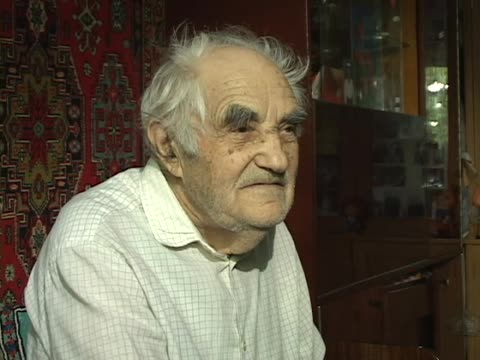
The camera cuts to a formal interview with Izrail (Yisruel) Yosifovich Gliazer (b. 1919 in Podgaytse, Ukraine) (part 1 of 3. See MDV 691 and MDV 693). Gliazer speaks about his father (b. 1880), who served in the Austrian army during World War I. His father worked as a glass and window maker. His mother, Pesye Levit, was from the town of Skalat. Gliazer was the youngest child in his family.
From the machine transcript
Introduction to Gliazer: Kerler records the name Israel ben Yosef Glazer, the date 30 June 2005 and Ternopil'. Gliazer gives his birth year as 1919, and says that he was born in Podgaytse, and explains the name's meaning. His father, Yosef, served in the Austrian army in the First World War and was a glazier who made and fitted windows. His mother Pesye was from Skalat, and she took care of the children and cared for him as a child. Gliazer also speaks well of Emperor Franz Joseph.
Includes the interviewer's introduction, the name's spelling and Gliazer's remarks about Franz Joseph and the Jews.
Gliazer speaks about his education in a traditional “khayder” (kheyder; religious school for young boys) as well as the atmosphere in his childhood synagogue.
From the machine transcript
Gliazer recalls cheder, whose teacher was called Moshe. He began at six or seven, with eighteen boys, learning the alphabet and then Chumash. At Katz's questions he recites the letters and describes the final-form letters. He also describes the synagogue where the cheder met, which had a women's section behind a small window.
Includes Gliazer reciting the Hebrew alphabet and naming the letter forms, which the catalogue does not mention.
Gliazer recalls his home life as a child, describing his mother, his sister who immigrated to Palestine in 1927 and his pious maternal grandfather (d. 1939). He also details the various types of people that lived in his shtetl (town).
From the machine transcript
Gliazer describes his mother as a housewife who sometimes helped in his father's shop, where he says there were both honest people and thieves. He remembers a mad girl in the town. He names his siblings: an eldest sister who emigrated to Palestine in 1927 and lived on a kibbutz, brothers Velvl and Moshe, and a younger sister Sarah. He then speaks of his maternal grandfather Hersh Levite of Skalat, a merchant regarded as a righteous man, who died about 1939.
Gives the names of his siblings and the shop and thieves, which the catalogue does not list.
Gliazer attended a Polish-language school before beginning work at a printer’s office, where documents, posters and brochures were produced for different ethnic and religious groups.
From the machine transcript
Gliazer says he studied in a Polish state school for seven classes. In the late 1920s, he says, he went to learn the printing trade in a printing shop in Podgaytse. He lists the work printed there: documents for merchants, posters and brochures for Polish, Ukrainian and Jewish organizations, and pamphlets for Catholic clergy. The shop also printed some Jewish material, including Hasidic leaflets. He remarks that the community had been rich and lively. Kerler adds a break and a question about reading.
Names the Catholic brochures and Hasidic leaflets he printed.
Gliazer also comments on prewar literary tastes and the shtetl’s Polish and Jewish libraries. He details how the Jewish libraries were run and operated mostly by uniformed young men from Zionist movements.
From the machine transcript
Gliazer describes his reading as a young person: Yiddish, Hebrew and Polish books, and several libraries in the town, with more Polish than Jewish books. The Jewish library was run by young people from Zionist groups including Hashomer Hatzair and the Revisionists, who wore brown shirts and belts, and books were lent free. He recalls Sholem Aleichem and some secular and Ukrainian writers in Yiddish translation.
Names the Revisionist youth in brown uniforms and the writers whose books were available.
Gliazer comments on the shtetl’s intellectuals and local writers. He also reports on the popularity of Bialik and other more well-known writers.
From the machine transcript
Gliazer names local writers, including Rosenthal and Poliak, who wrote in Yiddish about small-town Jewish life. Katz adds names of regional authors including Abraham Moyshe Fuchs of Ozerna. Gliazer says Bialik was well loved and his books and songs were known. He also recalls the Dybbuk, a book he owned, and gives its meaning as an evil spirit. Kerler asks what a 'good Jew' means, and the passage turns to the Hasidic rebbes his townspeople visited.
Includes the Dybbuk, the meaning of a good Jew, and the names suggested by Katz.
Gliazer describes the various local Hasidic groups and synagogues in his town, noting that his father was a follower of the Rebbe from Husyatyn. Gliazer details how people would visit the local Rebbes for advice or blessings, and how the Rebbe from Chortkiv would visit the shtetl on sukes (Sukkot). Cities and towns mentioned on this tape: Podgaytse, Skalat, Ternopil’, Ozerna, Husyatyn, Chortkiv
From the machine transcript
Gliazer says his father was a Hasid of the Husyatyn rebbe. He explains how people went to the rebbes for advice and blessing. The Chortkiv rebbe had more followers than the Husyatyn rebbe. The synagogue in Podgaytse associated with the Chortkiv rebbe was handed over to Jews, and Gliazer mentions candles and customs at Passover. Kerler asks how Gliazer lived with his parents at seven to nine years of age, and the account is cut off.
Does not clearly show the Chortkiv rebbe's visit for Sukkot; it shows a closing question about childhood and the synagogue's handover.
This tape is a continuation of a formal interview with Izrail (Yisruel) Yosifovich Gliazer (b. 1919 in Podgaytse, Ukraine) (part 2 of 3. See MDV 690 and MDV 693). He speaks about his experiences during the war as well as about local Nazi collaborators.
From the machine transcript
Gliazer talks about the war and the Holocaust years, saying the atrocities were committed not only by Germans but also by local non-Jewish collaborators. He names one local man who helped the Germans search out Jews. Kerler also asks briefly about children's play in Yiddish.
Opens with a question on children playing in Yiddish before turning to collaborators.
Gliazer talks about the curriculum of the Polish-language school he attended and his memories of Polish literature.
From the machine transcript
Gliazer answers Kerler's questions about the Polish-language school he attended: the subjects taught, such as mathematics, chemistry, physics and Polish language, were all in Polish. He recalls some Polish literature but cannot recite verses, and begins to describe a play.
He then speaks about the Jewish theater groups that would perform in Yiddish and Polish in his town, a topic which leads him to discuss Purim observances and the “shpiln,” or plays, that were sometimes performed then.
From the machine transcript
Gliazer describes Jewish amateur theater in the town, where a club staged plays in Yiddish and Polish in a hall or in the synagogue. Kerler asks about Purim, and Gliazer recalls it as a joyous holiday on which children got new clothes. Kerler recites a Purim begging rhyme, and Gliazer calls it typical of small Jewish towns.
According to Gliazer, Podgaytse had popular Jewish public baths that included a “mikve” (ritual bath) that was used by the men before shabes (the Sabbath). Gliazer also recalls the town’s different synagogues and other religious institutions.
From the machine transcript
Gliazer talks about the town's bathhouse and mikve, which men used on Friday before the Sabbath; his father or older brother took him. He lists the large synagogue and several small prayer houses (kloyzn), including a Hasidic one and a Chortkiv kloyz. He also answers whether there was a beis-medresh and whether yeshiva students ate days at members' homes.
Gliazer describes how Passover was celebrated by his family and recites one of the Four Questions. The team then discusses a potential plan to visit Podgaytse with Gliazer the next day.
From the machine transcript
Gliazer recites the first of the Four Questions and recalls the Passover seder at home with his father. Kerler and Katz ask him to repeat it. The interviewers then discuss with Gliazer a visit to Podgaytse the next morning at about ten, to see the Jewish sites, and agree to see how he feels. Gliazer notes his age and his health.
Includes planning of a visit to Podgaytse and his age.
Gliazer speaks about the ghetto in Krements’ during the war and how the Jews in the camp staged an uprising.
From the machine transcript
Gliazer tells of the Jewish uprising in the Kremenets camp or ghetto, in which he says his mother's family came from; Jews attacked the guards en masse, many died and few survived. He heard of it from a participant but declines to name him, and says the uprising is recorded in the Ternopil' historical museum.
Gliazer briefly mentions a memorial set up by foreign Jews in Skalat.
From the machine transcript
Gliazer mentions that his parents were hidden in Skalat, and that Jews from America, Israel and Poland set up a memorial there. Kerler asks about the language of the inscription, which is in Hebrew. They also note that Podgaytse has a synagogue and talk about driving there.
Adds the hiding of his parents and the inscription's language.
Gliazer then details his military service as a radio operator, describing the war years and his experiences against the Japanese in the Far East.
From the machine transcript
Gliazer answers Kerler's questions about his military service, which he began a year before the war as a radio operator (signalman). He spent the war far from the western front, in Siberia, and finished it against the Japanese, near Korea, opposite the Americans. The talk touches on kamikaze pilots, a Japanese general, and Japanese who speak Yiddish.
The camera cuts to a photograph in Gliazer’s home, while he and the research team drink tea. He underlines the importance for youth to understand the peaceful multiethnic character of prewar Europe. Reflecting on his father’s service in the Austrian army during the First World War, Gliazer states that "human beings are essentially good (lit. “humane”)"; the change during the Second World War is the fault of Hitler and others.
From the machine transcript
Over tea, Gliazer says young people must understand how many peoples once lived together in harmony before the war, and recalls how Jews and non-Jewish neighbors helped each other. He speaks of his father's service in the Austrian army and the Emperor Franz Joseph's keeping order, blaming Hitler and the Germans for the change. Much of this stretch is in Russian and garbled.
Adds a tea break and reflections on interethnic relations.
Gliazer shares his views on Stepan Bandera.
From the machine transcript
Gliazer gives his views on Bandera and the Ukrainian nationalist organization, which he calls terrorist, and on the assassination of the Polish minister Pieracki. He says Bandera's brothers were communists who were imprisoned with his own brother and killed, probably by the Russians.
Gliazer describes the changes that occurred when the Soviets came to power in his town in 1939, and how these events affected Jewish merchants, artisans and traders. Gliazer only details the development of political anti-Semitism, imported from Western Europe in the years before WWII.
From the machine transcript
Asked by Katz about 1939, Gliazer describes how Soviet rule hurt Jewish small merchants, artisans and traders, who could no longer earn a living. He traces antisemitism to German influence, saying it grew among Poles from the mid-1930s after Pilsudski's death, with press propaganda against Jews.
Returning to the subject of the early years of Soviet rule, Gliazer describes the general enthusiasm for the regime among poor working Jews. He further details the immediate closures of Jewish political, religious and cultural institutions, although one synagogue was kept open. Gliazer also briefly talks about the Soviet Yiddish newspaper Eynikayt.
From the machine transcript
Answering Katz, Gliazer describes the Soviet entry in September 1939. Poor Jewish workers welcomed it, wealthy Jews and non-Jews were later deported to Siberia, and Jewish theater, schools and cultural groups were closed, with only one rabbi left open. He also discusses the Yiddish newspaper Eynikayt, which was read, and the earlier German propaganda. Much of the stretch is garbled.
Adds the Jewish theater, the Soviet press and the arrival of the Soviets.
Gliazer returns to the subject of the Rebbes of Husyatyn and Chortkiv, their visits to the shtetl (town) and their respective Hasidim.
From the machine transcript
Gliazer answers Katz's questions about the rebbes of Husyatyn and Chortkiv. The Husyatyn rebbe came in summer from Vienna once a year, which was a great holiday for his Hasidim. The Chortkiv rebbe had more Hasidim, and in Ternopil' his followers took the horses off his carriage and pulled it themselves.
He then continues to speak about the war years and how the Germans used ideological propaganda to turn the Ukrainians against the Jews and the Soviet government. Gliazer also reflects on the wider philosophical meaning of the war in world history.
From the machine transcript
Gliazer continues on 1939–41, describing German officers visiting before the invasion, German spies on the border, and the Soviet failure to expect an attack. He reflects on the war as a whole, citing the six million Jewish victims and comparing Hitler and Stalin. Katz asks whether he believes in God.
Gliazer briefly comments on life in contemporary Ukraine and in the local Jewish community. Cities and towns mentioned on this tape: Podgaytse, Kremenets’, Ternopil’, Skalat, Vienna, Husyatyn, Chortkiv
From the machine transcript
Gliazer answers questions about life today in Ternopil' and the region, noting few Jews remain and that a community exists in Chortkiv. He thanks the visitors, while other voices speak in Russian about few Yiddish speakers left among the young.
This tape consists of a formal interview with Izrail (Yisruel) Yosifovich Gliazer (b. 1919 in Podgaytse, Ukraine) (part 3 of 3. See MDV 690 and MDV 691). He begins by discussing the various trades and jobs in the shtetl (town), including doctors and water-carriers. He also mentions the terminology associated with these professions.
From the machine transcript
Gliazer lists the trades and professions in the prewar shtetl: porter, shoemaker, tailor, doctor, lawyer, engineer, and four or five Jewish doctors. Kerler asks about the water-carrier and his yoke, buckets and barrels, and about Polish-influenced words for the vessels. Gliazer does not remember the term for the water-carrier.
Mostly a terminology exchange about the water-carrier's yoke and buckets.
Gliazer talks about his education in a “khayder” (kheyder; traditional Jewish religious school for young boys).
From the machine transcript
Gliazer recalls kheyder learning: Khumesh, siddur and Gemara, and being taught about tefillin by his father before his bar mitzvah at thirteen. Kerler and Katz ask whether he remembers Bible stories, the binding of Isaac, or passages of Gemara and Mishnah, and he remembers very little. A Russian-speaking visitor interrupts.
Gliazer details how Purim was observed in his shtetl, noting that non-Jews and Subbotniki (Judaizing Orthodox Christians) would observe the celebrations. He also tells the story of Purim.
From the machine transcript
Gliazer describes Purim in the shtetl: masks, collecting Purim money, and plays, with Christians coming to watch. He says the Subbotniki took a strong interest in the Jews and even rescued some during the war. Asked about the Purim play, he recounts the Esther and Mordecai story with Haman hanged.
Gives the Purim story and the Subbotniki's help to Jews during the war.
He speaks in further detail about the Subbotniki and their villages that were near to his shtetl.
From the machine transcript
Gliazer describes the Subbotniki as a group who kept to themselves with their own traditions and lived in about three nearby villages. They were tolerant of Jews, believed in God and held that one should be good and help others.
According to Gliazer, the Khusiatiner Rebbe would come to their shtetl once a year to visit his ancestors’ graves and pray in the local synagogue.
From the machine transcript
Gliazer says the Husyatyn rebbe came once a year to the town to visit his ancestors' graves and pray in the fine synagogue, and that neighbouring Christians, and even the Germans and Communists, did not touch it. He does not know where the tsadikim are buried. Katz then suggests a future visit to his town when Gliazer is well enough.
Includes talk of a possible later visit to the town.
Gliazer briefly mentions the family he had that moved to America before the war.
From the machine transcript
Gliazer says his mother's brothers emigrated to America after the First World War. They wrote to his father but not to his sister, and he heard nothing of them after the Second World War.
Gliazer briefly talks about the postwar period, noting that he moved to Ternopil’ from Chortkiv in the 1960s. He also talks about the synagogues in surrounding shtetlekh.
From the machine transcript
Gliazer says he lived in Chortkiv and moved to Ternopil' in the 1960s. He estimates 150 to 200 Jews in Ternopil' and fewer in Chortkiv, and says the synagogue in his hometown stands empty and unharmed. He recalls the wooden synagogue in Chortkiv, torn down by non-Jews for building wood after the war.
Includes the fate of the synagogues and Jewish population numbers.
Gliazer speaks about Jewish religious life in his shtetl and how it changed when the Soviets took power in 1939.
From the machine transcript
Asked about the town's synagogues and prayer houses, Gliazer distinguishes Hasidim from the less observant. He says that after 1939 the Soviets did not close the synagogues but restricted prayer to Sabbath. He then describes how the economy changed: no factories, small trade, and taxes on artisans.
Also covers the Soviet economic changes and taxation of artisans.
Gliazer details how the Nazis convinced local Ukrainians into collaboration through their propaganda. He also comments on Jewish views of Nazi Germany in the late 1930s.
From the machine transcript
Katz asks how Jews and non-Jews who had lived peacefully came to turn against each other. Gliazer describes antisemitic literature and caricature spreading from Germany from the 1930s, boycott calls and attacks on Jews. He recalls Hitler Youth slogans and his own puzzlement before leaving for the army in 1941.
Covers the 1930s propaganda and the Jewish reaction to Nazi Germany.
Serving several years, Gliazer encountered some anti-Semitism in the Red Army, but emphasizes the important role the Jews played in the war-effort overall.
From the machine transcript
Gliazer describes relations between Jews and non-Jews in the Red Army. He recounts a Muscovite comrade who praised Hitler for attacking Jews, and says that officially there was no discrimination in a multi-ethnic army. Part of the passage is in Russian and badly garbled.
Gliazer shares what he remembers about the figures of Ilya Ehrenburg and Shloyme Mikhoels.
From the machine transcript
Asked about Ilya Ehrenburg and Shloyme Mikhoels, Gliazer identifies Ehrenburg as a Soviet writer and Mikhoels as the Yiddish theatre director who led Jewish wartime contacts and was later killed by Stalinists. Kerler asks about Yiddish newspapers and Soviet Yiddish writers; Gliazer remembers the newspaper Der emes and the name Fefer.
Gliazer speaks about his one year of postwar military service in the Far East and comments on the place of anti-Semitism in the military.
From the machine transcript
Gliazer says he served another year after the war, in the Far East. He says officially Jews were treated well but that some individuals showed antisemitism, and tells of a Jew who was decorated while others complained.
Gliazer sings “Lomir zikh iberbeytn,” (Let’s Make Up) and briefly discusses Yiddish culture and theater in his shtetl.
From the machine transcript
Gliazer sings a few words of a Yiddish song, "Lomir zikh iberbeytn", and says there were many Jewish amateur performers in the town. Asked about plays, he mentions Land of Israel themes and Sholem Aleichem.
He details how some holidays were observed in his shtetl, focusing on Passover and Simkhes Toyre (Simchat Torah).
From the machine transcript
Gliazer describes Passover: the seder, matzo and the four questions, with his father's response, and the door opened for Elijah (or the Messiah). He describes Simchat Torah as a joyful day of dancing with Torah scrolls and calling up all to the Torah. Kerler asks about a custom of calling up the children, which Gliazer does not remember.
Gliazer talks about his town’s heavily Jewish fire brigade and briefly details the place of sports in Jewish life then.
From the machine transcript
Gliazer describes the town's fire brigade, which had a paid core and Jewish volunteers, and its orchestra. He mentions sport, mainly football, with a Jewish team whose name he forgets, and says he lacks a clear memory of the details.
Includes the Jewish football team and the brigade's orchestra.
Gliazer details what newspapers were read before the war in his town, and talks about the traveling peddlers who sold Jewish religious books and ritual items in his shtetl.
From the machine transcript
Gliazer names the Polish and Yiddish papers read before the war, including Heynt, and says prayer books came from Lviv. A traveling Jewish book dealer sold religious books, probably bringing them from Warsaw, and sold ritual items. Kerler also asks about tallit and the dealer's name.
Adds the Yiddish and Polish newspapers read, and the book dealer.
Gliazer shares his thoughts on contemporary world Jewry, emphasizing the importance of the State of Israel as well as the need for mutual assistance between people. Gliazer notes that he reads the American Yiddish newspaper “Forverts,” and shows the researchers his back issues.
From the machine transcript
Asked about the future of world Jewry, Gliazer says Israel is the one good thing and that without it Jewish life elsewhere would disappear through assimilation. He says Jews should help one another. He gets the American Yiddish Forverts and shows his back issues, and the interviewers thank him and discuss sending him materials.
Includes the closing thanks and talk of sending materials.
The camera cuts to outside Gliazer’s apartment building. Cities and towns mentioned on this tape: Podgaytse, Husyatyn, Skalat, Chortkiv, Ternopil’
From the machine transcript
The camera cuts to outside the building where Gliazer lives; the few audible words are unclear.