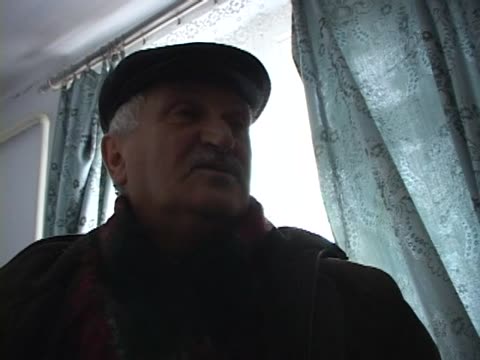
Boltykh speaks about his mother's, Zhenia (Sheyndl) Boltykh, life during the war. She was imprisoned in ghettos in Transnistria until 1944.
From the machine transcript
Boltykh describes his mother's wartime ordeal. She was deported with her parents, her father died in Vertiujeni, and she was driven to Transnistria where she suffered. He gives scenes of shootings, of hunger, and of how she escaped being taken with other young girls. She was held in camp until 1944 and then returned to Briceni.
Boltykh talks about his mother's life after the war. She was born 1911 in Briceni. He then provides personal information and talks about his family.
From the machine transcript
Boltykh continues with his mother's return to Briceni, where her house was gone and neighbors would give back nothing. She married his father, who had come back from the war without a leg; his father died in the 1990s (?) and she then lived with Boltykh. Kerler asks for names and dates: his mother Zhenia (Sheyndl) née Shuster, born 1911, his father Avrom (Yankl), his own name Itsik, and that he has no siblings.
adds the mother's maiden name Shuster and the family names
Boltykh speaks about Jewish life after the war. He recalls private prayer services.
From the machine transcript
Asked by Kerler about Jewish life after the war, Boltykh says there was little. The big prayer house was broken up in the 1960s and turned into a cultural building. A few old Jews gathered privately to pray with one man who could read.
adds the demolition of the prayer house in the 1960s
Boltykh speaks about life today and his family. His relatives recorded his mother's biography in Yiddish.
From the machine transcript
Boltykh talks about his elderly mother's present illness and about a relative from America who wrote down the family tree and her whole story in Yiddish. He offers to send Kerler the manuscript. He also complains that life today is not good and everything is expensive.
adds the relative's recorded family tree and the complaints about prices
Boltykh speaks about life during the Soviet period and life today. He adresses private religious services after the war.
From the machine transcript
Boltykh compares Soviet times with today: shortage and affordability then, high prices and small pensions now, and a house that is cold in winter. He says about ten camp survivors remain in town. He recalls a man who prayed at home and organised yortsayt prayers, mentions that Berts has a Jewish community without a rabbi, and answers Kerler's questions about his Yiddish and the languages of his home.
adds the questions about his own Yiddish and the languages of his home
Boltykh speaks about his mother's education. She attended a Romanian school. He then speaks about Jewish life in Briceni before the war, as he recalls it from his mother's telling.
From the machine transcript
Boltykh says his mother attended a Romanian school but could pray in Yiddish from the siddur. Recalling her stories, he describes Jewish Briceni with many tradesmen's clubs and a Jewish hospital where the wealthy paid for the poor. A relative of hers crossed the border illegally to Palestine (?) and later lived near Washington. He also mentions robbers who attacked the rich before the war and the lack of rights for Jews afterwards.
adds the Jewish hospital, tradesmen's clubs and the relative who went abroad
Boltykh speaks about life after the war and antisemitism. He then talks about his family and provides personal information. His father was born in Lipcani.
From the machine transcript
Boltykh says his father was born in Lipcani and his mother in Briceni, and speaks briefly of Yiddish theater before the war, which did not survive it. A stretch of mainly Russian speech follows on his date of birth and patronymic, which Kerler notes down together with the date of the interview. He then turns to his father.
adds the Yiddish theater and the Russian exchange on dates of birth
Boltykh speaks about his father's life during the war. He was imprisoned into a ghetto in 1944 and then served in the Red Army in 1945. He was injured in Kaliningrad and lost his leg.
From the machine transcript
Boltykh recounts his father's war: he was taken to a camp from Lipcani in 1944, then conscripted to the Red Army front, wounded in the leg at Königsberg (Kaliningrad?) and lost the leg. He describes combat shooting from a tank and lived as a war invalid until his death.
Boltykh talks about how his mother observed the holidays before the war. He then talks about Purim celebrations, as well as other holidays, after the war.
From the machine transcript
Boltykh describes how his mother celebrated holidays: matzo and special food for the poor at Passover paid for by the rich, her separate Passover dishes and knife, gefilte fish, and Friday candle blessing. He mentions Purim visits with presents to neighbors, fasting, and a blessing from the rabbi of Bălți. He says his father could not pray while his mother was learned.
adds Passover practices and Friday-night candle blessing
Boltykh talks about his family and memorialization today.
From the machine transcript
Boltykh says that all his grandparents died in the camps. His mother's father had been a letter writer, an advocate of sorts, who foresaw the war; he was thrown into a grave at Vertiujeni. Boltykh describes the yearly visit to Vertiujeni on the memorial day, travelling with a group from Bălți, with a kaddish and a rabbi who leads the prayer there.
adds the grandfather's occupation and the yearly commemorative trip to Vertiujeni
Boltykh speaks about his mother's childhood and holiday celebration before the war.
From the machine transcript
Asked about his mother's childhood, Boltykh describes family gatherings at holidays in Novoselytsia. Lemster asks about her reading: she read Yiddish books, among them Sholem Aleichem. They discuss whether a Yiddish writer from Lipcani or Briceni, who left in the 1970s (?), was known, and a booklet of poems.
adds the discussion of Yiddish reading and a local writer
Boltykh speaks about the contemporary Jewish community.
From the machine transcript
A short exchange in which the interviewers decide to wrap up the interview, with a remark about a man in his eighties and a Russian aside about not losing time.
The team are headed with Boltykh to the next interview with Semyon Semyonovich Katerberg. The team arrives at his apartment and sets up the interview with him and his wife Tatyana Yakovlevna Katerberg.
From the machine transcript
The team travels with Boltykh to the next interview, with Russian talk about parking, and arrives at Semyon Katerberg's home. Kerler introduces the team and explains the project to Katerberg and his wife, who has doubts about publishing; Lemster adds that they can use initials.
adds the travel and the project's explanation to the couple
The formal part of the interview begins. Katerberg provides personal information and talks about his family. His father was born in Yenovits, Ukraine, and owned a shop. He states that his mother and sister were shot at the beginning of the war.
From the machine transcript
The formal interview begins. Katerberg gives his name Shimen, his father's name Shmuel and his father's birthplace in Bukovina, Yenovits (?), and says the father kept a shop in Berlinți and died in 1941. His mother and sister, born 1930, were shot in the war; he names his sister (Maniya/Mariam, unclear) and gives dates of birth.
adds the details of the father's trade, the sister's name and the shooting of Jews in Berlinți
Katerberg speaks about Jewish life in Berlintsy before the war. According to him, thirty Jewish families lived there.
From the machine transcript
Katerberg describes Berlinți before the war as a village of about thirty-odd Jewish families, with small shops and a bit of land. There was a primitive prayer house, later a Soviet club, and he recalls a teacher.
Katerberg talks about his education. He attended a religious school (cheder). After the war, Katerberg was the president of a kolkhoz in the village Larga and moved to Berlinţi fifteen years ago. He then briefly mentions his bar mitzvah.
From the machine transcript
Katerberg talks about cheder in Berlinți and his teacher, named Steingauz (?), who died in the war and who beat the children. He studied Humash and Rashi. He says he moved to Briceni fifteen years ago after being kolkhoz chairman in Larga, and that he lived among Christians. Lemster asks about his bar mitzvah; he recalls only a meal.
adds the name of the teacher and the content of the studies
Katerberg discusses his childhood memories. In particular, he recalls how families gathered during the long winter nights. He also addresses food customs.
From the machine transcript
Katerberg recalls long winter evenings when neighbors gathered in turns at one house or another, baking bread and drinking tea, and Friday baking of challah. Lemster asks about Sabbath food: meat, gefilte fish, which Tatyana still makes. Her name is given as Tube.
Tatyana provides personal information.
From the machine transcript
Tatyana gives personal information: her Yiddish name Tube, now Tatyana, maiden name Akkerboim, from Berlinți, born in 1930 (?), and the interview date is repeated.
Tatyana explains how she prepares gefilte fish.
From the machine transcript
Tatyana explains how she prepares gefilte fish, from skinning to grinding the flesh, adding salt, pepper and sweet water, and baking or boiling it; the questions go on to fish skin stuffed with pieces and fish broth. Lemster asks about further details.
Semyon talks about the family gatherings during winter before the war. Tatyana adds that families from Berlinţi would often go to the neighboring village Beleavinţi.
From the machine transcript
The Katerbergs say that people spent winter nights with different families, and Tatyana explains that Berlinți and the neighboring village of Bilavintsy (Beleavinți) had Jews who often gathered in the latter. Asked about Yiddish reading, they recall little; their son cannot speak Yiddish.
adds the neighbouring village and the discussion of reading
Semyon talks about his family. Their son lives in Stanislav.
From the machine transcript
Katerberg says he remembers his grandmother, his mother's mother, who lived with them, but not his grandfathers; his father's parents were in Yenovits. He names his paternal grandfather Manes and maternal grandfather Aron. Their son, named for the father, lives in Stanislav.
adds the grandparents' names and the naming of their son
Tatyana talks about holiday celebration, particularly Purim. Semyon then explains how to play nuts, which he often did during Passover.
From the machine transcript
Tatyana recalls one Purim when children gathered and ran around a courtyard, with masquerade. Semyon describes nut games at Passover, such as setting up nuts to knock down, and mentions the dreidel at Hanukkah. They also recall Hanukkah money and sweets, but no recipe for latkes.
adds the nut games, dreidel and Hanukkah customs
The Katerbergs talk about prewar life in Berlinţi with a majority of Christian residents. Semyon attended a Romanian school for seven years.
From the machine transcript
The Katerbergs describe prewar Berlinți as a pleasant village with many Christians; the children played and attended Romanian school together. Semyon says he studied for seven years. They discuss whether Christians spoke Yiddish and say Jews and Christians were not distinguished, even in the army.
adds the discussion of Christians speaking Yiddish
Semyon briefly talks about his life during the war. He served in the Red Army at the Japanese front. He then touches upon local Jewish writers and postwar Yiddish press.
From the machine transcript
Katerberg briefly says he was in the army and on the Transbaikal (Japanese) front (?). Asked about Yiddish writers from Lipcani and about Soviet Yiddish press, he and Tatyana recall little, and she says people feared keeping such a journal in the house. Kerler closes by explaining the project and its dialect research aims.
adds the discussion of the Soviet Yiddish press and Kerler's closing explanation