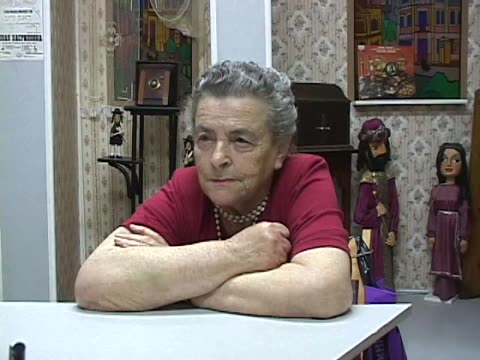
Rojtman provides personal information and speaks about her family. Her mother was also born in Vadul Raşcov. Rojtman's father was born in Rezina and was a worker. Rojtman grew up with one brother, who died in evacuation.
Rojtman gives her name and birth year and explains that Vadul Rascov lay on the Bessarabian bank of the Dniester, opposite Rashkov. Her mother Tabele was born in Vadul Rascov. Her father Shabsa, from Rezina, worked as a clerk, and her mother was a housewife. She grew up with one brother, Motl, who died in 1943. She remembers her grandmother Khaike as honest and hard-working, and her grandfather Moyshe, whose business still stands in the town.
Gives the grandparents' origins and a grandmother's work.
Rojtman speaks about her recent visit to Vadul Raşcov. She also addresses prewar Jewish life in town. She then returns to her family. Her paternal grandparents moved to Argentina before World War II. Rojtman also has relatives in Israel.
Rojtman describes the town today as almost vanished and recalls it as a cheerful town, with Simchat Torah processions of lanterns. She says her paternal grandfather left for Buenos Aires in 1913 and her grandmother in 1924, with nine children. She names them as Avrom and Nekhome. She has many relatives there who have no contact, while relatives from Israel visited the family.
Gives the grandparents' names and the larger emigration to Argentina.
Rojtman discusses her childhood memories of her home and neighbors. She also addresses prewar Jewish life. According to Rojtman, there were three synagogues in town. Rojtman recalls positive relations between Jews and non-Jews.
Rojtman recalls a poor but honest neighboring family with nine children and her father's acquaintances who visited the house. She describes the town as quiet and says Jewish holidays were kept well. There was one large stone synagogue and two small ones, with a dayan, a rabbi and a shoykhet, and the Jewish majority had good relations with non-Jews, many of whom spoke Yiddish. She also mentions the large Orthodox monastery. The passage ends with a Russian-language answer about schooling.
Adds the neighbors, the town's religious officials and the monastery.
Rojtman talks about her life and education before the war. She attended a Romanian primary school for four years and then studied at a Romanian secondary school in Botoșani. Rojtman mentions a letter exchange between herself and her grandfather in Yiddish. She then recites a poem in Romanian.
Rojtman says she attended a Romanian school for four years, then the gymnasium in Cuhureşti (?), and under the Soviets studied in Rezina. She had been taught Yiddish letters and used to write letters in Yiddish to her grandfather in Buenos Aires, but remembers nothing of it now. She tries to recite a poem, mostly Romanian, with Kerler asking about it. Kerler then turns to her childhood games.
The school place names are doubtful in the transcript; the poem is garbled.
Rojtman discusses her childhood memories and recalls her friends. She then addresses prewar cultural life, as well as her private religious education. Rojtman also speaks about her family's observance and prewar holiday celebration, particularly Passover, at home.
Rojtman names childhood friends and the games they played, with Kerler asking about hide-and-seek and blind man's buff. She recalls a visit by a rich Chișinău man who staged a performance in Romanian. A private teacher, a member of the Dascal family, taught her Yiddish letters at home. She describes her grandfather's observance, Sabbath, her grandmother's baking, and the family seder, where the rabbi's family and the siddurim figure.
Adds the private teacher's family name, games and the seder.
Rojtman talks about prewar holiday celebration, including Purim and Simchat Torah. She then speaks about prewar Jewish life in Vadul Raşcov and mentions Jewish and non-Jewish locals.
Rojtman recalls Purim and Simchat Torah in the town, with masks and the park, and the poor children who went house to house for money. A Russian-language stretch concerns a woman living on Bendery street, and there is talk about whether the town had an upper and a lower part. She also discusses Romanian-speaking Gentiles, the term 'podvalnik' (?), and Christians who spoke Yiddish. She describes it as a pleasant town with respected doctors, educated people and no bad people she can remember.
Rojtman addresses her life before the war and leisure activities. She also discusses prewar cultural life, including local Klezmer music, traditional weddings and organizations (Gordonia, Maccabi). Rojtman recalls chalutzim and libraries.
Rojtman describes how young people spent evenings and what Klezmer musicians played at weddings. She recalls wedding customs, with a master of ceremonies named Tuve who has died. She mentions charity for orphans' weddings and Zionist organizations, with many chalutzim leaving for Palestine in 1936 and fewer communists. She speaks about newspapers and the library in the synagogue and the doctor's private library, mainly in Romanian.
Adds orphans' weddings, library and book languages; Gordonia and Maccabi are not clear in the transcript.
Rojtman speaks about an acquaintance, apparently a woman now in America, and a few contemporary Jews. At Kerler's request she describes Simchat Torah, with Torah carried round the synagogue, dancing and music, and villagers coming from the surrounding area. She also mentions Purim noisemakers and the lack of electricity or cars, with one rich man's car from America in 1938. She says visitors from America made the town celebrate, and that people took pleasure in each other's good fortune.
Rojtman talks about prewar high holiday celebration, before addressing Sukkot and Sabbath celebrations. She explains how her friends frequently came to her house on Sabbath. Rojtman also describes her mother's cooking and dishes for Sabbath. She then addresses religious customs.
Rojtman recalls Rosh Hashanah and Yom Kippur, including fasting and the kapores custom, and trips to the Dniester. She says everyone built a sukkah in the yard. For Sabbath, her father returned from synagogue with friends who had no family and came to breakfast, and her mother baked and cooked well, including in the Russian oven in the yard. She talks about papalikes (?) and balabushkes, candle blessing, and her mother's observance.
Adds the high holidays, sukkah, specific dishes and candle blessing.
Rojtman speaks about prewar religious life. She then speaks about daily life in Vadul Raşcov. Rojtman then addresses prewar folk and healing customs, as well as describes a local Romanian healer.
Rojtman speaks about Hasidim and rabbis in the area, saying the local rabbis were good, ordinary men. She describes how people came from nearby towns, how roads and transport worked, and a fire at a Jewish bakery. Answering questions about folk healing, she mentions urine therapy and a Serbian woman healer who spoke Romanian. She recalls her mother's sister's belief in fortune-telling and her own fear of such women.
Rojtman answers Kerler's questions on terminology, including the words for rabbis, rebbes and the title 'good Jew', and names a few food items. She explains the role of a 'good Jew' as a person to confide in. She describes four such people in town and their families, and speaks of a Jewish man who crossed the Dniester and the many who were shot.
Adds the terms for rabbis and 'good Jew' and the family descriptions.
Rojtman speaks about her life after World War II. She is physician. Rojtman then talks about her family and prewar Jewish life. Rojtman also describes her father's work as merchant.
Asked about her work after the war, Rojtman says she was a physician. She then talks about her grandfather Itsik, whose photograph she did not bring and who had a vineyard in Stukney (?), a poor householder. She says he later did some trade in the area, and Lemster identifies the place from the Russian side. She describes local goods and merchants and says workers were hired.
Asked for childhood memories, Rojtman says she liked sliding on ice and climbing trees like the boys, and she was afraid of water. She describes a childhood accident with ice and a school winter story. Kerler asks about the name of ice skates, and she describes skates of iron with a strap and recalls playing on the ice. She says she is not afraid of cold now.
Kerler asks about the meaning of words in local Yiddish, including a stubborn or obstinate person, 'mamzer', and 'goylem'. Rojtman answers using Russian equivalents. She then answers questions on drinking, saying she remembers no vodka but brandy at kiddush and on yahrzeit, and that there was a Jewish tavern. Kerler asks for the Yiddish word for cemetery and for a 'good place', and she gives words for cemetery and explains the customs of visiting graves.