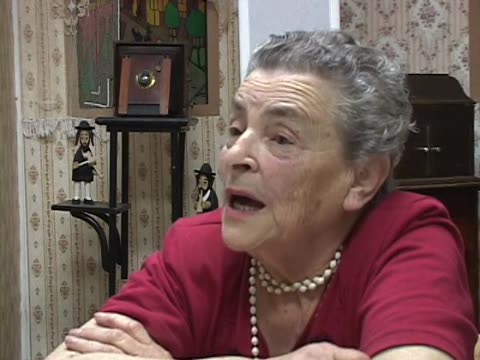
Rojtman speaks with distress about travelling to Odessa and Russia, saying the city has changed and its market is gone. She talks about fear of travel today and about antisemitism, including the case of an acquaintance, a Russian woman married to a Jew from Donetsk, and a Jewish-looking man from Leningrad. She also mentions a granddaughter's trip from Israel to Petersburg.
The family content is a granddaughter's trip to Petersburg and acquaintances; the transcript is mostly about travel to Odessa and Russia and about antisemitism.
Rojtman speaks about her life during World War II. She describes how her family evacuated from Vadul Raşcov on foot until 3:44 and then by train to Andijan, Uzbekistan. Rojtman finished her school education and then studied at a medical institute in Tashkent, Uzbekistan.
Rojtman answers Kerler's question about the war years. The family went on foot, apparently to a place whose name is unclear, and were then put on a train to Andijan in Uzbekistan. She finished school there and then studied at the medical institute in Tashkent.
Gives the Tashkent medical institute; the places named at the start are unclear.
Rojtman speaks about her life after the war. She arrived in Chișinău in January 1945. She then speaks about her traditional wedding in 1946. Rojtman also speaks about her family. Rojtman worked as medical doctor for forty-two years.
Rojtman recalls arriving in Chișinău in January 1945, her husband having brought his institute there from another town (garbled in the transcript). She describes her Jewish wedding in 1946 and who officiated. She discusses what language she spoke with her husband, Naum Rojtman, who knew several languages but little Yiddish. She says she worked as a doctor for forty-two years, and Kerler then begins the questionnaire.
Adds her husband's name, his institute and the languages spoken at home.
Rojtman answers Kerler's dialectological questions: greeting formulas, thanking, the word for 'please', and how Litvaks and Polish or Galician Jews spoke compared with her own Yiddish. Single words are elicited as well: names for a cat or kitten, luck, God, house, a plate or table, and a woman's name (Tobe/Tabl). Toward the end she and Kerler discuss the word 'maver' for a strong or stone wall, and she says another woman in the community would know much Yiddish.
Beyond the questionnaire, she talks about meeting Litvak and Polish Jews, especially in the war and in Tashkent.
Rojtman describes her mother as a beautiful, decent woman who loved doing good, and she tells how the family home in Vadul Rashkov took in people who had to cross the Dniester. She says everyone in Rashkov spoke well of her mother and that the Christians of Rashkov used to visit. She also describes a visit to Rashkov a few years after the war, finding no old Jews and speaking of the age of the older residents.
Gives detail on the visit to Rashkov and non-Jewish guests.