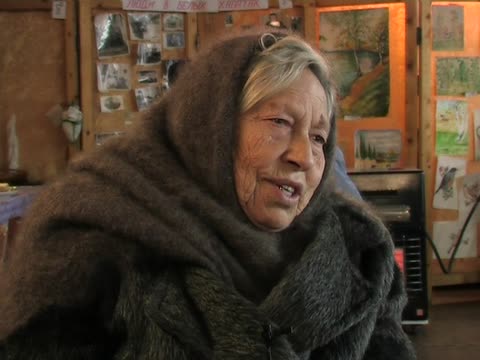
Mirenburg discusses holiday celebrations, in particular Sabbath. She also explains how her mother koshered meat. Mirenburg then talks about the fasting tradition on Yom Kippur and recalls how she also fasted in the ghetto. She then remembers Passover celebrations, including food customs.
Mirenburg answers questions about Sabbath in her parents' home: her mother's blessing over the candles, the non-Jewish 'Shabbes goy' who came to heat the stove, and her mother's baking of challah and salting of meat. She recalls her grandfather, who knew Yiddish and Hebrew and acted as a peacemaker. She remembers beginning to fast on Yom Kippur at age nine (and fasting in the camp/ghetto), and recounts a childhood incident when she told her mother that her sister sewed a sack on Sabbath. She then describes the Passover seder led by her grandfather, the afikoman gift, the four questions, and Passover foods such as matzo pancakes, potato cakes and 'Pesach bagels'.
Includes a childhood anecdote about her sister and the sack on Sabbath, and Passover food terms elicited by the interviewers.
Mirenbug discusses food customs, in particular gefilte fish, before she addresses Hanukkah and Purim celebrations. Mirenburg also remembers a childhood game and briefly talks about Simchat Torah.
Mirenburg answers questions on her mother's gefilte fish and on sweet Sabbath cholent, then on Hanukkah: lighting the candles, Hanukkah money and a dreidel from her grandfather, and playing the nut game in a hole. She says little of Purim, mentioning Esther and Mordechai and the Purim play held in the synagogue, and the Interviewers prompt her about Purim mumming, Simchat Torah (carrying an apple with a candle) and a Hebrew booklet about amulets, none of which she recalls in detail.
Gives details of the Hanukkah money and dreidel from her grandfather and the nut game; the Purim answer is thin.
Mirenburg talks about her family before the war: her grandmother left young with two children and learned a trade, and her mother, with four children, had no time to attend storytelling evenings. She recalls her mother singing Yiddish songs and teaching the children Sabbath observance but cannot remember the songs. Kerler then asks about food eaten before the Yom Kippur fast.
Mirenburg says there were craftsmen in Sguritzy, though none in her family, and recalls her mother sending her with Sabbath food to a poor tailor's family with several children. She also describes the kapores custom before Yom Kippur, with a chicken for each child, which was given to the poor.
Mirenburg talks about life before the war, including her childhood friends and non-Jews who spoke Yiddish. She then talks about prewar cultural life. Mirenburg attended concerts by Sidi Tal.
Mirenburg talks about her childhood friends, Jewish children and non-Jewish servants who spoke Yiddish, and mentions a Jewish girl who married a Christian, a rare case. She says there was a library of Yiddish books and recalls children watching the singer Sidi Tal perform Yiddish songs in a neighbor's courtyard; the interviewers ask whether she came from Chernivtsi. Kerler also asks about a fire brigade, which she does not know of.
Mirenburg discusses prewar religious life in her hometown Sguritzy, including visits to the Ştefăneşti rebbe. She also addresses blessings and talks about folk customs.
Mirenburg describes religious life in Sguritzy: sending questions to the rabbi about whether meat was kosher, and trips to the Ştefăneşti rebbe (Shtefaneshter rebbe), about which she knows little. She answers questions about terms for a holy man and a holy place and about prayer at graves. She also answers questions about drinking, the blessing 'azgile'(?) and folk remedies for the evil eye.
Adds the interviewers' terminology questions, graveside customs and evil-eye remedies.
Mirenburg answers questions about cultural terminology. She then talks about her life during World War II, in particular addressing the year 1941. She describes the beginnings of the German occupation in 1941, when her relatives happened to visit her family and how Mirenburg's family was forced to leave the house. She recalls how a Romanian soldier shot into the house and almost hit her aunt. Mirenburg maintains that she went to check on her aunt, while her family left the house; and as soon as she came outside her family already departed. Mirenburg explains how she came across an older woman, with whom she looked for family. Mirenburg then describes how she looked for her family and encounters with Romanian soldiers. Mirenburg recalls how she saw familiar people dead on the way and finally reunited with her parents and siblings. She then talks about the forced march toward the Rubleniţa woods andr recalls how they received food from Christians in the surrounding villages. According to Mirenburg, they stayed in the woods for ten days, before marching to the Cosăuţi woods. She mentions a woman who gave birth and collecting groups for forced labor during the time in the Rubleniţa woods. Mirenburg then reflects on reasons why the Christian inhabitants of Cosăuţi and Rubleniţa did not admit to the cruelties happening to Jews during the war. She then continues with her life during the war. According to Mirenburg, they stayed in the Cosăuţi woods for ten days, before marching to Yampil, where they stayed for three days. Mirenburg talks about the time in Yampil, during which her mother went to town to get food and encountered a German soldier. Mirenburg continues that after three days abidance in Yampil, her family was allowed to return home to Sguritzy, where they stayed for another three days, before forced to gather in the local synagogue. Mirenburg recalls the conditions in the synagogue and talks about how they were sent to Vertiujeni, where they had to stay for two months. From Vertiujeni, Mirenburg explains, they were supposed to go to the Rîbniţa ghetto, but returned home instead.
Mirenburg answers questions on the meanings of 'dibbuk' and 'golem', then at Kerler's request tells of the war. Following the German and Romanian entry into Sguritzy on 22 June 1941 (as she gives it), she describes relatives arriving, soldiers shooting into the house and her family fleeing, her search with an old woman for her family among dead townspeople, and being reunited with her parents. She recounts the forced march to the Rubleniţa woods, then the Cosăuţi woods, with little food from villagers and men taken for labor; then Yampil, where a German soldier brought food. After returning home they were crowded into a Soroca synagogue, held at Vertiujeni for two months, and told they would go to Rîbniţa but were returned.
Begins with a terminology questionnaire on dibbuk and golem; the transcript does not clearly show the aunt-shot episode in detail.